The Proposed Ghanafo Bond
The Proposed Ghanafo Bond is designed as a long-term financing instrument issued by the proposed Nkosuo Bank of Ghana and purchased by the Bank of Ghana. Its purpose is to finance productive investments—not ordinary government expenditure.
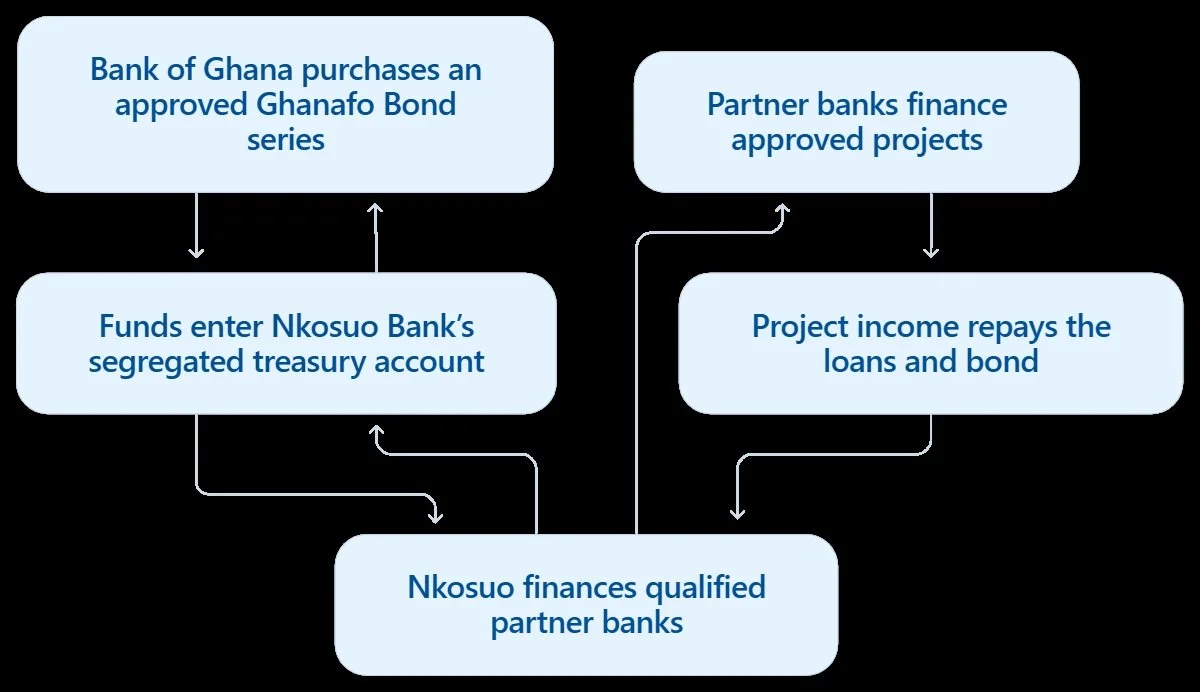
How it would work
Nkosuo Bank prepares a project programme
Before requesting money, Nkosuo Bank must identify projects that are genuinely ready—for example, affordable housing, modern trotro vehicles, agriculture, manufacturing, utilities or other productive infrastructure.
The programme must show:
The projects and beneficiaries to be financed.
The expected economic and social benefits.
How much money is required.
How the projects will generate income.
How and when the money will be repaid.
The risks and who will carry them.
The bond must never be issued merely because a ministry or politician wants money.
Nkosuo Bank issues a separate bond series
Each Ghanafo Bond series would have its own legally binding terms, including:
Principal amount.
Interest rate or coupon.
Maturity period.
Grace period.
Repayment schedule.
Approved use of proceeds.
Security and reserve requirements.
Reporting and audit obligations.
Conditions for suspending disbursement.
Procedures for handling default and recovery.
For example, there could be a Ghanafo Housing Bond Series and a Ghanafo Transport Bond Series. Their money and performance would be tracked separately.
The Bank of Ghana evaluates the request
The Bank of Ghana would not be required to purchase every bond presented by Nkosuo Bank. It could:
Approve the full amount.
Approve a smaller amount.
Delay the purchase.
Attach monetary or risk conditions.
Refuse the request entirely.
Its decision must consider inflation, liquidity, exchange-rate pressure, financial stability and the quality of the underlying projects. Price stability remains the Bank of Ghana’s primary statutory objective. Bank of Ghana monetary-policy framework
Money enters a protected Nkosuo account
When the Bank of Ghana purchases the bond, it credits a segregated Nkosuo Bank account. This creates additional reserve money in the financial system.
The money must therefore be introduced gradually. Ring-fencing controls where it goes, but it does not eliminate the possible effect on inflation, liquidity or the exchange rate.
Nkosuo Bank works through partner banks
Nkosuo Bank would normally be a wholesale institution. It would not operate ordinary branches, accept retail deposits or give cash directly to the public.
Qualified partner financial institutions would:
Find and assess eligible borrowers.
Conduct credit and identity checks.
Confirm collateral and project readiness.
Contribute or retain part of the credit risk.
Disburse against verified milestones.
Monitor the borrower.
Collect repayments.
Pursue recovery when a borrower defaults.
Nkosuo Bank would provide the longer-term capital that commercial banks often struggle to obtain.
Money is released gradually
The full approved amount should not be released at once. Disbursement would be tied to evidence.
For a housing project, for example:
First payment after clean land title and approvals.
Second payment after verified site preparation.
Further payments after certified construction milestones.
Final payment after completion and occupancy verification.
This prevents money from being released for projects that exist only on paper.
Illustrative financial example
Earlier discussions used the following figures only as an illustration—not as final terms:
TransactionIllustrative rateBank of Ghana purchases Ghanafo Bond2%Possible Bank of Ghana facilitation fee0.5%Nkosuo Bank lends to partner bank4%Partner bank lends to approved housing firm4–7%
If Nkosuo Bank issued a GH¢2 billion bond at 2%, its annual coupon would be GH¢40 million before other costs.
If a 0.5% facilitation charge also applied, the total direct funding cost would become approximately 2.5%. Lending to partner banks at 4% would leave a gross margin of approximately 1.5 percentage points for administration, reserves, expected losses and institutional sustainability.
These rates would have to be tested against inflation, risk, administrative costs and prevailing market conditions before adoption.
Where repayment would come from
The bond must be repaid from identifiable project cash flows, such as:
Mortgage or rent payments.
Vehicle lease payments and transport revenues.
Agricultural and industrial sales.
Electricity or water tariffs.
Toll or user charges.
Export earnings.
Enterprise loan repayments.
Legally approved government availability payments for essential public infrastructure.
Repayments collected by partner banks would return to Nkosuo Bank. Nkosuo would use them to pay the Ghanafo Bond’s interest and principal to the Bank of Ghana.
Who carries the loss if a project fails?
Losses should follow a clear order:
The borrower or project sponsor bears the first commercial consequences.
The partner bank carries its agreed portion of the credit risk.
Collateral, guarantees and project reserves are applied.
Nkosuo Bank uses provisions and its own risk capital.
Government intervention occurs only where Parliament has expressly approved a limited guarantee.
The Bank of Ghana must not be expected to purchase another bond simply to hide or refinance previous losses.
Essential protections
The Ghanafo Bond should be governed by firm rules:
No use for salaries, political projects or general government expenditure.
No borrower selected by a minister or political party.
No automatic Bank of Ghana purchases.
Annual and cumulative issuance limits.
Project-readiness and monetary-stability tests.
Segregated accounts for every bond series.
Independent engineering and financial verification.
Public disclosure of amounts, projects, repayments and arrears.
Parliamentary, regulatory and external-audit oversight.
Automatic suspension when conditions are breached.
No concealed subsidies or unlimited government guarantees.
Legal position
The Ghanafo Bond is currently a proposal, not an existing government programme. Nkosuo Bank would require licensing and supervision under Ghana’s development-finance framework. The Development Finance Institutions Act provides for the licensing and supervision of development finance institutions. Development Finance Institutions Act, 2020 (Act 1032)
Any public guarantees, contingent liabilities or government commitments would also have to comply with the Public Financial Management Act, 2016 (Act 921).
Most importantly, direct Bank of Ghana purchases would require a detailed legal opinion and probably a specifically authorised framework that protects the Bank’s independence and price-stability mandate.
In simple terms: the Ghanafo Bond allows the Bank of Ghana to provide carefully controlled long-term funding to Nkosuo Bank; Nkosuo channels it through qualified banks into productive projects; the income from those projects returns through the system to repay the bond. It is debt that must produce results and be repaid—not free money.