Is Mahama’s Government the End of Ghana’s Dinosaur Era?
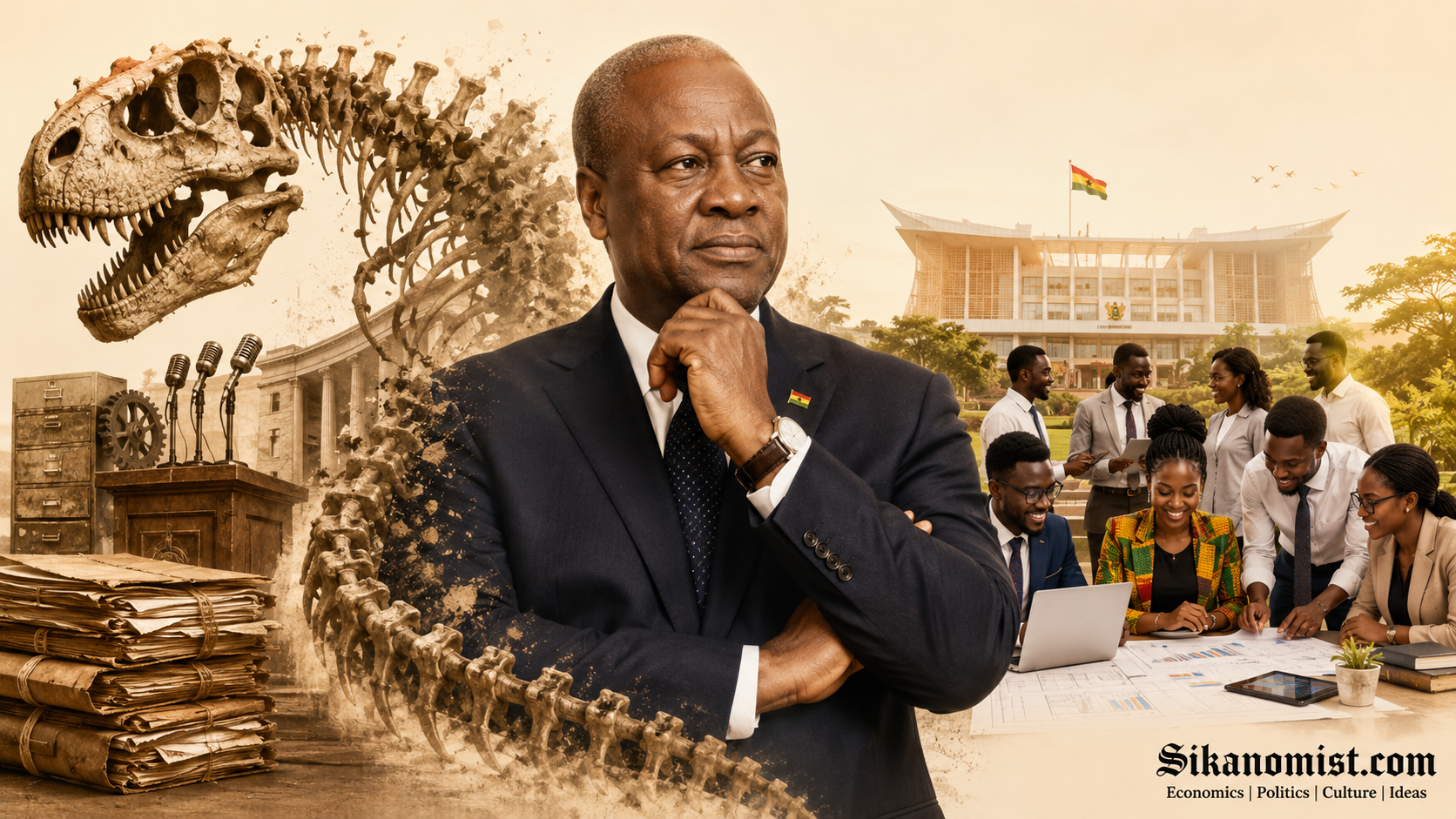
The term “dinosaur government” is a harsh metaphor used to describe a political administration that is outdated, rigid and unwilling to change. It refers to a government that continues to apply old political habits, obsolete ideas and inefficient systems to modern problems.
A dinosaur government may hold elections, appoint ministers and announce development programmes, yet still govern as though the country belongs to a different century. It may depend heavily on political loyalty, personal influence, fear, intimidation and control instead of professional institutions, innovation, cooperation and national purpose.
The important question for Ghana today is this: Can President John Dramani Mahama’s government become the last of Ghana’s dinosaur governments?
This is not a question being asked merely to criticise the President or his administration. It is a national question about the kind of political culture Ghana must leave behind and the kind of government the country must build for the future.
When Political Competition Replaces Government
Since the beginning of the Fourth Republic, too much political energy has been spent on proving the strength of the governing party against the opposition.
When one government leaves office and another takes over, the country often enters another season of accusations, investigations, arrests, prosecutions and public humiliation. Some investigations may be necessary, especially where there is credible evidence of corruption, financial loss or abuse of office. No public official should be above the law.
However, justice must always be based on evidence, proper investigation and fair legal processes. It must not become a political performance.
When arrests are made mainly to satisfy party supporters, embarrass former officials or create dramatic headlines, the state may gain very little. Cases can drag on for years, collapse in court or even expose the country to compensation claims and judgement debts.
A nation cannot build its future by constantly using state power to fight yesterday’s political battles.
Accountability is important, but accountability must recover public resources, strengthen institutions and prevent future wrongdoing. It should not simply replace one political injustice with another.
Ministers Must Not Replace Civil Servants
One major feature of dinosaur government is the habit of allowing political appointees to push professional civil servants aside.
Ministers are appointed to provide political leadership and policy direction. Civil servants, engineers, economists, planners, procurement officers, legal professionals and other technical officers are employed to provide continuity, institutional memory and professional expertise.
The two groups are supposed to work together.
Problems begin when ministers and political advisers behave as though technical officers are obstacles rather than partners. Projects may then be designed without proper consultation. Contracts may be rushed. Professional warnings may be ignored. Procurement rules may be treated as inconveniences, and national programmes may be shaped around political interests instead of sound technical judgement.
The result is often waste, abandoned projects, poor-quality work, cost overruns and policies that disappear when a new government takes office.
Ghana needs ministers who respect civil servants and civil servants who perform their duties with competence, courage and political neutrality.
A minister may remain in office for only a few years, but the Civil Service must protect the long-term interest of the state.
Ghana Must Enter a New Era of Partnership
Ghana deserves a new era of cooperation between political leaders, public servants, businesses, researchers, professionals, traditional authorities, religious leaders, the media and ordinary citizens.
The country has many imaginative and capable people. Every day, Ghanaians develop business ideas, community solutions, agricultural innovations, digital products and creative projects. Yet many of these ideas receive little attention because the first question people are sometimes asked is not whether the idea can help Ghana, but which political party the person supports.
That culture must end.
A good idea should not become unacceptable because it comes from an opposition supporter. A professional should not be excluded because he or she does not belong to the governing party. A business should not need political connections before receiving a fair opportunity.
The value of a citizen’s contribution must be judged by its usefulness to the nation, not by the colour of the citizen’s party card.
Ghanaian First, Party Member Second
Political parties are necessary in a democracy. They organise citizens, present competing ideas and provide choices during elections. But political parties must never become more important than Ghana.
A healthier political culture would encourage citizens to see themselves as Ghanaians first and party supporters second.
This does not mean people should abandon their political beliefs. It means that party loyalty should not prevent them from recognising truth, condemning wrongdoing or supporting a good national policy.
When a government introduces a useful programme, opposition supporters should be able to acknowledge its value. When a government makes a serious mistake, its own supporters should be able to demand correction.
A mature democracy is not one in which citizens defend everything their party does. It is one in which citizens defend the national interest, even when doing so is politically uncomfortable.
Patriotism and Truthfulness Must Become Common Values
Ghana cannot progress through slogans alone. Patriotism and truthfulness must become the common denominator of public life.
Patriotism is not simply waving the national flag or singing the national anthem. It is protecting public money, telling the truth, doing professional work properly and refusing to participate in actions that harm the country.
A patriotic minister will not force a bad decision on a public institution for political advantage. A patriotic civil servant will not manipulate procedures for personal gain. A patriotic businessperson will not provide poor-quality work after receiving a government contract. A patriotic journalist will not deliberately mislead the public in order to defend a political party.
Truthfulness is equally important. Ghana cannot solve problems that it refuses to describe honestly.
If a project is failing, leaders must say so. If the country cannot afford a promise, the public must be told. If an official has made a mistake, the mistake should be corrected rather than hidden behind propaganda.
A country that fears the truth will continue repeating the same errors.
The Presidency Must Represent Serious National Work
The presidency should be treated as the centre of national leadership, coordination and responsibility.
The Jubilee House is not merely a ceremonial building. It is the official seat of government and should symbolise disciplined attention to the work of the state.
The President and the governing team must demonstrate that national leadership is a full-time responsibility. The country needs a presidency that is organised, focused, accessible to professional advice and committed to implementation.
Ghana does not only need leaders who announce visions. It needs leaders who follow programmes from conception to completion.
The nation must be able to see clearly who is responsible for each major policy, what progress has been made, what challenges remain and how public money is being used.
Faith Must Support the Nation Without Becoming Political Theatre
Ghana is a deeply religious society, and religious leaders can contribute greatly to national development. They can encourage honesty, peace, discipline, compassion and responsibility.
However, spiritual support should not become public theatre.
Pastors, prophets, imams and other religious leaders should be free to pray for the nation and advise leaders. But faith should not be used to compete for political influence, display access to power or make dramatic claims designed mainly to attract attention.
Religious leaders should be willing to tell governments the truth, not merely offer public praise. Their greatest contribution may often happen quietly, through sincere prayer, wise counsel and service to vulnerable communities.
Spiritual leadership becomes less credible when it appears too closely tied to political favour.
The Government Must Be Free to Serve Ghana, Not Only the Party
Every government comes to power through a political party, but governing is different from campaigning.
After an election, the President becomes the leader of the whole country, not only the leader of those who voted for the governing party.
The governing team must therefore be able to make decisions based on Ghana’s long-term interest, even when those decisions are unpopular within the party.
Party financiers, influential supporters, campaign activists and internal political groups should not be allowed to determine every appointment, contract and policy.
A government that cannot free itself from excessive party pressure will struggle to make difficult but necessary national decisions.
Political parties must help governments come to power, but they must not prevent governments from governing wisely.
Ghana Needs an Era of Dreams and Implementation
Ghanaians are not lacking in dreams. The country dreams of modern railways, reliable public transport, efficient hospitals, productive farms, competitive factories, clean cities, affordable housing and good schools connected to real employment opportunities.
The challenge is implementation.
Ghana needs a system in which vision is connected to planning, planning is connected to funding, funding is connected to professional execution, and execution is connected to public accountability.
Projects should not exist only in manifestos and speeches. They must be carefully designed, properly financed and completed to the required standard.
Government, the private sector, universities, technical institutions, local communities and international partners must work together to produce goods and services that can take Ghana to the world.
The future will not be built by political slogans. It will be built by engineers, farmers, teachers, scientists, entrepreneurs, technicians, nurses, manufacturers, artists, public servants and responsible political leaders working together.
The Media Must Move Beyond Permanent Politicking
Ghana’s media also has an important role in ending dinosaur government.
Too much national discussion is reduced to political confrontation. Radio and television programmes often bring representatives of political parties together to argue, defend and accuse one another, even when the subject requires professional knowledge.
Political debate has its place, but not every national problem should be discussed mainly by party communicators.
When the issue is flooding, engineers and city planners should be heard. When the subject is public health, doctors and health administrators should lead the discussion. When the country is discussing industry, manufacturers, economists, investors and workers should be invited.
The media must help citizens understand policy, compare solutions, investigate public spending and follow the progress of national projects.
Journalism should not become an extension of party communication.
A serious media industry must ask difficult questions of every government, provide space for informed ideas and help the country imagine what is possible.
Can This Government End the Dinosaur Era?
President Mahama’s government has an opportunity to demonstrate that Ghana can govern differently.
It can choose professional institutions over political interference. It can choose cooperation over permanent conflict. It can choose evidence over propaganda, implementation over ceremony and national service over party reward.
But this opportunity will mean little unless it is translated into practice.
The government must allow civil servants to work. It must protect professional advice. It must investigate wrongdoing fairly. It must avoid politically motivated humiliation. It must welcome good ideas from outside the governing party. It must respect independent institutions and communicate honestly with the public.
Above all, it must build systems that will continue working after the current administration leaves office.
That is how a government becomes more than another political administration. That is how it becomes a bridge between an outdated political culture and a more capable national future.
Ghana Must Choose Its Future
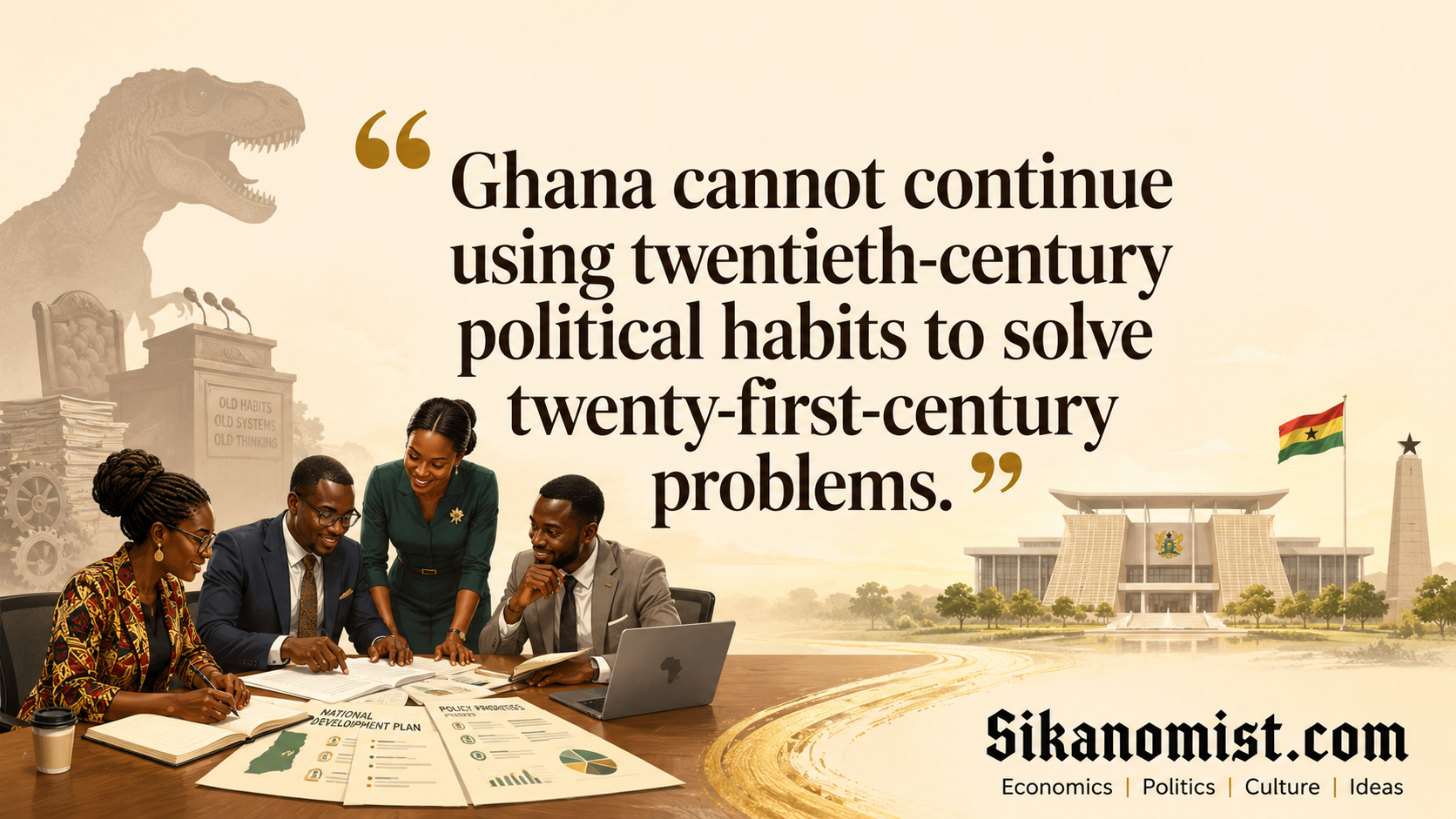
Ghana cannot continue using twentieth-century political habits to solve twenty-first-century problems.
The country faces youth unemployment, climate risks, rapid urbanisation, technological disruption, weak industrial capacity, housing shortages, pressure on public finances and growing competition from other nations.
These challenges require imagination, competence, courage and cooperation.
The dinosaur era must end: the era of political revenge, excessive party control, neglected professional advice, abandoned projects, public showmanship and endless partisan conflict.
A new era must begin: an era of patriotism, truthfulness, institutional strength, professional government, national partnership and serious implementation.
The question is not only whether President Mahama’s government will be the last dinosaur government.
The deeper question is whether Ghanaians themselves are ready to stop rewarding dinosaur politics.
Politicians respond to the culture citizens tolerate. When the public demands competence instead of drama, evidence instead of propaganda and national progress instead of party warfare, political leadership will have to change.
Ghana deserves a government prepared for the future.
It deserves leaders who understand that political power is temporary, but the consequences of government decisions can last for generations.
The dinosaur era must not simply change its political colours.
It must come to an end.
Reader’s Question
Do you believe Mahama’s government can end Ghana’s old political habits and begin a new era of professional, patriotic and citizen-centred governance?