Ghana’s Waste Crisis Needs Systems, Not Symbolism.
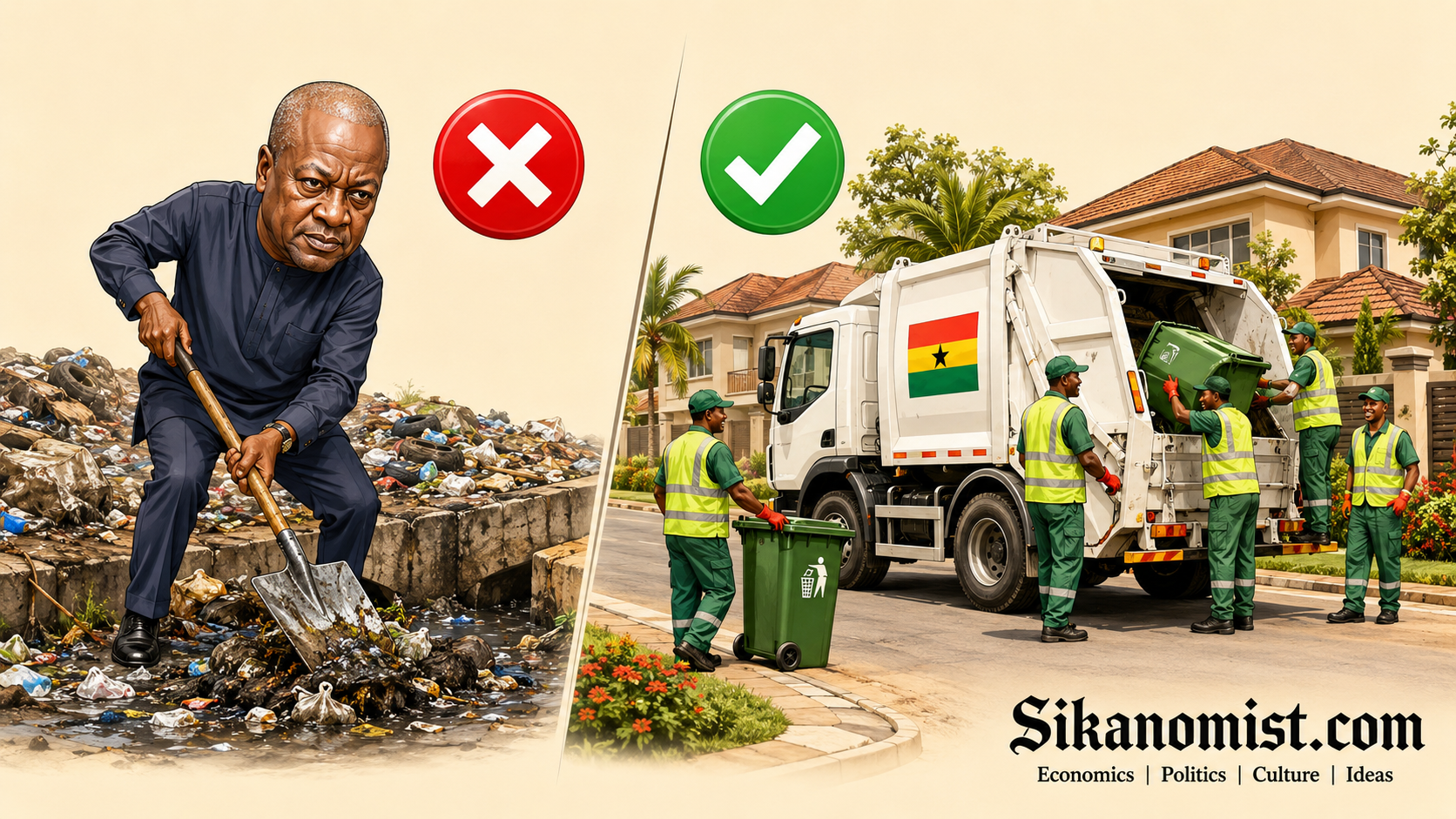
Ghana’s waste problem has reached a point where symbolism is no longer enough. The sight of a sitting President clearing rubbish from drains may attract public attention, but it should also make the country uncomfortable. A President holding a shovel or removing waste from a gutter may show concern, but it cannot be the solution to a national sanitation failure.
Recent flooding has once again exposed one of Ghana’s weakest public systems: waste collection and drainage management. Yes, flooding has many causes. Poor drainage, building on waterways, weak enforcement, bad urban planning and heavy rainfall all play a part. But one cause is visible to everyone: choked gutters, littered streets and waste dumped where water must pass.
When rubbish blocks drains, rainwater has nowhere to go. When plastic waste fills gutters, water flows onto roads, into homes and through communities. When refuse piles up in open spaces, it eventually finds its way into drains, streams and waterways. This is not a mystery. It is a management failure.
That is why the recent two-day clean-up exercise led by the President should not be treated as the main achievement. It should be treated as a warning sign. A country should not need the President to personally clear rubbish before drains are opened. If the President must enter the gutter for the system to move, then the system itself is weak.
The current President has been at the centre of Ghana’s public life for many years. He served as Vice-President from 2009 to 2012, President from 2012 to 2016, Leader of the Opposition from 2017 to 2024, and returned to office after the 2024 election. With that level of experience, Ghana should expect more than emergency gestures. Ghana should expect structure, policy, enforcement and results.
The issue is not whether the President cares. The issue is whether the country has a system that works when the President is not physically present. A serious sanitation system cannot depend on cameras, public clean-up days and presidential appearances. It must depend on institutions, routine collection, local accountability and strict enforcement.
Ghana needs a clear national waste management policy that connects directly to the work of every Metropolitan, Municipal and District Assembly. The national government must provide the framework, standards and funding direction. But every local authority must have its own practical sanitation strategy based on its geography, population, drainage network, market centres, residential areas and waste levels.
Accra’s waste problem is not the same as Tamale’s. Kumasi’s waste challenge is not exactly the same as Cape Coast’s. A fishing community, a market town, a mining area and a fast-growing suburb cannot all use the same lazy approach. The national strategy must set the destination, but the districts must design the road.
Each Metropolitan, Municipal and District Assembly should be required to prepare a proper waste and drainage management plan. This plan should show how waste will be collected, how often it will be collected, where it will be taken, how drains will be inspected, how blocked drains will be cleared, and who will be held responsible when the system fails.
Ghana must also move away from treating sanitation as an occasional event. Clean-up exercises are useful for mobilisation, but they are not a substitute for daily management. A country does not clean itself once every few months. A city does not become clean because leaders appear in public with gloves for a day. Clean cities are built through routine systems that work quietly every morning, every week and every month.
Waste collection must become predictable. Every household, shop, market, school, office and public institution must know how waste is collected and what the rules are. If people know that collection is reliable, they are less likely to dump rubbish into gutters. But if collection is irregular, expensive or absent, many people will continue to use drains, open spaces and water bodies as illegal dumping grounds.
Enforcement must also be serious. Ghana cannot continue to beg people not to dump waste into gutters while allowing offenders to go unpunished. Laws must work. People who dump refuse into drains should face real penalties. Businesses that litter public spaces should be sanctioned. Markets that fail to manage waste should be held accountable. Contractors who fail to collect waste after being paid must also be punished.
But enforcement must be fair. Government cannot punish citizens for dumping waste when it has failed to provide proper collection points, bins, transfer stations and affordable collection services. The citizen has a responsibility, but the state also has a duty. Sanitation is a partnership between public authority and public behaviour.
Technology can help. District assemblies should map drains, track waste collection routes, monitor dumping hotspots and publish sanitation performance reports. If a drain is repeatedly blocked, the assembly should know why. If a neighbourhood is always flooded, engineers and sanitation officers should work together to identify the cause before the next rainy season. Flood prevention must begin before the clouds gather.
The private sector also has a role to play. Waste management companies, recycling businesses, plastic recovery firms and community sanitation groups must be part of the solution. But this partnership must be properly regulated. Ghana cannot build a clean nation if waste contracts are treated mainly as political rewards. Sanitation contracts must be based on performance, capacity and measurable results.
Ghana must also treat waste as an economic opportunity. Plastic, organic waste, paper, metal and other materials can be sorted, recycled and reused. Composting can support agriculture. Recycling can create jobs. Waste-to-energy projects can be explored carefully where they are practical. A country that sees waste only as dirt will keep dumping it. A country that sees waste as a resource will build industries around it.
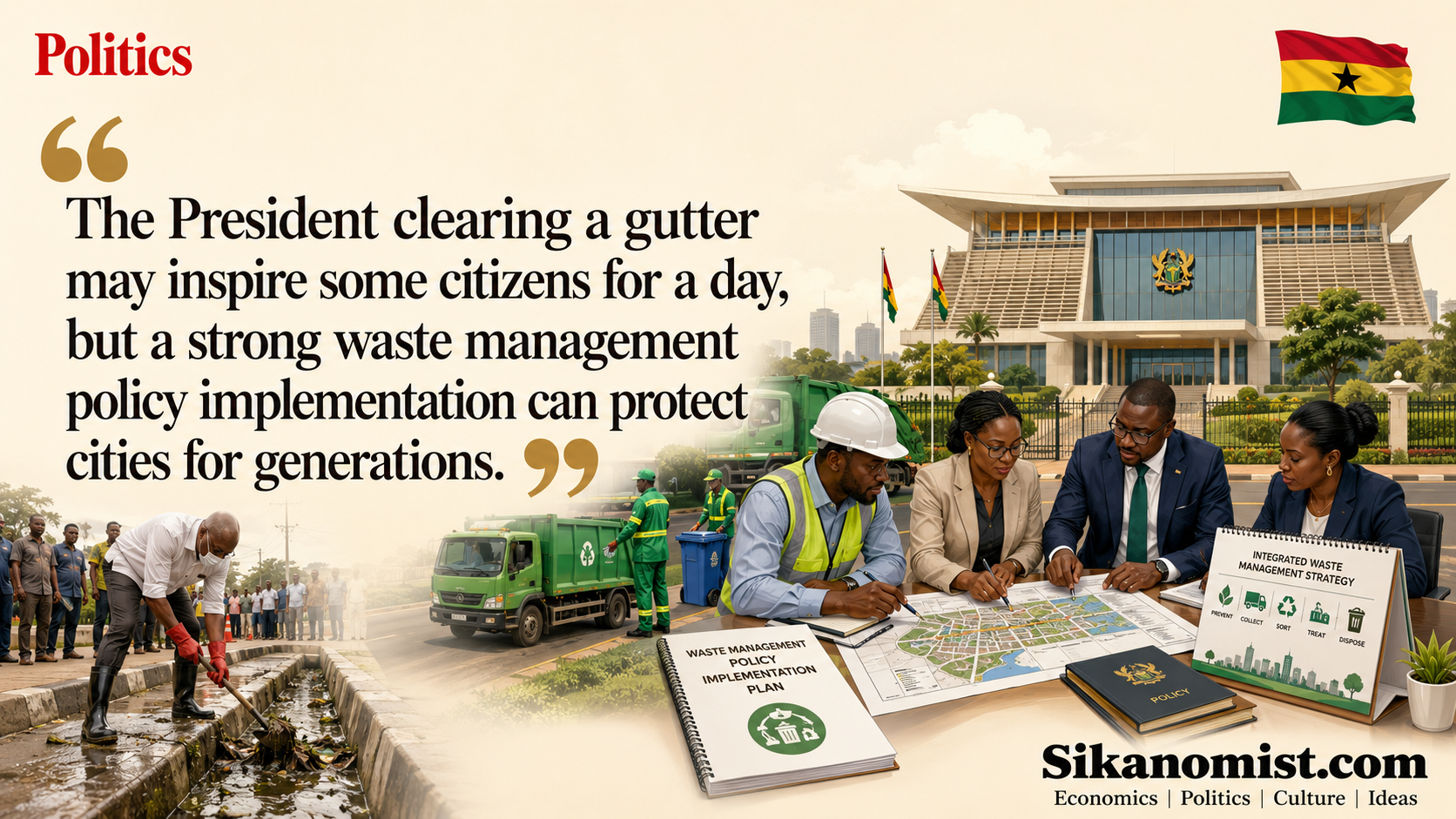
The bigger lesson is that leadership must move from performance to policy. It is good for leaders to show example, but example without system becomes theatre. The President clearing a gutter may inspire some citizens for a day, but a strong waste management policy can protect cities for generations.
Ghana does not need heroic sanitation. Ghana needs organised sanitation. Ghana does not need the President in every gutter. Ghana needs every assembly to know its job and do it. Ghana does not need another national clean-up photo. Ghana needs clean streets when no camera is present.
The recent flooding should force the country to think deeply. Are our assemblies working? Are sanitation officers empowered? Are engineers listened to? Are contractors performing? Are citizens obeying the law? Are waste systems properly funded? Are drains inspected before the rains come? Are local authorities punished when they fail?
A serious country asks these questions before disaster. A careless country asks them after homes are flooded.
Ghana must now choose seriousness. The President can lead, but he should lead through policy, institutions and accountability. Ministers can support, but they should support through funding, coordination and enforcement. Assemblies must act, because sanitation is local before it becomes national. Citizens must change behaviour, because no government can clean a country whose people keep dirtying it.
The way forward is clear. Ghana needs a national waste management strategy. Every district must have a local plan. Drainage maintenance must be routine. Waste collection must be reliable. Dumping must be punished. Recycling must be encouraged. Contracts must be performance-based. Citizens must be educated and held accountable.
The President clearing rubbish from a drain should not become the image of leadership. The better image would be a Ghana where the drains are already clean, the streets are not littered, the assemblies are working, and rain no longer brings fear to communities.
That is the Ghana we should build.
Because in the end, a nation is not made clean by one powerful man entering a gutter. A nation is made clean when its systems work even when nobody is watching.
Reader’s question:
Should Ghana continue relying on national clean-up exercises, or is it time for every district to be held accountable for a working waste management plan?