The Proposed Ghanafo Compact
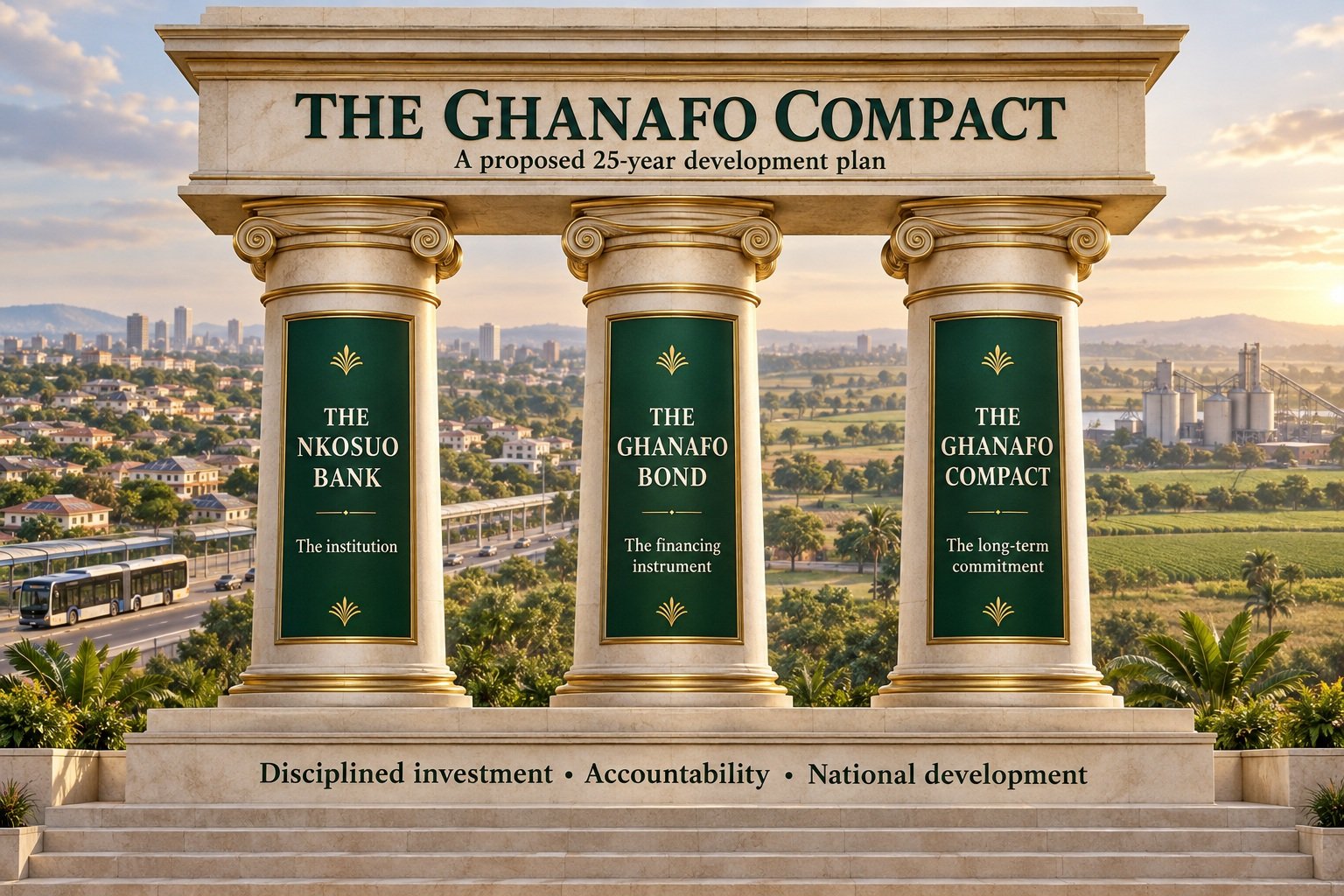
The Ghanafo Compact proposes a 25-year national framework for converting long-term finance into productive assets, sustainable employment, stronger Ghanaian businesses and improved living standards.
It brings together three connected proposals:
Nkosuo Bank of Ghana, referred to asNkosuo Bank: the proposed institution that would prepare, finance, monitor and recover qualifying long-term investments.
The Ghanafo Bond: the proposed long-term financing instrument through which Nkosuo Bank could obtain carefully controlled cedi funding.
The Ghanafo Compact: the national policy, legal and performance framework intended to protect the programme across changes of government.
The proposal retains a maximum cumulative Ghanafo Bond scenario of GH¢5 trillion over 25 years and a stretch ambition of developing an economy with nominal gross domestic product of at least US$5 trillion after 25 year.
Neither figure is an immediate commitment, appropriation, forecast or guarantee. Both require independent legal, monetary, fiscal and economic validation before they can form part of an implementable programme.
Decision requested from national officials
National officials are not being asked at this stage to approve GH¢5 trillion of financing, direct the Bank of Ghana to purchase a bond or establish an unconditional 25-year entitlement.
They are invited to authorise or support a structured feasibility and consultation process that would:
Determine whether the proposed Ghanafo Bond model is constitutionally and legally permissible.
Test its inflation, exchange-rate, fiscal, public-debt and Bank of Ghana balance-sheet effects.
Compare Nkosuo Bank with the option of expanding or restructuring existing institutions, including Development Bank Ghana, the Ghana Infrastructure Investment Fund and Ghana EXIM Bank.
Establish the legal and prudential status of Nkosuo Bank.
Develop baseline, conservative, transformation and stretch economic scenarios.
Design an initial pilot that is small, independently assessed and capable of being stopped without creating unfinished projects or systemic losses.
Prepare draft legislation, operating manuals and a public consultation paper.
The proposed principle
Subject to the Constitution, applicable law and the independent judgement of the Bank of Ghana, Parliament may consider a tightly controlled Ghanafo Bond programme under which the Bank of Ghana could be the sole eligible purchaser of specified bond series issued by Nkosuo Bank.
No law should compel the Bank of Ghana to purchase a bond. No phase envelope should create an automatic entitlement. No transaction should proceed without a published monetary-impact assessment, a credit and balance-sheet risk assessment, a legal-compliance opinion, prepared projects and an independently verified repayment plan.
If an authoritative legal and monetary review concludes that direct Bank of Ghana subscription is incompatible with the Constitution or the Bank of Ghana Act, the financing model must be redesigned before legislation.
Possible alternatives for technical consideration should include budgeted equity, concessional facilities, market-based institutional borrowing, project bonds, private co-investment and carefully structured refinancing facilities permitted by law.
Why the proposal deserves examination
Ghana’s development problem is not merely a shortage of ideas. It is also a shortage of affordable, long-term, well-governed finance for productive investment.
Commercial credit is often too expensive or too short for housing, industrial capacity, agricultural value chains, organised transport, utilities, research infrastructure and other projects with long construction or repayment periods.
The Compact therefore proposes a disciplined system in which:
Financing is released only in approved bond series and project-linked tranches.
Nkosuo Bank operates principally as a wholesale and project-finance institution through regulated participating financial institutions.
Sponsors and participating institutions retain real financial risk.
Project revenues enter controlled accounts.
Ghanafo Bond debt service, provisions and required reserves are funded before recovered capital is reinvested.
Subsidies and government compensation are explicit, budgeted and reported.
Failed projects are recognised, restructured or resolved rather than concealed through repeated refinancing.
Political office-holders cannot direct the approval, refusal, procurement, restructuring or recovery of a named transaction.
Main risks that must be resolved
The proposal has five material risks:
Legal risk: direct Bank of Ghana subscription may conflict with constitutional and statutory restrictions on monetary financing.
Monetary risk: liquidity and import demand may increase years before new production becomes available, creating inflation and exchange-rate pressure.
Fiscal risk: losses at Nkosuo Bank or the Bank of Ghana may ultimately require public recapitalisation, even where proceeds do not enter the Consolidated Fund.
Credit and implementation risk: weak projects, poor construction, inadequate risk-sharing or politically influenced lending may destroy capital.
Institutional risk: a new institution may duplicate existing development-finance bodies unless its additionality is demonstrated.
These risks do not require the idea to be abandoned. They require the design to be tested and strengthened before any financial commitment is made.
1. National problem and institutional gap
Ghana has substantial human, agricultural, mineral, cultural, geographic and entrepreneurial assets. It also faces persistent constraints that limit production and household prosperity:
Inadequate long-term finance.
Expensive and short-tenor commercial credit.
Import dependence and foreign-exchange vulnerability.
Limited industrial and agro-processing capacity.
Housing shortages and high accommodation costs.
Inadequate transport, logistics and utility systems.
Youth unemployment and underemployment.
Low labour productivity and a narrow tax base.
Policy discontinuity and unfinished projects.
Public capital that is spent without producing recoverable assets.
Ghana already has institutions with development-finance functions.
Development Bank Ghana provides wholesale long-term finance through participating financial institutions, while the Ghana Infrastructure Investment Fund finances infrastructure assets. Ghana EXIM Bank, commercial banks, pension funds and other institutions also perform related functions.
Before Nkosuo Bank is established, an independent institutional-gap and cost-benefit study should determine:
Which financing gaps remain unmet.
Why existing institutions cannot meet them under their present mandates.
Whether Nkosuo Bank should be a new institution, a statutory window, a subsidiary or a restructured mandate within an existing institution.
The expected costs of governance, staffing, systems and supervision.
How duplication, competition for projects and regulatory arbitrage would be prevented.
What measurable additionality Nkosuo Bank would provide.
The case for Nkosuo Bank should rest on demonstrated national need, not institutional novelty.
2. The three-part national framework
2.1 Nkosuo Bank of Ghana
Nkosuo Bank would be responsible for long-term productive finance.
Its proposed functions would include project preparation, wholesale financing, project finance, participating-institution selection, portfolio monitoring, recovery and capital recycling.
Its legal form must be settled before legislation. Options requiring formal assessment include:
A statutory public corporation.
A state-owned company under the Companies Act, 2019, Act 992.
A licensed wholesale development finance institution under the Development Finance Institutions Act, 2020, Act 1032.
A specially constituted institution subject to an expressly defined prudential regime.
Whatever structure is selected, Nkosuo Bank should remain subject to appropriate capital, liquidity, single-obligor, related-party, fit-and-proper, anti-money-laundering, cybersecurity, audit and regulatory requirements.
2.2 The Ghanafo Bond
The Ghanafo Bond would be a dedicated, long-term instrument issued by Nkosuo Bank.
Each bond series should specify:
Principal amount.
Coupon or pricing method.
Maturity and amortisation.
Grace period, if any.
Seniority and security.
Eligible project pool.
Disbursement timetable.
Debt-service reserve.
Reporting obligations.
Events of default.
Suspension and cure procedures.
Impairment, restructuring and recovery treatment.
The term bond series means a separately approved issuance with its own legal terms.
A tranche means a release of proceeds under an approved bond series after stated conditions have been met.
A programme envelope means a maximum legal ceiling. It is not an expenditure target or purchase obligation.
2.3 The Ghanafo Compact
The Ghanafo Compact would be a national policy framework supported by legislation, regulations, operating codes and periodic parliamentary review.
A parliamentary resolution may endorse the policy direction, but only legislation can create enforceable duties and controls.
The Compact should complement the Constitution, the national budget, the Bank of Ghana, the Ministry of Finance, the National Development Planning Commission and Ghana’s official long-term development framework.
It should not replace or bypass them.
3. Constitutional, legal and monetary feasibility gateway
No Ghanafo Bond should be issued or purchased until the Attorney-General, the Ministry of Finance and the Bank of Ghana have confirmed that the proposed transaction complies with:
Article 183 of the Constitution.
The Bank of Ghana Act, 2002, Act 612, as amended by Acts 918 and 1158.
The Public Financial Management Act, 2016, Act 921, as amended by Act 1136.
Applicable public-debt, accounting, securities, procurement, state-ownership and development-finance law.
Calling expenditure productive or keeping proceeds outside the Consolidated Fund does not, by itself, remove the monetary, fiscal or legal character of a transaction.
3.1 Bank of Ghana independence
The Bank of Ghana should retain the power to approve the requested amount, approve a smaller amount, defer consideration or refuse a transaction.
It should never be directed to purchase a bond by the Government of Ghana, Parliament, Nkosuo Bank, a political party or the proposed Review Council.
Before any purchase, the body authorised under the Bank of Ghana Act should receive:
A monetary-policy compatibility assessment.
A liquidity and sterilisation-cost assessment.
An exchange-rate and foreign-reserve assessment.
A credit and balance-sheet risk assessment.
A legal-compliance opinion.
A fiscal-risk and public-debt classification.
A project-readiness certificate.
Central-bank acquisition of a Ghanafo Bond would create reserve money.
Ring-fencing may control the timing and use of proceeds, but it does not eliminate the monetary effect.
The outcome would depend on disbursement speed, import content, production lead times, repayment, default, sterilisation and the response of inflation and the exchange rate.
3.2 Bank of Ghana balance-sheet protection
The Bank of Ghana’s 2025 financial statements reported negative equity and a recapitalisation path extending to 2032.
Any Ghanafo Bond proposal must therefore be assessed against the Bank of Ghana’s capital position, reserve money, assets, liabilities, sterilisation capacity and policy mandate.
An impaired Ghanafo Bond could weaken the Bank of Ghana’s balance sheet and create a later fiscal cost.
The proposal must not describe central-bank financing as costless.
3.3 Public-debt and fiscal classification
Before the first issuance, the Ministry of Finance, Controller and Accountant-General, Auditor-General, Bank of Ghana and Ghana Statistical Service should publish the approved legal, accounting and statistical treatment of:
Ghanafo Bond liabilities.
Nkosuo Bank assets and liabilities.
Bank of Ghana exposure and impairments.
Government guarantees.
Availability payments and compensation.
Expected recapitalisation obligations.
Consolidation within public-sector debt statistics.
No sovereign guarantee, charge on the Consolidated Fund or obligation to recapitalise Nkosuo Bank should arise by implication.
4. Financing and operating architecture
4.1 Flow of funds
The proposed transaction chain should operate as follows:
Nkosuo Bank prepares a bond series supported by an approved pool of qualifying projects.
The Bank of Ghana independently assesses legal, monetary, credit and balance-sheet compatibility.
Approved proceeds enter a segregated Nkosuo Bank treasury account.
Board-approved sector windows receive portfolio limits, not automatic allocations.
Eligible participating financial institutions originate or co-finance qualifying transactions.
Borrowers or special-purpose project companies receive milestone-based disbursements through controlled project accounts.
Project revenues and repayments return through ring-fenced collection accounts.
Required operating payments, debt service, provisions and reserves are funded in the contractual order.
Only surplus recovered capital may be reinvested.
Neither the Government of Ghana nor a participating institution should be permitted to use undisbursed proceeds temporarily for another purpose.
4.2 Two financing windows
The Compact should separate projects with commercial revenue from public-service projects.
Commercial window: project revenues, enterprise cash flows, rents, mortgages, leases, fares, tariffs or sales service the financing.
Public-service window: an explicitly appropriated government service payment, availability payment, viability-gap contribution or compensation services the financing.
Public benefit alone is not a repayment plan.
Government compensation must be affordable, valued, included in the medium-term fiscal framework and lawfully appropriated before financial close.
4.3 Risk-sharing
Every transaction should specify, before approval:
Sponsor equity.
Participating-institution exposure.
Nkosuo Bank exposure.
Security and collateral.
Completion support.
Currency and interest-rate risk.
Cash waterfall.
Order of losses.
Recovery route.
Participating institutions should retain meaningful risk throughout the life of each loan.
The exact minimum should be calibrated by product and prudential review. Side agreements that remove the required retained risk should be prohibited.
The programme may use pari-passu co-lending, capped first-loss or second-loss sharing, partial credit guarantees and wholesale credit lines.
Every window must disclose who bears first loss, the maximum Nkosuo Bank loss and how recoveries are shared.
No guarantee should be implied or unlimited.
4.4 Cash waterfall and capital recycling
Project cash should be applied in the following contractual order, adjusted where necessary for the project type:
Statutory payments and essential operating and maintenance costs.
Replenishment of the project debt-service reserve.
Scheduled senior, participating-institution and Nkosuo Bank debt service.
Cure of arrears and required cash sweeps.
Permitted distributions to investors.
At Nkosuo Bank level, Ghanafo Bond interest and scheduled principal, expected-credit-loss provisions, liquidity reserves and required capital must be funded before recovered capital is recycled.
The same principal cannot be treated simultaneously as bond repayment and new lending.
4.5 Pricing and subsidy discipline
Pricing should cover expected credit losses, operating costs, liquidity and maturity costs, and a reasonable capital margin.
Rates may differ by risk, tenor and product.
Any concessional rate, interest buy-down, viability-gap contribution or public-service subsidy should be explicit, budgeted and reported.
It must not be hidden as a loss imposed on Nkosuo Bank or the Bank of Ghana.
4.6 Asset-liability and currency management
Nkosuo Bank should:
Match project grace periods and amortisation to bond maturities.
Maintain a Board-approved liquidity reserve calibrated through stress testing.
Publish maturity-gap and liquidity-risk information.
Conduct quarterly liquidity, credit, inflation, interest-rate and foreign-exchange stress tests.
Maintain a contingency funding and institutional-resolution plan.
Prohibit short-term borrowing used to finance long-term illiquid assets.
Foreign-currency debt should be used only where a borrower has contracted foreign-currency revenue or an affordable, documented hedge.
Import replacement may create economic value, but it does not necessarily provide cash in foreign currency for debt service.
5. Governance and institutional responsibilities
5.1 Nkosuo Bank governance
Nkosuo Bank should be operationally independent but constitutionally appointed and publicly accountable.
Board vacancies should be publicly advertised and assessed by an independent statutory Nominations Panel against published professional, integrity and independence criteria.
The Panel should submit a merit-ranked shortlist for appointment by the President, acting in consultation with the Council of State in accordance with article 70, clause 1, paragraph d, subparagraph 3, of the Constitution.
This formal appointment process should not allow unrestricted political selection.
The legislation should prescribe:
Board size and required skill mix.
Fit-and-proper standards.
Disqualifying political and financial conflicts.
A proposed six-year cooling-off period for specified recent party-political offices, subject to constitutional review.
Three-year terms, with initial one-year, two-year and three-year appointments so that approximately one-third of the board retires each year.
Removal only for defined cause, due process and written reasons.
Quorum, voting and committee rules.
Mandatory declarations, recusal and related-party restrictions.
5.2 Separation of functions
Nkosuo Bank should maintain separate functions for:
Project preparation.
Origination.
Independent credit risk.
Treasury and asset-liability management.
Legal and compliance.
Environmental and social risk.
Monitoring and evaluation.
Workout and recoveries.
Internal audit.
Originators should not approve their own projects, and their remuneration should not depend only on approvals or disbursements.
5.3 Bank of Ghana
The Bank of Ghana should protect price and financial stability, supervise Nkosuo Bank where required by law, assess any proposed bond transaction independently, manage liquidity and publish its exposure.
It should not select projects, contractors or borrowers.
5.4 Government of Ghana and Ministry of Finance
The Government of Ghana may set broad lawful priorities, provide budgeted seed capital, remove administrative barriers and propose programmes.
The Ministry of Finance should oversee fiscal risks, guarantees, shareholder policy and multi-year commitments.
Neither the Government nor the Ministry should direct the approval, refusal, restructuring or recovery of a named transaction.
5.5 Parliament
Parliament should enact the legal framework, approve statutory ceilings and guarantees where required, receive reports, conduct oversight and refer suspected breaches to competent authorities.
It should not allocate funds among constituencies, select borrowers or contractors, or compel an individual bond purchase.
5.6 NDPC, SIGA and the Review Council
The Compact should be integrated into Ghana’s official long-term and medium-term development plans through the National Development Planning Commission, or NDPC.
Where Nkosuo Bank is a specified entity, the State Interests and Governance Authority, or SIGA, should perform its lawful ownership and performance-oversight role without intervening in transactions.
A Ghanafo Compact Review Council may coordinate independent evaluation, with its secretariat anchored in the NDPC to reduce duplication.
The majority of evaluators should be independent of institutions being assessed.
The Bank of Ghana, Nkosuo Bank and Ministry of Finance may provide data or participate without voting when their own performance is under review.
The Auditor-General should remain outside the Council so that audit independence is protected.
5.7 Regional presence
The proposal recommends Sunyani as the head-office location, supported by lean area offices serving the Coastal, Middle and Savannah belts and all sixteen regions.
Before the location is fixed in law, a transparent site assessment should examine operating cost, staffing, digital connectivity, access to national institutions, regional-development value and service accessibility.
Regional fairness should be measured and reported, but financing should not be divided equally among regions or constituencies.
Project quality, need, economic potential, inequality, repayment capacity and environmental sustainability should guide investment.
6. Project eligibility, appraisal and recovery
6.1 Additionality and preparation
Nkosuo Bank should finance projects that address a demonstrated market failure, extend tenor, improve risk allocation or mobilise additional capital.
It should not displace finance already available on reasonable commercial terms.
Projects should pass the following stages:
Concept screening.
Pre-feasibility assessment.
Full feasibility and economic cost-benefit analysis.
Independent technical, legal, environmental and social review.
Credit approval.
Legal and financial close.
Milestone-based disbursement.
Completion testing.
Operating and repayment monitoring.
Benefits-realisation review.
Requirements should be proportionate to project size and risk.
Consultants must not approve their own work, and preparation costs may be recovered from successful commercial projects where appropriate.
6.2 Conditions before first disbursement
Material projects should have, where applicable:
Verified land title and permits.
Environmental and social approval.
A lawful procurement route.
Perfected security and insurance.
Sponsor equity paid before public financing.
A construction contingency.
Performance bonds and retention arrangements.
Independent engineer certification.
A maintenance and operating plan.
A ring-fenced collection account.
A debt-service reserve.
Step-in and contractor-replacement rights.
Sponsors should fund unapproved cost overruns before further Nkosuo Bank disbursement.
6.3 Participating financial institutions
Eligible participating financial institutions should meet published requirements covering capital, liquidity, asset quality, governance, audited accounts, anti-money-laundering and counter-terrorist-financing controls, beneficial ownership, regulatory compliance, digital reporting, collateral-registry use, sector expertise and stress-test capacity.
Approval should be renewed periodically.
Contracts should specify risk retention, on-lending margins, servicing standards, audit access, collections, data protection, borrower complaints, security, loss allocation, suspension, replacement-servicer rights and termination.
A portion of servicing fees should depend on verified collections, covenant compliance, project completion and data quality.
Poor performance should lead to fee clawback, reduced allocations, increased risk retention, suspension or debarment after due process.
6.4 Capital, provisioning and concentration
Nkosuo Bank must have genuine paid-in, loss-absorbing seed capital before the first Ghanafo Bond.
Regulations should establish:
Prudential capital and liquidity minima.
Expected-credit-loss recognition and provisioning.
Single-obligor and connected-group limits.
Sector, region, participating-institution and contractor concentration limits.
Related-party prohibitions.
Portfolio stress testing.
Recapitalisation and resolution procedures.
Losses should be borne in the contractually agreed order by sponsor equity, security and recoveries, participating-institution risk, project reserves or guarantees, and Nkosuo Bank provisions and capital.
There should be no automatic Bank of Ghana or sovereign bailout.
6.5 Failure and recovery
Some projects will fail.
The recovery process should follow a defined ladder:
Early-warning classification and intensified monitoring.
Suspension of further drawdown and distributions.
Time-limited cure plan.
Independent viability review.
Restructuring only where recovery is credible.
Management or contractor replacement and lender step-in.
Enforcement, sale or lease of productive assets.
Insolvency or liquidation where the project is not viable.
Repeated refinancing, interest capitalisation or a new bond series must not be used to make arrears appear current.
7. National transformation missions
The long-term investment shares below are consultation assumptions, not entitlements or spending targets.
They should be replaced by five-year portfolio ranges after the project pipeline, absorptive capacity and correlated risks have been assessed.
The illustrative productive investment windows are as follows:
Industry and manufacturing: 24 per cent.
The principal purposes include machinery, factories, supplier networks, processing, pharmaceuticals, construction materials, exports and technology upgrading.
Agriculture and agro-industry: 18 per cent.
The principal purposes include irrigation, mechanisation services, livestock, fisheries, storage, cold chains, processing, markets and agricultural logistics.
Housing and serviced communities: 16 per cent.
The principal purposes include affordable and market housing, rental housing, mortgages, completion finance, serviced land, water, sanitation and local materials.
Transportation and logistics: 14 per cent.
The principal purposes include organised public-transport fleets, modern trotro systems, maintenance, terminals, ticketing, logistics, rail, ports and local assembly.
Energy, water and utilities: 14 per cent.
The principal purposes include generation, transmission support, distribution, renewable energy, water, sanitation, recycling and efficiency.
Digital and knowledge economy: 6 per cent.
The principal purposes include broadband, data centres, cybersecurity, research, technology parks, software and commercially useful digital systems.
Tourism, culture and creative economy: 4 per cent.
The principal purposes include heritage, hospitality, museums, film, music, sport, recreation, ecological tourism and creative-business infrastructure.
Productive healthcare and education infrastructure: 4 per cent.
The principal purposes include laboratories, technical training, research, teaching hospitals, diagnostics, medical equipment and care facilities for older persons.
The total is 100 per cent.
This is an illustrative consultation scenario only.
Every sector window should specify eligible products, risk-sharing, pricing, tenor, security, monitoring and recovery rules.
7.1 Producing for residents of Ghana
Exports and foreign-exchange earnings are essential, but national prosperity also depends on the quality and affordability of goods and services available within Ghana.
The Compact should increase the supply of food, housing, transport, healthcare, education, clothing, furniture, household goods, recreation, digital services and secure employment.
Support for import replacement should be competitive and economically efficient.
Projects should not receive permanent protection for producing goods at unsustainable cost or poor quality.
7.2 Employment and skills
Employment reporting should distinguish temporary construction work, permanent operating jobs, full-time and part-time employment, apprenticeships, informal work formalised, pension-contributing employment and jobs displaced by technology.
Major projects should state the skills required, how workers will be trained, how technology will be transferred and how Ghanaian management and supplier capability will develop.
8. Programme envelope, phases and economic ambition
8.1 GH¢5 trillion maximum scenario
The proposed GH¢5 trillion represents a maximum cumulative nominal principal scenario over 25 years.
It is not:
An appropriation.
A government-revenue source.
A borrowing approval before individual bond series are authorised.
A guaranteed minimum purchase.
An automatic annual allocation.
Permission to disregard inflation, debt sustainability or the Bank of Ghana’s balance sheet.
The programme should report three separate controls:
Cumulative nominal issuance.
Maximum concurrent outstanding principal.
Annual net new financing subject to monetary, fiscal and absorptive-capacity limits.
Constant-price reporting should be used to evaluate real scale, but it should not automatically increase statutory borrowing authority.
8.2 Five-year consultation scenario
The phase figures below are phase-only planning ceilings.
They are neither cumulative targets nor compulsory expenditure.
Phase One covers Years 1 to 5.
Its purpose is institution building and controlled pilots.
Its maximum indicative phase ceiling is GH¢50 billion.
Phase Two covers Years 6 to 10.
Its purpose is early productive expansion.
Its maximum indicative phase ceiling is GH¢250 billion.
Phase Three covers Years 11 to 15.
Its purpose is national scaling.
Its maximum indicative phase ceiling is GH¢700 billion.
Phase Four covers Years 16 to 20.
Its purpose is industrial acceleration.
Its maximum indicative phase ceiling is GH¢1.5 trillion.
Phase Five covers Years 21 to 25.
Its purpose is global-scale productive expansion.
Its maximum indicative phase ceiling is GH¢2.5 trillion.
The maximum total over the 25 years is GH¢5 trillion.
The first pilot should be divided among a small number of sectors with observable repayment cycles.
Its aggregate size should not exceed GH¢2 billion and should in every case be the lower of that nominal ceiling and any macroprudential limits established after modelling.
Each five-year statutory ceiling should expire unless Parliament renews the next ceiling after receiving an independent evaluation.
Renewal should permit, but never compel, the Bank of Ghana to assess an individual bond series.
8.3 US$5 trillion stretch scenario
World Bank data place Ghana’s nominal gross domestic product in current US dollars at approximately US$114.2 billion in 2025.
Reaching nominal gross domestic product of US$5 trillion after 25 years would require the economy to become about 43.8 times larger and to grow by approximately 16.3 per cent a year in nominal US-dollar terms.
Under a 6 per cent nominal US-dollar growth assumption, illustrative gross domestic product after 25 years would be approximately US$490 billion.
Under an 8 per cent assumption, it would be approximately US$782 billion.
Under a 10 per cent assumption, it would be approximately US$1.24 trillion.
Under a 12 per cent assumption, it would be approximately US$1.94 trillion.
Under a 14 per cent assumption, it would be approximately US$3.02 trillion.
Under a 16.3 per cent assumption, it would be approximately US$5 trillion.
This is arithmetic, not a forecast or causal economic model.
Nominal US-dollar gross domestic product is affected by real production, domestic prices and the exchange rate.
The US$5 trillion figure should therefore remain a stretch scenario, while binding performance should focus on:
Real gross domestic product and real gross domestic product per person.
Labour productivity.
Household income and affordability.
Manufacturing and agro-processing output.
Export complexity and foreign-exchange earnings.
Formal, pension-contributing employment.
Project completion, utilisation and repayment.
Quality housing, transport, utilities, healthcare and skills.
Independent modelling should publish baseline, conservative, transformation and stretch scenarios before legislation.
9. Performance gates, suspension and monitoring
9.1 Annual issuance gates
Before every new bond series, the Bank of Ghana and other authorised bodies should assess inflation, money growth, liquidity, interest rates, exchange-rate pressure, reserves, public debt, fiscal risks, Nkosuo Bank capital, portfolio performance, project readiness and implementation capacity.
9.2 Suspension rules
Regulations should distinguish between three categories of triggers.
First, hard statutory triggers.
These include a missed bond payment beyond a defined period, failure to submit audited accounts, confirmed diversion, breach of capital or reserve requirements, falsified statutory returns or an unresolved material audit qualification.
Second, macroeconomic triggers.
These should be assessed by the Bank of Ghana under a published methodology, allowing reduction, deferral or refusal.
Third, integrity triggers.
These should permit an interim pause based on credible evidence, followed by a defined investigation and final decision.
The legal framework should identify the decision-maker, evidence, notice, cure period, publication, reinstatement and review process.
Suspension should ordinarily stop new commitments.
It should not abandon a viable, already contracted project where abandonment would increase public loss.
9.3 Performance dashboard
The annual dashboard should distinguish:
Inputs: amounts approved and disbursed.
Outputs: assets completed and operational.
Outcomes: capacity utilisation, revenue, reliability, permanent employment and affordability.
Impacts: productivity, household income, taxes, exports and efficient import replacement.
Financial health: debt-service coverage, arrears, expected losses, recoveries, liquidity and capital.
Integrity: procurement breaches, conflicts, political-interference reports, audit findings and remedial action.
Every indicator should have a baseline, target, data owner, reporting frequency and independent-verification method.
Failed and cancelled projects, cost overruns, restructurings and displaced jobs should be reported alongside successes.
10. Integrity, procurement and public accountability
10.1 Political independence
Political interference should be defined as an attempt to direct the approval, refusal, restructuring, procurement or recovery of a named transaction outside a lawful written policy process.
The recipient of such an instruction should be required to refuse, record and report it through protected channels.
Whistle-blowers should receive protection from retaliation, and breaches should be referred to the competent authority.
10.2 Procurement
Procurement should comply with the Public Procurement Act, 2003, Act 663, as amended by Act 914, wherever that law applies.
Where a private borrower is not a procurement entity, the financing agreement should impose a competitive, transparent and value-for-money procurement standard proportionate to the project.
Controls should include electronic procurement, beneficial-ownership checks, conflict declarations, contract publication, change-order limits, independent complaints and debarment with notice, reasons, duration and appeal rights.
10.3 Prohibited use and conduct
Nkosuo Bank and Ghanafo Bond resources should not be used for:
Government salaries, arrears or general budget support.
Routine ministry expenditure.
Political campaigns, party donations or election activity.
Ceremonial contributions, funeral donations, sika nsa, meaning customary condolence money, wreaths, religious donations or unrelated sponsorships.
Personal gifts, personal vehicles or status benefits for officials.
Party colours, campaign messages or portraits of office-holders on projects.
Bullion vans, physical cash distribution or unapproved financial channels.
Directed loans, contracts or restructurings.
Undisclosed related-party transactions.
Foreign-exchange speculation.
Repeated refinancing intended to conceal failure.
Employees may attend funerals or make donations privately, using their own resources and approved personal leave.
Nkosuo Bank may acquire a strictly limited pool of operational vehicles for field inspection, engineering, safety and remote-site monitoring, subject to published fleet controls.
It should not provide personal official vehicles.
10.4 Transparency and audit
A searchable public project register should disclose, subject to lawful protection of personal data and genuine commercial confidentiality:
Bond series and project location.
Approved and disbursed amounts.
Sponsor, participating institution and Nkosuo Bank risk shares.
Beneficial owners and contractors.
Subsidy or government-compensation element.
Expected completion and repayment.
Progress, employment, arrears, restructuring, losses and recoveries.
The Auditor-General’s constitutional mandate should be preserved.
Nkosuo Bank should also maintain internal audit, an Audit Committee, technical and value-for-money audits, procurement assurance, cybersecurity review and environmental and social assurance.
Management should respond to audit findings within defined periods, and unresolved material findings should suspend new commitments.
11. Implementation roadmap
Stage Zero: 18-to-24-month preparation and consultation
Before Year One, Ghana should complete:
An Attorney-General constitutional and legal opinion.
A Bank of Ghana monetary-financing and balance-sheet assessment.
A Ministry of Finance fiscal-impact, debt-classification and affordability analysis.
An NDPC alignment and institutional-gap study.
A regulatory assessment under the Development Finance Institutions Act.
A SIGA governance and state-ownership assessment.
Auditor-General, Internal Audit Agency and Public Procurement Authority consultation.
Securities, custody and settlement opinions from the relevant authorities.
Public-investment, public-private-partnership, competition, anti-money-laundering and counter-terrorist-financing, beneficial-ownership, data-protection and insolvency reviews.
Independent macroeconomic scenarios and pilot stress tests.
National, regional, private-sector, labour, civil-society and diaspora consultation.
Phase One: Years 1 to 5
Establish the approved institutional structure and provide paid-in seed capital.
Recruit the board and management through the statutory process.
Build risk, treasury, monitoring, procurement, data and audit systems.
Establish a Project Preparation Facility.
Select participating financial institutions.
Approve the required operating manuals.
Conduct an independent operational-readiness review.
Undertake a deliberately limited pilot of no more than GH¢2 billion, subject to lower macroprudential limits.
Publish pilot results before any scaling.
Phases Two to Five: Years 6 to 25
Later phases should proceed only after independent review and parliamentary renewal of the next ceiling.
Scale should depend on repayment, institutional capacity, inflation, public debt, Bank of Ghana independence, project performance, private co-financing, exports, productivity and living standards.
The programme should rely increasingly on repayments, retained earnings, pension and insurance co-investment, private finance, project bonds and market refinancing of seasoned performing assets.
Dependence on new Ghanafo Bond issuance should decline over time.
12. Legislative development and next decision
The eventual legal package may require:
A Nkosuo Bank Act or another lawful institutional instrument.
A Ghanafo Bond framework expressly reconciled with the Bank of Ghana Act.
Amendments required by the Attorney-General’s formal opinion.
Alignment with public-finance, debt, procurement, state-ownership, companies, securities, data, anti-money-laundering and counter-terrorist-financing, environmental, public-investment and public-private-partnership law.
Five-year statutory ceilings that expire unless renewed.
Enforceable prohibited-use, conflict, reporting, suspension and recovery rules.
Protection for officials who refuse and report unlawful instructions.
Precise enforcement responsibilities for regulators, audit bodies, investigative authorities and courts.
The immediate national decision should be whether to subject the Ghanafo Compact to a formal, independent feasibility process.
Approval of that process would not constitute approval of the financing envelope or a Bank of Ghana transaction.
The Compact’s permanent principle should be:
Ghana should create or mobilise long-term capital only where it can convert that capital into productive assets, sustainable employment, stronger communities, expanding businesses and an economy capable of servicing the financing without sacrificing price stability, fiscal sustainability or institutional independence.
The purpose is not simply to make Ghana’s economy appear larger.
It is to make Ghana more productive, prosperous, resilient and capable of providing a good life for its people.
Annex A: Required operating instruments before the first bond
The following should be independently reviewed, approved and published before any Ghanafo Bond purchase:
Credit Policy and Delegated Authority Framework.
Participating Financial Institution Eligibility and Accreditation Code.
Risk-Sharing and Guarantee Manual.
Treasury, Liquidity and Asset-Liability Management Policy.
Project Preparation and Appraisal Manual.
Environmental and Social Risk Framework.
Pricing and Subsidy Policy.
Procurement and Beneficial-Ownership Standard.
Monitoring, Data and Public Disclosure Standard.
Workout, Recovery and Institutional Resolution Policy.
Conflict-of-Interest, Gifts and Integrity Code.
Whistle-blowing and Political-Interference Reporting Protocol.
Annex B: Core legal and policy references for formal verification
Constitution of the Republic of Ghana, 1992, including articles 70, 86 to 87, 108, 178 to 179, 183, 187 and 284.
Bank of Ghana Act, 2002, Act 612, as amended by the Bank of Ghana Amendment Act, 2016, Act 918, and the Bank of Ghana Amendment Act, 2025, Act 1158.
Public Financial Management Act, 2016, Act 921, as amended by the Public Financial Management Amendment Act, 2025, Act 1136.
Development Finance Institutions Act, 2020, Act 1032.
State Interests and Governance Authority Act, 2019, Act 990.
Companies Act, 2019, Act 992.
Public Procurement Act, 2003, Act 663, as amended by Act 914.
Public Private Partnership Act, 2020, Act 1039, and Public Investment Management Regulations, 2020.
Right to Information Act, 2019, Act 989; Data Protection Act, 2012, Act 843; Internal Audit Agency Act, 2003, Act 658; Whistleblower Act, 2006, Act 720; applicable anti-money-laundering legislation; and related regulations.
Bank of Ghana, Annual Report and Financial Statements 2025, published in 2026.
Bank of Ghana, Monetary Policy Framework and current monetary-policy reports.
Ministry of Finance public-debt reports and the Public Financial Management Act.
National Development Planning Commission, Vision 2057 and related national planning frameworks.
Ghana Statistical Service, 2021-to-2050 population projections and official national accounts.
World Bank Ghana country data, including 2025 nominal gross domestic product in current US dollars.
Development Bank Ghana and Ghana Infrastructure Investment Fund official mandate and performance documents.
Important legal note:
This consultation draft is a policy proposal.
All statutory references, amendment effects and proposed legal routes must be confirmed by the Attorney-General and the competent public institutions before presentation as settled law or before any Bill is introduced.