When the Law Is Strong Against the Weak but Weak Against the Powerful
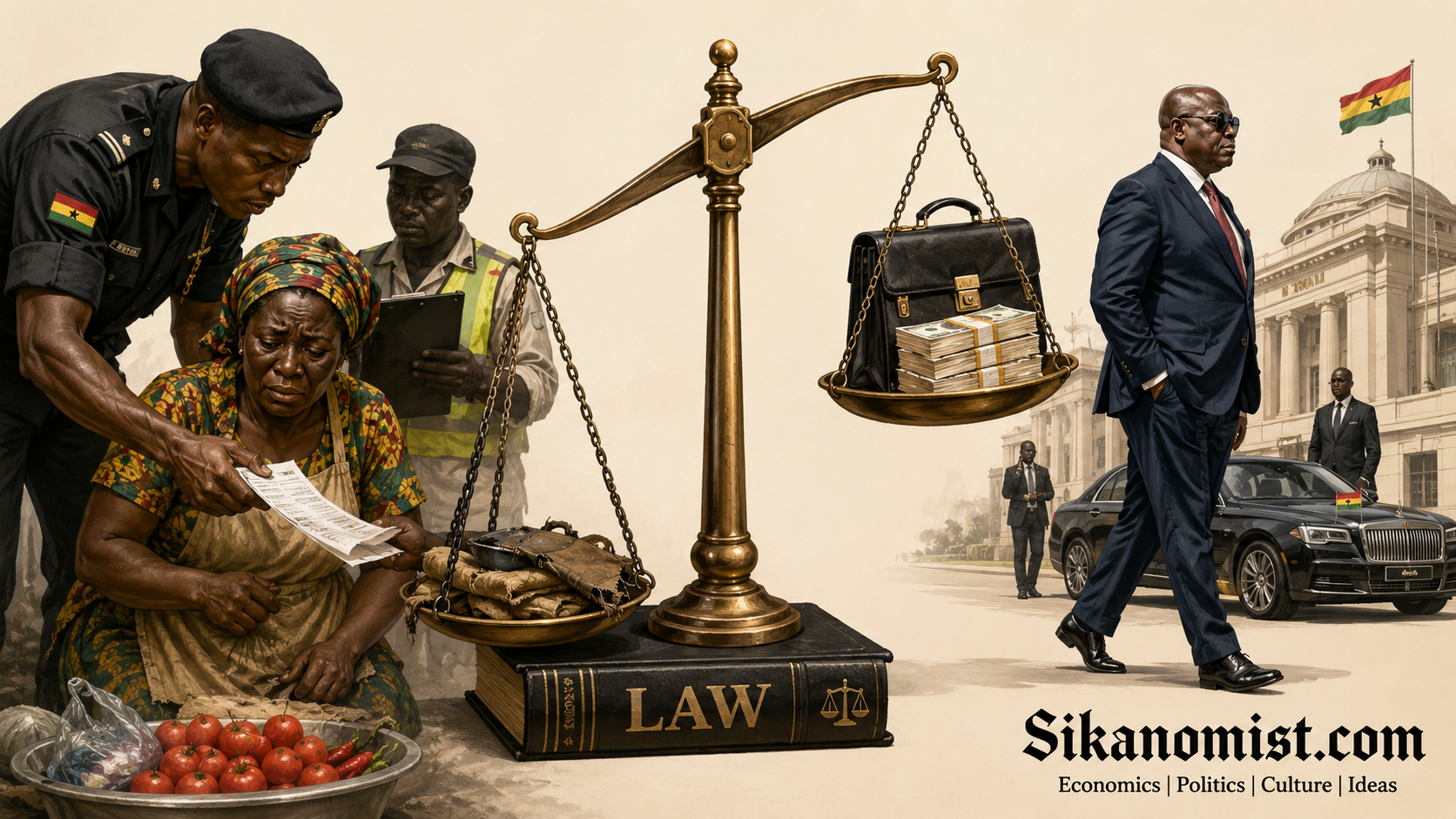
A law that is enforced only against the powerless is not justice. It is selective authority.
This is one of the most dangerous problems any country can face. When ordinary citizens are punished quickly for breaking the law, while wealthy, connected or politically influential people are treated differently, public trust begins to disappear.
The problem is not only that some people escape punishment. The deeper problem is that citizens begin to believe that the law itself is not serious.
They begin to see the law as something designed for the poor, the weak and the unknown, but negotiable for those with money, power or political connections.
When that happens, the state loses moral authority.
One Law, Two Experiences
In theory, the law should treat every citizen equally.
The market trader, the minister, the driver, the business owner, the civil servant, the chief executive and the politician should all be subject to the same rules.
But in practice, many citizens experience the law differently.
An ordinary person may be arrested immediately for a minor offence. A street vendor may have goods seized without warning. A poor family may see a structure demolished quickly. A commercial driver may be punished on the spot.
Yet when an influential person breaks a similar rule, the process may suddenly become slower, softer and more complicated.
Officials may begin making telephone calls. Meetings may be arranged. Enforcement may be delayed. Files may disappear. Technical officers may be asked to “wait for instructions”.
The law has not changed, but the treatment has.
This creates two countries within one country: one for people with influence and another for everyone else.
Influence Must Not Become a Licence
Influence is part of every society. Some people hold public office. Some are respected traditional leaders. Some are wealthy business owners. Some belong to powerful political parties. Some have personal access to decision-makers.
But influence must never become a licence to ignore the law.
A person’s position should increase responsibility, not reduce it.
A minister should be more careful with public rules because the public is watching. A wealthy business owner should not use money to avoid regulation. A political party official should not expect special treatment from state institutions. A senior public servant should not be protected from accountability simply because of rank.
The more influence a person has, the greater the duty to act responsibly.
When powerful people are treated as though the law does not apply to them, others learn the wrong lesson. They begin to believe that success in Ghana does not depend on doing the right thing, but on knowing the right person.
That belief damages the character of the nation.
Selective Enforcement Encourages Disobedience
People are more likely to obey laws they believe are fair.
When citizens see that rules are applied equally, they may not always like the outcome, but they are more likely to respect the system.
However, when enforcement is selective, citizens begin asking why they should obey.
Why should one person stop building when another connected person is allowed to continue?
Why should one company follow procurement rules when another can win a contract through political influence?
Why should one driver obey traffic laws when a politically connected convoy can ignore them?
Why should one trader pay fees when another is protected by a local official?
These questions are dangerous because they weaken voluntary obedience.
A country cannot enforce every law through fear. It depends on citizens accepting that the rules are legitimate.
Selective enforcement destroys that legitimacy.
The Problem of Illegal Construction
The unequal application of the law is often visible in construction and land use.
A small property owner may be stopped quickly for failing to obtain the right permit. Yet a large building may continue rising even when questions have been raised about its location, approval or safety.
Sometimes a structure reaches several floors before authorities suddenly announce that it is illegal.
This raises an important question: where were the institutions when the foundation was being laid?
If officials have the power to demolish a completed building, they should also have the power to stop the construction at the beginning.
Allowing a project to continue and then destroying it later is not strong governance. It may be evidence of delayed enforcement, poor coordination or political interference.
The cost is enormous. Families lose homes. Investors lose capital. Workers lose jobs. Communities are disrupted. Public confidence is damaged.
Strong institutions do not wait until mistakes become disasters.
The Law and Political Connections
Political connections often place public officers in difficult positions.
A technical officer may know that a rule has been broken but fear that enforcement will offend a powerful party figure. A local official may hesitate because the offender supported a campaign. A regulator may delay action because a minister has shown interest in the matter.
This is how institutions become weak.
Political parties should compete for power, but they should not become shields against the law.
A person should not be able to escape responsibility because he or she belongs to the governing party. Opposition members should not be targeted simply because they are politically vulnerable.
The law must not become a weapon used against opponents or a shelter used to protect allies.
Justice must be blind to party colours.
Equal Treatment Protects Government
Some politicians may believe that protecting party members or supporters helps the government.
In reality, it often harms the government.
When citizens see connected people escaping accountability, they blame the administration in power. Even when the President or minister is not personally involved, the public may assume that the protection came from above.
Selective enforcement therefore damages the reputation of government.
A wise administration should insist that its own supporters obey the law. It should understand that the strongest proof of fairness is not how it treats opponents, but how it treats friends.
Any government can investigate an opponent.
The real test is whether it can act when the offender belongs to its own side.
The Poor Often Carry the Heaviest Burden
Selective law enforcement is especially painful because poor citizens usually have fewer ways to defend themselves.
They may not have lawyers. They may not know influential people. They may not understand complicated procedures. They may not have money to delay a case or challenge an unfair decision.
This makes them easier targets.
A weak institution may act quickly against a person who cannot resist, while avoiding someone who can create political or financial trouble.
That is not courage. It is convenience.
The strength of a justice system should be measured by how well it protects people without power.
A country that is harsh with the weak but cautious with the powerful has not achieved equality before the law.
Institutions Must Protect Their Officers
Many public officers know when something is wrong, but they may feel unprotected.
A planning officer who stops an influential person may be transferred. A police officer who acts against a connected individual may be criticised. A regulator who refuses political pressure may lose an opportunity. A civil servant who documents an improper instruction may be described as disloyal.
Ghana cannot demand equal enforcement while leaving honest officials exposed.
Public officers need clear legal and administrative protection when they act professionally.
Instructions should be documented. Complaints should be reviewed independently. Transfers should not be used as punishment. Whistleblowers should be protected. Technical decisions should not be overturned casually by political authority.
Institutions become brave when the people inside them know that the system will defend them.
Wealth Must Not Buy a Different Law
Money can influence many things, but it must not purchase a different form of justice.
A wealthy person may be able to hire better lawyers, but that should not mean the investigation disappears. A large company may have access to government officials, but that should not weaken regulation. A contractor may be important to the economy, but that should not excuse poor work or broken rules.
Business confidence does not grow where companies can buy protection.
Serious investors prefer countries where rules are clear and predictable. They want to know that contracts will be respected, regulators will act professionally and competitors will not win through political connections.
Equal law enforcement is therefore not anti-business.
It is one of the foundations of a fair economy.
The Media Must Avoid Selective Outrage
The media also has a responsibility.
Sometimes an issue becomes important only because the person involved belongs to the “wrong” political party. Similar behaviour by a favoured side may receive less attention.
This weakens public debate.
Journalists and commentators should apply the same standards to every government, every party and every powerful individual.
Wrongdoing does not become acceptable because it was committed by someone we support.
The media must ask consistent questions: Was the law followed? Was the process fair? Was public money protected? Were citizens treated equally?
A country cannot build justice through partisan outrage.
Citizens Must Also Reject Favouritism
Politicians are not the only people who encourage selective enforcement.
Citizens often condemn favouritism in public but request it in private.
Someone may complain about corruption and later call a politician to help a relative avoid punishment. A person may demand strong institutions but expect special treatment when personally affected. A business owner may criticise political interference while looking for connections to secure a contract.
This culture must change.
Equal treatment means accepting the law even when it affects us, our family, our party or our friends.
We cannot demand fairness only when fairness benefits us.
A nation becomes just when citizens defend principles, not merely personal interests.
Punishment Alone Is Not Enough
Equal enforcement does not mean the state must always be harsh.
The law should also be reasonable, humane and proportionate.
Minor offences should not attract unnecessary cruelty. Poor citizens should not be humiliated. Regulators should educate where possible. Authorities should give clear notice and fair opportunity to comply.
The goal of law is not simply to punish. It is to protect society, correct behaviour and maintain order.
But compassion must also be equal.
The powerful should not receive patience while the weak receive force.
Fairness means applying both discipline and mercy according to clear principles, not political influence.
Leadership Must Set the Standard
The strongest message must come from the top.
The President, ministers, chief executives and political party leaders must make it clear that no one is above the law.
They must avoid making private calls to protect friends. They must respect technical officers. They must allow regulators to work. They must accept lawful decisions even when those decisions are politically inconvenient.
Leadership is not only about giving orders.
It is also about allowing institutions to perform their duties without interference.
A leader who protects an ally from the law may gain temporary loyalty but weaken the entire state.
A leader who allows the law to work may disappoint a few supporters but strengthen the nation.
The Law Must Be Strongest Where Power Is Greatest
The law should not become weaker as influence increases.
It should become more careful, more transparent and more determined.
A public official controls public resources and should therefore face greater scrutiny. A large company affects many lives and should therefore meet higher standards. A political leader influences national decisions and should therefore be more accountable.
Power creates responsibility.
The law must be strongest where power is greatest because the damage caused by powerful people can be much larger.
A poor citizen may break one rule. A powerful official can weaken an entire institution.
Building Equal Justice
Ghana can build a fairer system.
Public agencies must publish clear procedures. Enforcement decisions should be recorded. Citizens should know why action was taken and how to appeal. Regulators should be independently funded and professionally led. Courts should be accessible. Public officers should be protected from political retaliation.
Technology can also help.
Digital permits, transparent procurement platforms, automated tracking systems and public databases can reduce secret interference. When decisions leave a visible record, it becomes harder to change them quietly for powerful people.
But systems alone are not enough.
The country also needs courage.
Officials must be willing to act. Politicians must be willing to accept limits. Citizens must be willing to reject favours. The media must be willing to apply equal standards.
Ghana Must Choose Equality Before the Law
The future of Ghana depends not only on new roads, factories, schools and hospitals.
It also depends on whether citizens believe the country is fair.
Development without justice creates anger. Growth without equal treatment creates resentment. Democracy without the rule of law becomes a contest for access to power.
The law must not ask who you know before deciding what is right.
It must not become strong when dealing with the poor and suddenly uncertain when facing the powerful.
Ghana needs a legal and institutional culture in which every citizen understands that influence cannot erase responsibility.
A law that protects friends and punishes opponents is not law.
A law that fears wealth is not strong.
A law that humiliates the weak but negotiates with the powerful is not justice.
The credibility of the state will be restored when citizens can look at a decision and say:
The same rule would have applied to anyone.
That is equality before the law.
That is the foundation of public trust.
And that is the Ghana we must build.

Reader’s Question
Do you believe Ghana’s laws are applied equally to ordinary citizens, politicians, wealthy people and those with powerful connections?