Are Ghana's Large Funerals a Cultural Asset or an Economic Burden?
Ghana's funeral culture is admired across Africa. But is it becoming too expensive for the country's future?
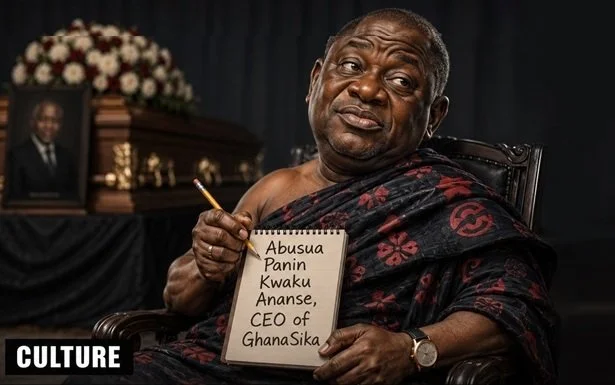
In many parts of Ghana, a funeral is not simply a burial. It is a major social event. Families spend months preparing. Hundreds or even thousands of people attend. There is food, music, transportation, clothing, decorations, photography, printing, and numerous other expenses. Beyond these costs, there is another uniquely important feature of Ghanaian funerals: cash donations, often known as sika nsa or nsawa.
The expectation is clear. The more prominent, wealthy, or successful a person is perceived to be, the larger the donation they are expected to give. For many Ghanaians, this system reflects generosity, solidarity, and respect. Yet an uncomfortable question deserves attention:
Has funeral spending become so large that it is beginning to undermine investment, business growth, and job creation?
The Case for Funerals
Before criticizing funeral spending, it is important to understand why funerals matter. Funerals bring families together. They strengthen community ties. They provide emotional support during periods of grief. They also generate significant economic activity.
Tailors make funeral cloth. Caterers prepare food. Musicians perform. Decorators, photographers, printers, transport operators, and event organizers all benefit and for many small businesses, funeral seasons provide an important source of income.
Funerals are also one of the ways Ghanaians demonstrate respect for the dead and maintain connections between generations so these benefits should not be dismissed.
The Hidden Economic Cost
Yet every cedi spent has an alternative use and the Sikanomist's question is simple:
What could the money have done if it had been invested elsewhere?
Consider a business owner who contributes thousands of cedis annually to funeral donations. That same money could have been used to:
Purchase new equipment.
Expand inventory.
Hire additional workers.
Invest in technology.
Save for future opportunities.
When multiplied across thousands of businesses and professionals, the numbers become significant.
The issue is not a single funeral but the issue is the cumulative effect of dozens of funerals, weddings, outdooring ceremonies, anniversaries, and social obligations over many years.
For many middle-class Ghanaians and entrepreneurs, these obligations quietly consume resources that might otherwise be invested in productive activities.
The Pressure of Status
One of the most challenging aspects of the current system is social expectation. A wealthy businessperson is expected to give more. A politician is expected to give more. A chief executive is expected to give more. A successful professional is expected to give more.
Often the donation is publicly announced or recorded, creating additional pressure. Many people contribute not because they can comfortably afford it but because they fear being seen as disrespectful, stingy, or unsupportive.
This transforms what begins as generosity into a form of social obligation.
A Competitive Disadvantage?
Imagine two entrepreneurs. One operates in Ghana and the other operates in a country where social obligations require far less spending on funerals and similar ceremonies. Over twenty years, the Ghanaian entrepreneur may spend tens of thousands of cedis on funeral-related obligations.
The other entrepreneur invests those resources back into the business. The difference may seem small each year, but over decades it can become substantial.
Capital that could have financed growth is instead consumed by recurring social expenditure. This is one reason why some economists argue that excessive ceremonial spending can reduce national investment and slow job creation.
Culture Must Evolve
The solution is not to abolish funerals nor is it to abandon Ghanaian traditions. Culture is valuable. Community is valuable. Respect for the dead is valuable.
The challenge is finding ways to preserve these values while reducing unnecessary costs. Perhaps future funerals could be:
Shorter and simpler.
More focused on family and community than public display.
Less dependent on expensive status competition.
Less demanding of large cash donations.
More respectful of the financial realities facing families.
A dignified funeral does not necessarily require extravagant spending.
Indeed, some of the most meaningful funerals are remembered not for their cost but for the love, respect, and gratitude shown to the deceased.
The Bigger Question
Ghana's future prosperity will depend on how much of its resources are invested in productive activities. Every society must balance consumption with investment and the question is not whether funerals are important or not because they are.
The question is whether the current scale of funeral spending still serves Ghana's long-term interests. If preserving culture today comes at the cost of limiting investment, entrepreneurship, and job creation tomorrow, then reform becomes not an attack on tradition but an investment in the next generation and as Ghana seeks faster economic growth, perhaps the time has come to ask a difficult but necessary question:
Can we honour our dead with dignity while freeing more resources to build the future for the living?