The Asantehene at Howard: Diaspora Pride Must Build Lasting Institutions
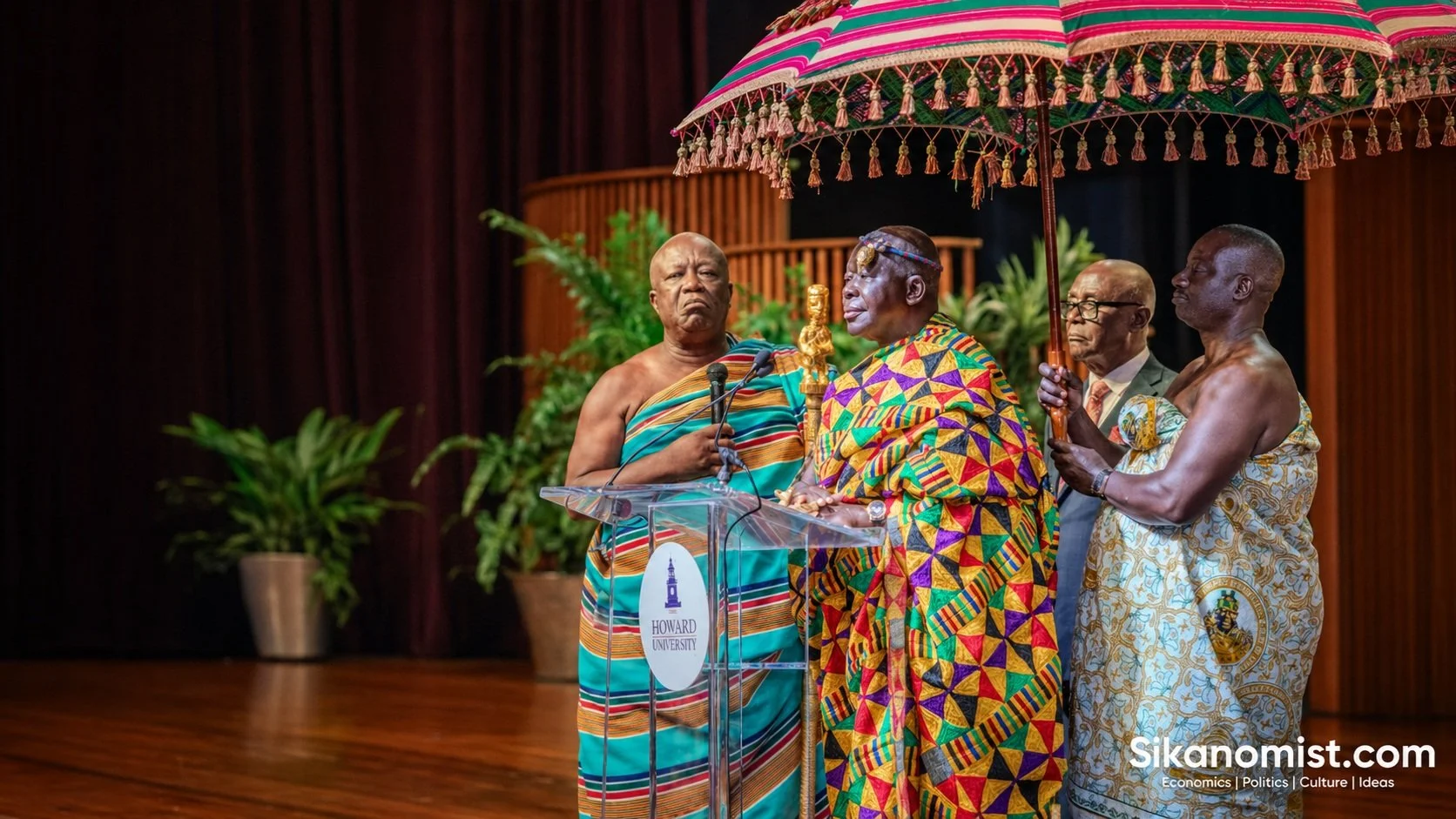
Otumfuo Osei Tutu II addressing Howard University in Washington DC
When Otumfuo Osei Tutu II addressed Howard University in Washington, D.C., on 25 August 2026, the occasion represented more than a royal visit. It brought one of Africa’s most respected traditional leaders to one of the United States’ most important centres of Black scholarship.
Howard was an appropriate setting for a discussion about Africa and its global diaspora. Founded in 1867, the historically Black university has educated generations of African-American leaders and maintained deep intellectual connections with the African continent.
Howard said the lecture would explore governance, cultural preservation, traditional leadership and Ghana’s enduring relationship with the diaspora. In the address itself, the Asantehene moved beyond general expressions of kinship. He proposed a Howard–Manhyia Dialogue and encouraged structured cooperation among Howard, Ghanaian universities and traditional institutions through research, educational exchanges and professional partnerships. Howard University, Opemsuo
Culture is part of development
One of the address’s strongest ideas was that culture must not be treated merely as entertainment. It is more than ceremonial clothing, festivals and royal pageantry. It includes language, historical memory, moral values, family organisation, customary law and knowledge about resolving conflict. Opemsuo
These things matter to development. A society that loses confidence in its language and memory may also lose confidence in its ability to produce original solutions. Ghana can embrace science, technology and international cooperation without treating its inheritance as an obstacle to modernity.
Cultural confidence, however, cannot become an excuse for resisting reform. Traditions that promote dignity, responsibility and social cohesion deserve protection. Practices that deny people justice or opportunity must be questioned. A living culture develops without surrendering its foundations.
Homecoming must build institutions
Ghana has successfully encouraged people of African descent to visit, reconnect and, in some cases, acquire citizenship. The Year of Return strengthened the country’s position as an important cultural home for the global African family.
But homecoming creates emotion. Institutions turn that emotion into lasting value.
Diaspora engagement cannot remain a collection of ceremonies, emotional speeches and holiday visits; it must build institutions that outlast the applause. Ghanaian universities should pursue serious partnerships with Howard and other historically Black institutions. These could support student and faculty exchanges, joint research, scholarships, digital heritage projects and collaboration in medicine, engineering, agriculture and technology.
Diaspora professionals should also be able to contribute without permanently relocating. Funded, time-limited placements could connect experienced doctors, lecturers, engineers and technology specialists with Ghanaian institutions while ensuring that they work alongside—and do not displace—local professionals.
The diaspora is not one uniform community. Recent Ghanaian migrants, their children and African Americans have different histories, expectations and relationships with Ghana. Programmes must therefore be designed with them, not merely announced on their behalf.
Ghana must become dependable
Ghana cannot invite diaspora participation while maintaining systems that frustrate it. Investors frequently encounter uncertain land ownership, bureaucracy, weak contract enforcement and unreliable intermediaries. Professionals willing to serve may struggle to identify credible institutions through which to contribute.
Government agencies, universities, traditional authorities and businesses must create transparent partnership channels, publish clear requirements and report measurable results. The diaspora should be welcomed as partners—not treated as visiting wallets or ceremonial decorations.
Diaspora communities must also approach Ghana with humility. They should not arrive as rescuers who believe they possess every answer. Productive cooperation requires respect for local knowledge, honest listening and shared responsibility.
The Asantehene can convene, inspire and open doors, but institutions must carry the work forward. The proposed Howard–Manhyia Dialogue offers a practical starting point if it receives clear leadership, defined objectives and public reporting.
The success of the Howard visit will be measured by what Africa and its diaspora build together afterwards. Scholarships, research partnerships, professional exchanges and trusted investment channels would be a worthy return on the goodwill renewed in Washington.
Practical recommendations
Establish the Howard–Manhyia Dialogue within 12 months, with named leaders, funding and measurable objectives.
Launch pilot exchanges between Howard and selected Ghanaian universities.
Create funded diaspora professional placements in healthcare, education, engineering and technology.
Establish a transparent diaspora investment desk providing due diligence, land guidance and dispute resolution.
Publish an annual Ghana–diaspora partnership scorecard covering scholarships, research, investment, jobs and beneficiaries.

Reader’s question
What lasting institution should Ghana and its global diaspora build first following the Asantehene’s Howard University address?