Dolly Parton Is Gone, but Her Kindness Remains—Ghanaian Stars Should Study Her Legacy
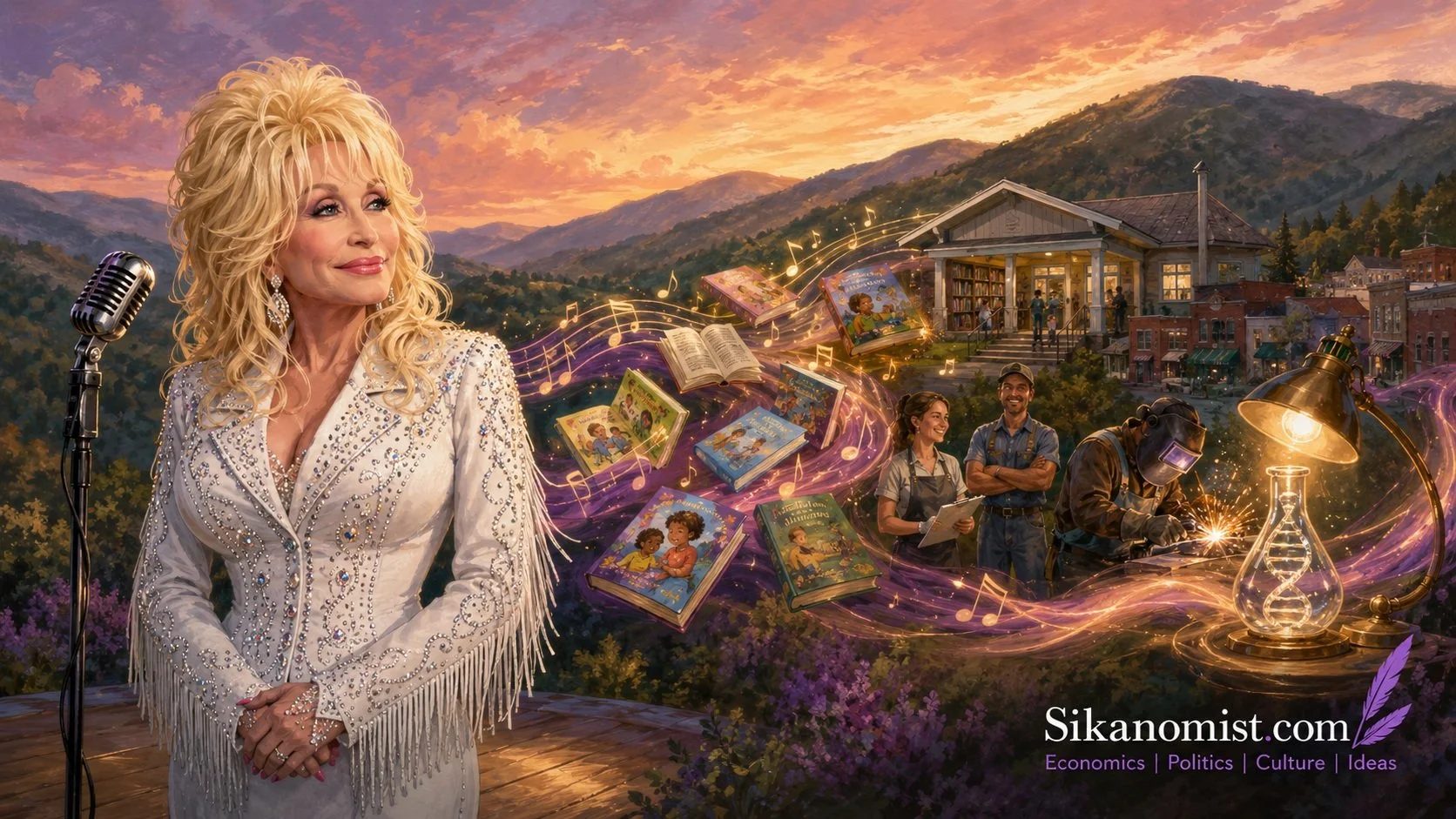
Dolly Parton
Dolly Parton rose from rural poverty to become one of the world’s most celebrated entertainers. Yet her most enduring achievement may be the way she turned music, ownership and fame into books for children, employment, scientific research and lasting public service. Ghanaian stars should study the institutions behind her generosity.
Dolly Parton understood something about fame that many famous people never learn.
Attention is temporary. Popular taste changes. Applause ends. But kindness, when built into a dependable institution, can continue working long after the celebrity has left the stage.
Parton, the American country music singer, songwriter, actor, businesswoman and philanthropist, died peacefully in Nashville on 25 August 2026. She was 80.
Her official organisation confirmed her death but did not disclose its cause. People later reported through her representatives that she had faced a brief battle with cancer.
Her family requested a private service and encouraged people wishing to honour her to support Dolly Parton’s Imagination Library—the literacy programme she established to give books to children. Official Dolly Parton website, Reuters
That request captured the life she chose to live.
Her family did not ask the world merely to buy another recording or gather around another statue. They directed public affection towards an institution serving children.
Parton gave the world memorable music, sparkling costumes, humour and a personality large enough to fill any stage. Yet behind the rhinestones was a disciplined songwriter, careful businesswoman and generous builder of institutions.
Ghanaian musicians, actors, footballers, media personalities and other public figures should study that combination.
She demonstrated that celebrity can become more than admiration. It can become literacy, employment, research, local development and an inheritance that continues helping people after the famous person is no longer present.
Fame attracts attention, but an institution can continue doing good after the applause has ended.
From poverty to possibility
Dolly Rebecca Parton was born in Tennessee in 1946, one of 12 children in a poor family living in the Appalachian Mountains.
Her childhood was materially difficult but culturally rich. Her family possessed little money, yet music, faith, storytelling and strong family relationships filled the home.
Parton later transformed those experiences into songs.
Coat of Many Colors recalled a coat her mother made from scraps of cloth and the ridicule she faced when she wore it to school. The song did not conceal poverty, but neither did it allow poverty to define the family as worthless.
The coat had little financial value. Its meaning came from the love with which it had been made.
That ability—to take an ordinary experience and reveal its deeper human significance—became one of Parton’s greatest strengths as a songwriter.
Her stories were rooted in a particular place, but the emotions travelled easily: love, jealousy, ambition, humiliation, separation, loyalty and hope.
Ghanaians should recognise something familiar in this.
Our strongest highlife, gospel, hiplife and traditional songs also take local language and experience and make them emotionally universal. A song does not need to abandon its home before it can speak to the world.
Parton did not become international by pretending that rural Tennessee had never shaped her. She took her accent, memories, faith and mountain stories onto the global stage.
Her roots were not an obstacle to international success. They were part of what made her distinctive.
She wrote what the world remembered
Some performers are remembered mainly for their voices. Dolly Parton understood that the song itself was an asset.
She wrote approximately 3,000 songs during her career, including Jolene, 9 to 5, Coat of Many Colors and I Will Always Love You.
Many Ghanaians may know I Will Always Love You principally through Whitney Houston’s extraordinary recording for The Bodyguard. But Parton wrote the song and first turned it into a country hit in 1974. Library of Congress
Houston’s performance carried it to another generation and a much larger international audience. Beneath both versions, however, remained Parton’s composition.
That distinction matters.
Parton understood that creative work could provide both immediate success and long-term economic value. She treated authorship and ownership as seriously as public performance.
This offers an important lesson for Ghanaian musicians.
An artist may become famous while remaining uncertain about who owns the master recording, publishing rights or royalty income. Excitement about releasing music can lead young performers to sign contracts they do not fully understand.
Some discover years later that the song made them famous but belongs almost entirely to somebody else.
Artists should not refuse every partnership. Record companies, producers, publishers and investors can help creative work reach larger audiences.
The lesson is that creators must understand the value they are negotiating.
They need trustworthy legal advice, proper documentation and knowledge of performance, publishing and licensing rights. A successful song should become part of the artist’s long-term economic foundation—not merely a brief source of public attention.
She made an image without becoming imprisoned by it
Parton’s appearance was impossible to ignore.
Her towering blonde hair, bright costumes, high heels and rhinestones made her instantly recognisable. She exaggerated glamour so confidently that she controlled the joke before anyone else could use it against her.
But appearance was never the whole business.
Behind the public image was a writer who understood emotion, a performer who understood audiences and an entrepreneur who understood ownership.
This combination allowed her to remain visible without being reduced to appearance alone.
Ghanaian celebrities can learn from that discipline.
A distinctive image can help an artist become recognisable. Fashion, humour, language and presentation can all become valuable parts of a public identity.
But image without substance fades quickly.
The clothing must eventually lead to music worth hearing. Social-media visibility must lead to work worth remembering. Public popularity should be connected to a structure capable of preserving and expanding its value.
Parton understood that the costume might attract attention, but the songwriting had to justify it.
She turned memory into institutions
Parton did not simply speak proudly about her home region. She attached her international success to work that benefited the place that had shaped her.
In 1986, she became a partner in an existing Tennessee attraction that was relaunched as Dollywood. The enterprise helped expand tourism and employment in the region rather than allowing her hometown to remain only a sentimental reference in interviews.
The more remarkable institution, however, was created from a deeply personal memory.
Parton’s father could not read or write. In 1995, she responded by establishing the Imagination Library in her home county.
The idea was simple: send participating children a carefully selected book every month from birth until the age of five, without charging their families.
What began in one community expanded across the United States and into Canada, Britain, Australia and Ireland. According to the programme, it was sending more than three million free books each month by 2026. Dolly Parton’s Imagination Library
This was not a one-day presentation designed around cameras.
It became an organised system involving the Dollywood Foundation and local partners. Children receive age-appropriate books addressed directly to them, allowing reading to become a regular part of family life.
The distinction is important.
One ceremonial presentation may produce attractive photographs. A functioning programme creates repeated benefits.
The Imagination Library also recognised something fundamental about inequality. A child’s intellectual development begins before formal schooling. Homes filled with books and adults who read to children offer opportunities that poorer families may struggle to provide.
Parton did not attempt to write every book, finance every delivery personally or administer every local branch herself. She built a model through which communities and institutions could work together.
Ghana needs more of this thinking.
Many Ghanaian children live in homes with few age-appropriate books. Some school and public libraries remain understocked or inaccessible.
Ghanaian public figures could help establish local book-gifting programmes in partnership with publishers, schools, libraries, district assemblies and delivery services.
Books could be selected in English and Ghanaian languages. Parents could receive guidance on reading with children. Ghanaian writers and illustrators could gain new markets for their work.
The celebrity would provide visibility or resources. Professional institutions would supply selection, continuity and accountability.
A famous name could become a door through which thousands of children enter reading.
Generosity that trusted expertise
Parton’s philanthropy extended beyond literacy.
In 2020, she donated $1 million to Vanderbilt University Medical Center to support COVID-19 research. Her contribution helped fund research associated with early work on Moderna’s COVID-19 vaccine. Vanderbilt University Medical Center
She made another $1 million contribution to paediatric infectious-disease research at Vanderbilt in 2022. Vanderbilt University Medical Center
Parton was not a medical scientist. She did not pretend to be one.
She placed resources behind people with the knowledge to conduct the work.
That offers another lesson for Ghanaian philanthropy.
Public figures do not need to become experts in every problem they wish to address. They can identify credible institutions, support qualified professionals and require transparent reporting.
The celebrity’s contribution may be money, access, public trust, time, mentorship or the ability to bring other supporters together.
This form of generosity may be quieter than arriving with cameras to distribute cash, but it can produce deeper results.
Kindness must become dependable
Ghanaians are generous people.
We contribute at funerals, support relatives, pay school fees for children outside our households and respond when neighbours face emergencies.
Ghanaian musicians, athletes, actors and businesspeople are already supporting schools, hospitals, sports programmes and struggling families. Their contributions deserve recognition.
A person facing an immediate crisis cannot eat an institution. Direct help continues to matter.
But occasional generosity and organised public service are not the same thing.
A donation responds to today’s need. A dependable institution prepares to respond tomorrow as well.
An artist may pay one fan’s medical bill. A well-governed health fund can assist patients for years.
A footballer may give boots to a youth team. A properly managed academy can train generations.
A musician may distribute exercise books. A literacy programme can work continuously with schools, publishers and libraries.
Ghanaian public figures do not all need to establish new foundations bearing their names. Some may create well-governed institutions; others can provide sustained support to credible organisations already doing effective work.
The important question is not whose photograph appears on the project, but whether the work continues and produces measurable benefits.
Charity becomes legacy when kindness is given a structure capable of surviving the giver.
Public service must be properly governed
A famous name can attract donors and public attention, but it cannot replace proper administration.
Charitable organisations require competent boards, professional staff, transparent procurement, audited accounts and published results.
Good intentions do not remove the need for accountability. An organisation operating in the language of compassion owes the public particular care.
Celebrity philanthropy should also complement rather than replace the state.
Government remains responsible for adequately funded schools, hospitals, libraries, sports facilities and cultural institutions. Successful private citizens should not be expected to carry the cost of public services merely because they possess influence.
Their contribution is voluntary and may take different forms.
One person may give money. Another may mentor young people, advocate for a neglected cause or connect an institution to new supporters. Some people may prefer to give privately, and the absence of publicity should not be treated as proof that they do nothing.
The principle to learn from Parton is not that every famous Ghanaian must reproduce her foundation.
It is that public influence can be used thoughtfully, proportionately and consistently.
Ghanaian stars can build more together
No individual celebrity can create every institution Ghana needs.
Collaboration can achieve what one personality cannot sustain alone.
Musicians could jointly support a national music archive or a rights-education programme for emerging artists. Footballers could establish a transparent education and welfare fund for young and retired players. Actors and producers could create a permanent film-training institute. Media personalities could support reading programmes across several districts.
Working together would spread costs, reduce dependence on one celebrity and allow an initiative to continue when individual careers change.
Public figures can also join existing organisations rather than creating competing foundations for similar purposes.
An established library, scholarship programme or medical charity may benefit more from sustained support than the country would gain from another organisation built mainly around a personal brand.
The true test should be whether beneficiaries still receive useful support after the launch ceremony and publicity have ended.
A legacy needs preparation
Ghana often waits until a celebrated person dies before discussing legacy.
Tributes become generous. Politicians issue statements. Media stations replay old performances. Friends reveal private acts of kindness that received little attention during the person’s lifetime.
Then the funeral ends and public memory begins to fade.
A stronger culture would encourage public figures to prepare their legacies while they are alive.
Artists need wills, organised copyright ownership, preserved archives and credible succession plans.
Musicians should preserve recordings, compositions, photographs, costumes, contracts and interviews. Actors should protect films, scripts and production records. Athletes should document their careers and create routes through which their knowledge reaches younger players.
Ghana also needs archives and cultural institutions capable of receiving and preserving these materials.
A musician’s death should not immediately become a family dispute over masters, royalties and unpublished recordings.
Legacy requires preparation.
Parton spent decades building structures through which her name would continue working. Her death therefore leaves grief, but it does not leave only emptiness.
The songs remain. The businesses remain. The foundation remains. The books continue arriving.
Kindness became part of her power
Parton was admired across divisions of age, class and political identity.
This did not mean everybody agreed with every choice she made. It meant she developed a public personality grounded in humour, warmth and an apparent refusal to treat ordinary people with contempt.
Her friendliness did not appear to depend on whether somebody was powerful.
That quality matters in societies where fame can quickly create distance.
Some public figures become successful and begin treating supporters, workers and journalists as irritations. They demand special treatment while forgetting that public affection helped build their careers.
Parton showed that a celebrity could be commercially intelligent without appearing cold, glamorous without appearing inaccessible and confident without appearing cruel.
Kindness did not make her less powerful. It became part of her power.
Ghanaian stars do not need to copy her clothing, personality or public style. Authenticity cannot be produced through imitation.
But they can learn the importance of treating people with dignity.
Fans are not merely numbers beneath a social-media account. Workers are not disposable. Young artists are not threats merely because they may one day become successful.
The way a public figure treats people becomes part of the work remembered after the final performance.
The kindness remains
Parton’s life can be counted in songs, awards, films, businesses and money.
But those measurements do not fully explain the affection that followed her death.
People sensed that success had not made her ashamed of where she came from or indifferent to those still struggling there.
The poor child from Tennessee became a global star, then used that fame to support literacy, employment, disaster relief and scientific research.
She did not merely escape poverty. She widened the path for others.
Ghanaian public figures should study this legacy without merely copying its form.
A musician may support music education. A footballer may strengthen youth development. An actor may help preserve Ghanaian film. A business leader may finance scholarships, libraries or local enterprise.
Some may build new institutions. Others may make existing ones stronger.
What matters is that generosity becomes dependable, professionally managed and capable of continuing when the cameras leave.
Dolly Parton has given her final performance, but children will continue opening books because she once decided that fame should become service.
That may be the most beautiful song she ever gave the world.
Practical recommendations
Protect creative ownership. Artists should understand publishing, master recordings, licensing, royalties and contracts before signing agreements.
Choose causes with personal meaning. Public figures can support problems they understand and remain committed beyond one publicity event.
Start at a realistic scale. A dependable programme serving one community well may create more value than a national foundation that cannot continue.
Work through credible partners. Celebrities can contribute visibility and resources while educators, health professionals and established organisations provide expertise.
Turn repeated giving into continuity. Where appropriate, recurring donations can become scholarships, book programmes, training schemes or transparent community funds.
Build accountable institutions. Foundations require competent boards, professional management, published objectives, audited accounts and measurable results.
Collaborate across professions. Musicians, athletes, actors and businesses can pool resources for literacy, training, archives and welfare programmes.
Preserve Ghana’s creative heritage. Artists should organise recordings, manuscripts, photographs, costumes and contracts for future archives and scholarship.
Plan succession early. Wills, rights administration and institutional succession can protect families and prevent creative catalogues from falling into dispute.
Respect different forms of service. Giving may involve money, mentorship, advocacy, time or professional knowledge. Public visibility is not the only proof of generosity.
Keep the state responsible. Celebrity philanthropy should complement—not replace—properly funded public education, healthcare, libraries and cultural institutions.
Measure what continues. The true test is whether people still receive useful support after the launch ceremony and publicity have ended.
Reader’s question
How can Ghanaian musicians, athletes, actors and business leaders turn personal success into lasting institutions that create opportunities for future generations?