Dangote’s IPO Could Open a New Age of African Industrial Ownership
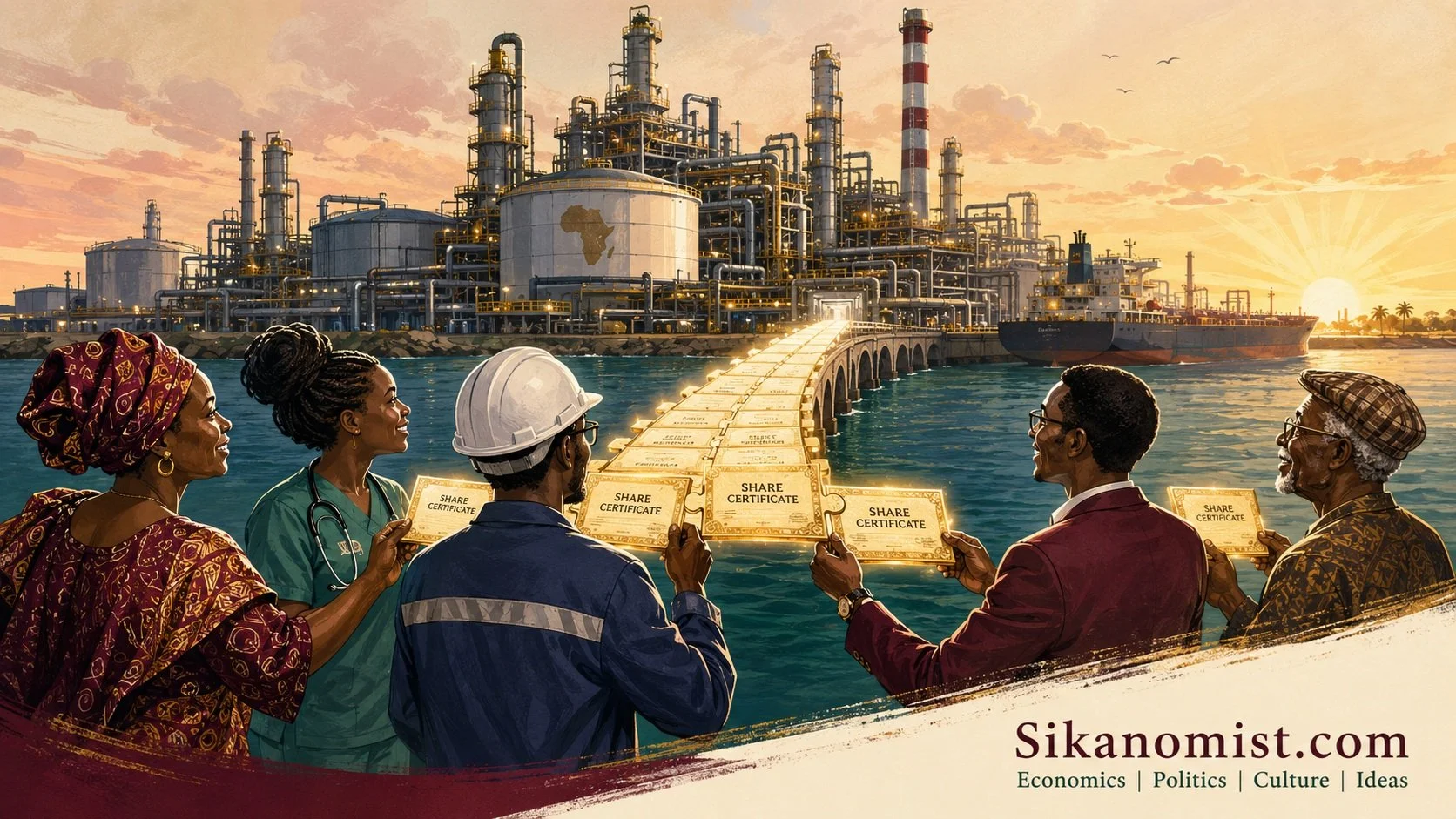
Dangote Group has demonstrated that African enterprise can build industry on a global scale. Its proposed refinery listing could now allow ordinary Africans and continental institutions to share in that achievement—and prove that African savings can finance Africa’s industrial future.
For decades, Africa has supplied the world with crude oil, minerals, cocoa and other raw materials, only to import many of the finished products made from them.
The continent exports crude oil and imports petrol. It exports bauxite and imports aluminium products. It exports cocoa and imports expensive chocolate. It produces cotton but imports clothing. In almost every case, Africa receives the smaller reward from supplying the raw material while businesses elsewhere earn the greater value from processing, financing, branding and distributing the finished product.
The Dangote Petroleum Refinery represents a determined attempt to change that pattern.
Built in Lagos, Nigeria, the refinery has shown that a large African private enterprise can mobilise enormous capital, overcome considerable difficulties and construct an industrial facility of international importance. Its growing output is already reducing Nigeria’s reliance on imported petroleum products and increasing the supply of fuel produced on African soil.
Now Dangote Group is reportedly preparing to invite the public to participate in that achievement.
The proposed initial public offering, or IPO, could raise approximately $5 billion, although the final size and terms will depend on regulatory approval and the prospectus. An October listing has reportedly been considered, with the offering expected to focus strongly on retail investors.
Aliko Dangote has described the planned listing as a “people’s IPO”—an opportunity for ordinary Nigerians to acquire a stake in one of the continent’s most important industrial assets. Discussions have also taken place among African stock-exchange leaders about how investors elsewhere on the continent might gain access. Reuters
This is more than a Nigerian financial event.
If properly executed, the IPO could become a landmark in African industrial ownership. It could demonstrate that Africans are not only capable of building world-class industries but can also mobilise their collective savings to own, finance and expand them.
Dangote has shown that Africans can build industries of global scale. The IPO can now show that Africans can also own them together.
From importing fuel to exporting it
The strongest argument for supporting the IPO is not sentiment. It is what the refinery has already begun to accomplish.
According to the United States Energy Information Administration, Nigeria’s seaborne petroleum-product shipments averaged 561,000 barrels per day during the second quarter of 2026. This compares with an annual average of only 79,000 barrels per day in 2023, before the Dangote refinery began operating.
Nigeria’s seaborne imports of petroleum products, which stood at almost 400,000 barrels per day in 2023, fell below 130,000 barrels per day during the second quarter of 2026. Exports to other African countries reached nearly 120,000 barrels per day. US Energy Information Administration
These figures represent an important shift.
Nigeria, one of the world’s major crude-producing countries, spent many years depending heavily on imported refined fuel. It exported its crude, paid foreign refineries to process it and then used scarce foreign exchange to buy petroleum products from abroad.
The refinery is helping to reverse that arrangement.
Instead of exporting all the opportunity contained in Nigerian crude, the country can retain more refining activity at home. That means greater industrial capability, new technical knowledge, more regional exports and the possibility of building supporting businesses in transport, petrochemicals, storage, packaging and manufacturing.
The lesson is larger than petroleum.
African development requires more enterprises that process African resources within Africa. Economic independence will not be achieved merely by owning natural resources underground. It will come from acquiring the technology, capital, institutions and businesses required to transform those resources into useful products.
Dangote Group has moved beyond discussing this ambition. It has built an asset that is helping to change the direction of regional petroleum trade.
The importance of public ownership
A privately owned industrial champion can create employment, supply goods and strengthen an economy. But a publicly listed company can do something additional: it can allow many people to participate in the wealth created by that enterprise.
The proposed IPO could open ownership to Nigerian households, pension funds, investment institutions and, eventually, investors across Africa.
That distinction matters.
Ordinary Africans frequently participate in major companies only as customers. They buy cement, fuel, telecommunications services, food and consumer goods, but rarely own meaningful stakes in the companies earning income from their purchases.
Public capital markets can help change this relationship.
When well governed, stock exchanges give citizens an opportunity to move from consumption into ownership. A teacher, nurse, trader, engineer or small business owner may not have enough money to construct a refinery, but can invest a modest amount in shares of an industrial company.
Millions of modest investments can become a powerful source of long-term capital.
This is how a people’s IPO should be understood. It is not simply the sale of shares. It is an invitation for African savings to enter African industry.
The opportunity is especially important because much of Africa’s household and institutional wealth is either held in short-term instruments, placed in government debt, kept outside the formal financial system or invested in assets that do not create new productive capacity.
Government bonds have an important role, but a continent cannot build its industrial future by lending nearly all its long-term savings to governments for recurrent expenditure. A greater share of African capital must reach factories, farms, refineries, power systems, transport networks and technology businesses.
The Dangote IPO could help demonstrate how this transition can begin.
An IPO for expansion, not an exit
The reported purpose of the offering makes the proposal even more significant.
Dangote Group plans to expand the refinery’s capacity substantially, with an ambition of reaching approximately 1.4 million barrels per day. If achieved, this could strengthen the facility’s position as one of the world’s largest refining complexes and increase Africa’s ability to meet more of its own petroleum-product demand.
The proposed listing should therefore be seen principally as a platform for expansion rather than the end of an industrial journey.
Africa’s need for refined products remains enormous. Population growth, urbanisation, construction, transport, aviation, agriculture and manufacturing will continue to create demand for energy, even as countries gradually adopt cleaner technologies.
A larger refinery could supply more petrol, diesel, aviation fuel and petrochemical feedstocks to African markets. It could also support industries producing plastics, fertiliser inputs, packaging, textiles and other manufactured goods.
The greater opportunity lies in building an industrial ecosystem around the refinery rather than treating it as an isolated facility.
Nigeria and neighbouring countries should encourage businesses that use the refinery’s output as an input. Industrial parks, logistics systems, storage terminals, chemical plants and manufacturing companies could multiply its economic effect.
A refinery creates its deepest value when other productive businesses begin to grow around it.
African capital for African industry
The proposed listing could also strengthen Africa’s financial architecture.
Too many African companies believe that major expansion requires capital from London, New York, Dubai or other financial centres outside the continent. International investment remains valuable, but Africa must also learn to mobilise its own substantial savings.
The continent has pension funds, insurance companies, banks, sovereign institutions, investment funds, wealthy individuals and millions of ordinary savers. Much of this capital remains fragmented within national borders.
A successful Dangote listing could encourage greater cooperation among African stock exchanges, regulators, brokers and settlement systems.
Representatives of exchanges from Ghana, Nigeria and other African markets have already discussed possible mechanisms for broadening access to the offering. An immediate foreign listing has not been confirmed, but future cross-listing, depositary receipts or other approved investment instruments could allow wider participation. Nigerian Exchange Group
This cooperation should be encouraged.
The African Continental Free Trade Area will not reach its full potential if goods can cross borders more easily while investment capital remains trapped within small national markets.
A business in Nigeria should be able to raise funds from investors in Ghana, Kenya, South Africa and Côte d’Ivoire. A successful Ghanaian manufacturer should likewise be capable of attracting Nigerian and other African shareholders.
This would create a continental marketplace in which African savings follow the strongest African opportunities.
Africa’s integration will be incomplete if its goods can cross borders but its investment capital cannot.
What Ghana stands to gain
Ghana should pay close attention to the Dangote IPO.
The first reason is energy security.
A productive refinery in West Africa could shorten supply routes and diversify the sources from which Ghana obtains refined petroleum products. Regional supply cannot guarantee lower prices on its own; crude prices, taxes, exchange rates, transport costs and market competition will still matter. Nevertheless, a strong supplier within the sub-region can improve resilience when distant supply chains are disrupted.
The second opportunity is investment.
If an approved structure eventually gives Ghanaian investors access to the shares, individuals and institutions may be able to obtain exposure to an important West African industrial asset.
Participation should occur through authorised channels and after investors have read the approved prospectus. Supporting African industry does not mean investing blindly. It means studying the business carefully and making informed decisions with a long-term perspective.
The third and greater opportunity is education.
Ghana must learn from Dangote Group’s willingness to build at scale.
Ghana has entrepreneurs, pension savings, banks, natural resources, universities and an established capital market. Yet many promising Ghanaian businesses remain small, undercapitalised and unable to expand beyond one or two locations.
The country needs a deliberate system for helping serious domestic enterprises move from small businesses into medium-sized companies, from medium-sized companies into national champions and from national champions into continental enterprises.
This requires patient finance, credible management, functioning infrastructure, export support and policies that remain stable beyond one political term.
The Ghana Stock Exchange must also become a more active source of productive capital. Listings should not be reserved mainly for established banks, telecommunications companies and a limited number of large institutions. Ghana needs more manufacturers, agricultural processors, transport companies, housing businesses, retailers and technology enterprises capable of raising money from the public.
A successful Dangote IPO should inspire Ghanaian entrepreneurs to think beyond borrowing from banks. It should also encourage citizens to see the stock exchange as a place where national industries can be financed and collectively owned.
Ghana should not be content merely to import Nigerian fuel and purchase Nigerian shares. It must build enterprises that Nigerians and other Africans will also be eager to own.
Excellence creates a greater opportunity
Dangote Group has built its reputation through large investments in cement, food production, logistics and other essential industries. Its willingness to enter difficult sectors and commit capital for the long term has made it one of Africa’s most consequential industrial groups.
The refinery extends this history of ambition.
Its journey has not been easy. A project of such scale must navigate financing, construction, regulation, crude supply, technical operations and changing international markets. Bringing the facility into production represents an achievement that should be recognised across Africa.
Success, however, creates a new responsibility.
When a family-owned or privately controlled business invites ordinary people to become shareholders, it enters a deeper relationship with the public. Investors must receive clear information about the company’s finances, expansion programme, ownership structure, use of proceeds, dividend policy and material risks.
This is not a sign of distrust. It is how a good company builds confidence and attracts committed long-term shareholders.
The approved prospectus will provide investors with the information needed to understand the opportunity. Regulators must ensure that the official documents are accessible, and financial institutions should help ordinary investors understand them in straightforward language.
That will protect both the public and the reputation of the offering.
Dangote Group’s record provides a strong foundation for confidence. Transparent information can strengthen that confidence further.
A people’s IPO must reach the people
If this is to become a genuine people’s IPO, access will matter as much as the amount raised.
The process should not be designed only for wealthy investors and large institutions. Ordinary Nigerians should be able to apply through secure, simple and affordable channels.
There must be clear information about the minimum investment, application period, allocation rules, payment methods and procedures for receiving shares. Digital platforms can extend access, but banks, brokers and other authorised institutions will remain important for people who have limited digital experience.
Investor education must accompany the offering.
Many first-time investors may expect share prices to rise immediately or believe that dividends are guaranteed. They must understand that shares can increase or decrease in value, dividends depend on company performance and industrial investment is most suitable for those able to take a longer view.
The company, regulators, stock exchange and financial advisers should guard against fraudulent websites, unauthorised agents and false promises of guaranteed allocations.
A successful public offering is not measured only by the money collected on listing day. It is measured by whether investors are treated fairly, receive reliable information and remain confident owners of the business over many years.
Pension funds can help build productive Africa
The IPO may also provide African pension funds and institutional investors with an opportunity to support productive industry.
Retirement savings are naturally long-term. Refineries, power plants, factories, railways and housing developments also require long-term capital. There is therefore a reasonable economic argument for connecting part of Africa’s pension wealth with carefully selected productive assets.
This must always be done professionally.
Pension trustees and fund managers have a primary duty to contributors and retirees. They should examine the prospectus, assess expected returns, consider risks and avoid concentrating too much money in any single investment.
When these standards are respected, pension capital can support both retirement security and national development.
Africa should not force pension funds to finance prestige projects. But neither should it assume that productive African industry is unsuitable for retirement savings merely because it is African.
The correct approach is disciplined participation: invest where the business case is sound, the information is adequate and the price is reasonable.
Patriotism may draw attention to an opportunity. Professional analysis must determine the investment.
The beginning of a broader movement
The most important result of the Dangote IPO may not be the amount it raises. It may be the example it sets.
Africa needs many more businesses that begin as entrepreneurial ventures, grow into industrial champions and eventually invite the public to share in their ownership.
Successful family businesses should not have to remain permanently closed. Listing part of their ownership can provide capital for expansion, improve continuity beyond the founder, strengthen corporate systems and distribute wealth more broadly.
Governments can support this movement by improving regulation, reducing listing costs, protecting minority shareholders and offering sensible incentives to companies entering public markets.
Stock exchanges must also become easier for ordinary people to use. Investment accounts should be affordable, dividend payments reliable and company information readily available.
Schools and universities should teach basic investment and business ownership. Citizens should learn the difference between saving, lending, investing and speculating.
A country in which millions of people own productive enterprises is likely to develop a stronger culture of enterprise, accountability and long-term thinking.
A nation becomes economically stronger when its citizens are not only workers and consumers, but owners.
Ghana must build its own champions
The Dangote story should encourage Ghana, but it should also challenge it.
Ghana has produced successful entrepreneurs and respected companies. Yet the country has not developed enough enterprises with the scale to transform major industries across Africa.
Too many domestic policies focus on distributing imported goods rather than producing at home. Too many businesses remain dependent on short-term, high-interest loans. Too many potentially strong enterprises fail when the founder retires or dies because ownership, management and succession were never properly institutionalised.
Ghana needs to build the foundations from which its own industrial champions can emerge.
Long-term financing must become available for commercially sound projects in agriculture, manufacturing, housing, transport, pharmaceuticals, energy and technology. Public policy should reward companies that reinvest, export, train workers and develop local supply chains.
Ghanaian businesses must also improve bookkeeping, governance, succession planning and financial disclosure. A company cannot attract thousands of public shareholders if its finances remain mixed with the personal affairs of its founder.
The lesson from Dangote is not that every company must immediately become enormous. It is that African entrepreneurs must be permitted and encouraged to think on a scale equal to Africa’s needs.
As the proverb teaches, “Little drops of water make a mighty ocean.” Small investments from millions of Africans can help finance enterprises larger than anything most individuals could build alone.
Let Africa own its industrial future
The Dangote refinery proves that Africa does not have to remain merely a supplier of raw materials and a buyer of finished products.
The proposed IPO could take that achievement one step further.
It could give ordinary people and African institutions an opportunity to share in the ownership of a major productive asset. It could deepen Nigeria’s capital market, strengthen cross-border financial cooperation and help finance further industrial expansion.
It could also encourage other African companies to open themselves to public ownership and invite African savings into African production.
Support for the listing should therefore be confident but informed. Investors must use authorised channels, read the approved prospectus and make decisions suited to their financial circumstances. Good disclosure and responsible regulation will help the IPO fulfil its promise.
Ghana should welcome the opportunity, explore lawful ways for its investors to participate and draw the larger lesson for its own development.
The continent will not achieve economic independence by consuming what others manufacture, borrowing all its development capital abroad or leaving its greatest enterprises in the hands of only a few owners.
It must build, finance and own.
The Dangote refinery has proved that Africa can build at scale. Its IPO could prove that African capital can own and expand the industries that will shape the continent’s future.
Reader’s question
How can Ghana mobilise its savings and capital market to build industrial companies that citizens across Africa will want to own?