Ghana Must Protect the Weaver Behind the Kente
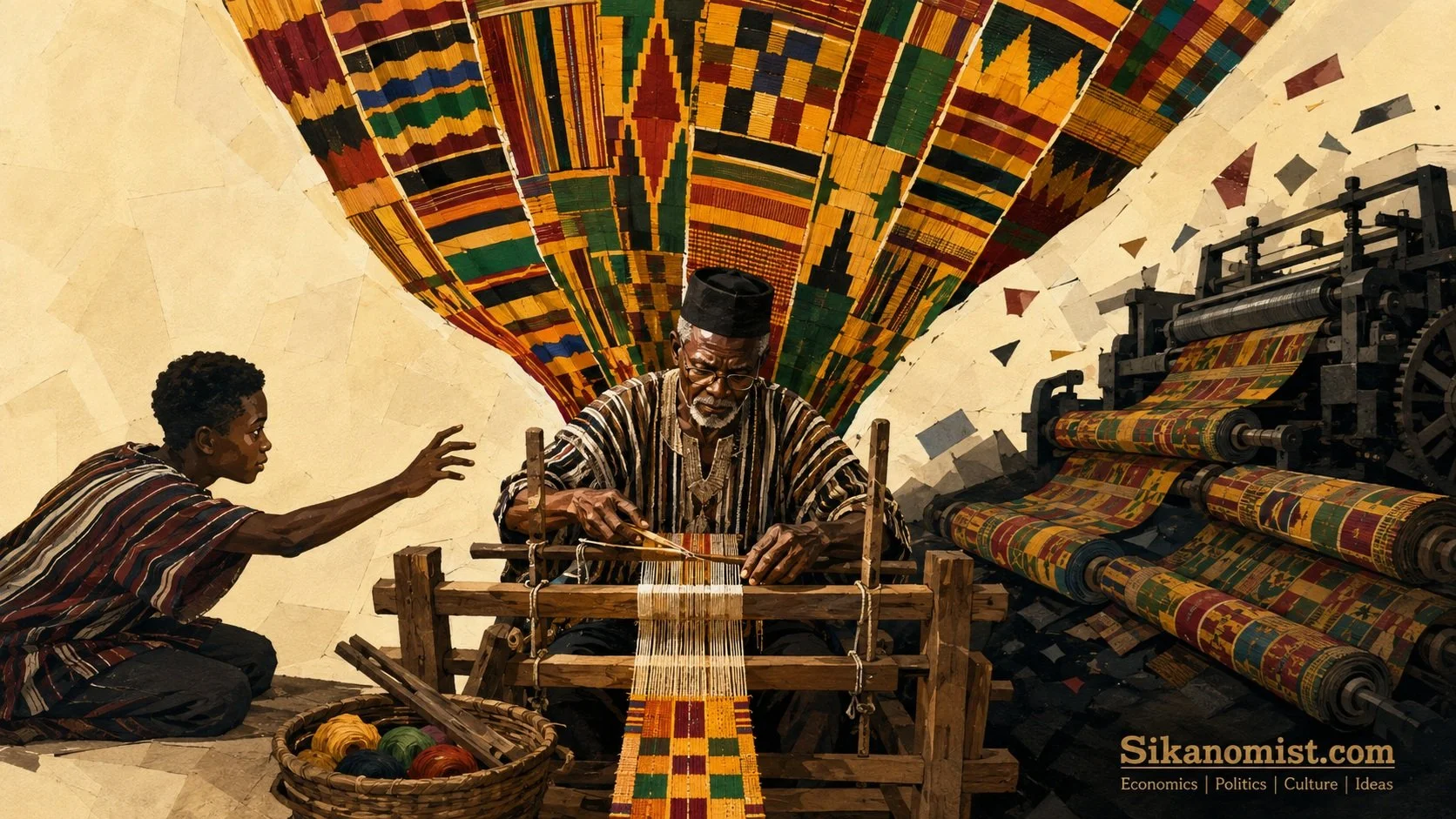
Ghana proudly presents Kente to the world as a symbol of dignity, identity and achievement. But unless the country protects the people who weave it, the cloth may flourish while the communities that created it decline.
At the 31st Agortime Kente Festival in Kpetoe, the colours were magnificent. Chiefs, public officials, artisans and visitors gathered in cloths carrying generations of history. Every pattern appeared to speak of courage, leadership, unity, prosperity and remembrance.
But behind the beauty was an uncomfortable question: who will weave Ghana’s Kente for the next generation?
The question is no longer merely cultural. It is also economic and urgent. Master weavers are growing older. The cost of yarn and other materials is rising. Young people are reluctant to spend years learning a demanding craft when other occupations appear to offer quicker and more reliable incomes. At the same time, cheap Kente-inspired fabrics are being mass-produced and sold at prices with which traditional weavers cannot compete.
Ghana celebrates the cloth, but the weaver is struggling.
This contradiction should concern the entire country. Kente is not simply a colourful material worn at festivals. It is one of Ghana’s most recognisable contributions to global culture. It appears at weddings, graduations, installations, funerals and state ceremonies. It is worn by members of the Ghanaian diaspora and presented to visiting dignitaries. Around the world, it has become a visual language of African pride.
In 2024, the craftsmanship of traditional woven Kente was inscribed on UNESCO’s Representative List of the Intangible Cultural Heritage of Humanity. That recognition was important. But international recognition cannot replace local protection.
A country cannot preserve a cultural tradition by celebrating its finished product while neglecting the people, skills and communities that make it possible.
The cloth is not the whole culture
Authentic Kente is created through knowledge passed from one generation to another. A weaver must learn how to prepare the loom, arrange the threads, combine colours, develop patterns and maintain the patience required to produce each strip. The work demands concentration, experience and creativity.
The meaning of Kente also extends beyond its physical appearance. Its patterns and colours may communicate moral lessons, historical events, social status and communal values. A person looking at a piece of Kente may see an attractive design. An experienced weaver sees a language.
This is why a factory-printed imitation cannot be considered the same as handwoven Kente. It may reproduce the appearance, but it does not carry the same labour, technique or relationship with the weaving community.
This does not mean Ghana should attempt to prohibit every affordable Kente-inspired fabric. Printed materials have helped make Ghanaian designs accessible to people who cannot afford handwoven cloth. They also have a place in fashion and everyday clothing.
The problem begins when imitation is presented as authenticity, traditional designs are copied without acknowledgement and mass-produced fabrics push genuine weavers out of the market.
Consumers should know what they are buying. A printed Kente-inspired fabric and authentic handwoven Kente should not be labelled, priced or promoted as though they were identical.
Recognition without reward
Kente has become globally valuable, but too little of that value reaches the communities that sustain it.
A design developed by a Ghanaian weaver can be photographed, copied and reproduced abroad on thousands of metres of fabric. The original creator may receive no payment, recognition or commercial benefit. In some cases, Ghanaian traders may later import and sell those imitations in the same market as locally woven cloth.
The country then finds itself buying back a weakened version of its own creativity.
At the Agortime festival, the Member of Parliament for Agortime-Ziope, Charles Agbeve, called for stronger protection for Kente designs. His concern deserves national attention. Ghana’s laws recognise expressions of folklore, but legal recognition means little if copying remains easy, enforcement is weak and traditional creators do not know how to defend their interests.
Conventional copyright is not always suited to communal traditions. Some Kente patterns have been developed and preserved collectively over generations. They may not have one identifiable designer who can register and defend them as personal property.
Ghana therefore needs a protection system designed for the realities of traditional cultural production. It should recognise both newly created designs belonging to individual weavers and historic patterns held collectively by communities.
Protection should not prevent innovation. Kente has survived precisely because weavers have continued to experiment with colours, materials and designs. The objective should be to prevent dishonest copying while allowing Ghanaian artisans and designers to build new products from their own heritage.
Make authenticity visible
Ghana should introduce a trusted certification system for authentic handwoven Kente.
Every certified cloth could carry a secure label showing where it was woven, the name of the producer or co-operative, the materials used and, where appropriate, the meaning of its design. A simple digital code could allow buyers to confirm its origin.
Such a system would not solve every problem, but it would make authenticity visible. It would help tourists, members of the diaspora, fashion houses and ordinary consumers distinguish an original woven product from a printed imitation.
Certification could also establish different categories. A premium silk cloth, an affordable cotton Kente and a Kente-inspired printed material can all serve different customers. What matters is honest labelling of each product.
Ghanaian missions abroad, tourism agencies, hotels, universities and cultural organisations could help promote the certification system. When an embassy presents Kente to a guest, or a public institution purchases cloth for a national ceremony, it should be able to show that the product came from a recognised Ghanaian weaving community.
The state must become a responsible customer of the culture it claims to promote.
Apprenticeship must become a livelihood
The ageing population of master weavers is perhaps the greatest long-term danger.
Young Ghanaians will not preserve Kente simply because elders tell them it is important. They must be able to see a respectable livelihood in it. Cultural appeals cannot compensate for poverty.
Traditional apprenticeships often require years of learning with limited earnings. For a young person facing transport costs, family responsibilities and uncertain employment, this can be difficult. Many will naturally choose work that provides a quicker income.
The proposed Youth in Kente Weaving Initiative in Agortime is therefore encouraging. But it should not become another small programme launched at a festival and forgotten when the ceremonial cloths have been folded away.
Apprentices should receive modest stipends while they train. Master weavers should be compensated for teaching them. Participants should also learn bookkeeping, digital marketing, product photography, customer service and basic intellectual-property management.
Technical universities and vocational institutions can support this work without removing it from the communities that own the tradition. Students could divide their time between formal lessons and practical training under recognised master weavers.
The loom must meet the laptop. Ghana should not force young people to choose between tradition and technology.
A new generation of weavers should be able to sell through online shops, accept international orders, document the history of their designs and communicate directly with customers in Accra, London, New York or Toronto. Digital commerce can shorten the distance between the village loom and the global market.
Finance the craft, not only the festival
Many cultural festivals attract politicians, corporate sponsors and media attention. Yet the artisans being celebrated often return to poorly equipped workshops when the visitors leave.
Ghana must direct some of its cultural spending away from temporary ceremonies and towards permanent productive capacity.
Weaving co-operatives could receive affordable financing to purchase yarn in bulk, improve their workshops and complete large orders. Common service centres could provide storage, design support, quality testing, packaging and access to reliable internet services.
These facilities should not become expensive government buildings with little activity. They must be managed with the participation of the weavers themselves and judged by practical results: apprentices trained, orders completed, incomes increased and new markets reached.
The unfinished Kente Village and Centre of Excellence at Agortime could become a valuable model if it remains focused on production. It should be a working centre where people learn, weave, conduct research, sell products and experience the culture—not simply another monument opened with speeches and later neglected.
The same principle should apply to other weaving communities, including those in the Ashanti Region and northern Ghana. Kente belongs to the richness of Ghana’s national heritage, while its different traditions remain rooted in particular communities. Supporting one centre should not require diminishing another.
Tourism must leave money at the loom
Cultural tourism is often discussed as though the presence of visitors automatically improves local lives. It does not.
A tourist may visit a weaving community, take photographs, buy food along the way and return to an Accra hotel without purchasing anything from a local weaver. The country may record another visitor, but the artisan may receive no benefit.
Successful Kente tourism must be designed around the local economy. Visitors should be able to watch weaving demonstrations, learn about the meanings of different patterns, try the loom, order customised cloths and buy certified products directly from producers.
Local guides, food vendors, transport operators, photographers and accommodation providers should also benefit. Better roads to weaving communities matter, but roads alone do not constitute a cultural development strategy. What matters is the economic activity that becomes possible at the end of the road.
Ghana’s diaspora can play a particularly important role. Many Ghanaians abroad already wear Kente at weddings, graduations and cultural celebrations. They should be encouraged to buy authentic products directly from recognised weavers rather than purchasing unverified imitations overseas.
The diaspora does not need to treat every purchase as charity. It should receive excellent design, reliable service and high-quality products in return. Cultural loyalty must be matched by professional business practices.
Preserve a living industry
There is a danger in treating heritage as something that belongs only in museums. A tradition survives not because it is kept behind glass, but because people continue to practise it, adapt it and earn a living from it.
Kente must remain part of modern Ghanaian life. Designers should be encouraged to use it thoughtfully in contemporary clothing, accessories, furniture and interior decoration. Weavers should be free to create new patterns reflecting present-day events and ideas, just as previous generations responded to the world around them.
But modernisation must take place with the participation of the communities that carry the knowledge. Ghana should not modernise Kente by removing the weaver from the story.
The goal is not to freeze the cloth in the past. It is to give its custodians the power to carry it into the future.
Festivals are useful. UNESCO recognition is valuable. Speeches about heritage can inspire national pride. But the real test of cultural policy is whether a talented young Ghanaian can become a weaver, live with dignity, support a family and pass the craft on to another generation.
If the world continues to wear Kente while Ghana’s weavers disappear, we will have preserved the pattern but lost the culture.
The next time Ghana celebrates Kente, the country should look beyond the cloth on the dignitary’s shoulder. It should look towards the artisan at the loom—because that is where the future of Kente is being decided.
Reader’s Question
How should Ghana protect authentic Kente and ensure that traditional weavers receive fair rewards for their skills and creativity?