Saglemi and the Blame Game: The State Failed Before the Looters Arrived
After more than a decade of abandonment, deterioration, investigations, political accusations and broken promises, the Saglemi Affordable Housing Project is moving again.
President John Dramani Mahama has announced that the first 700 housing units should be completed and offered for sale by March 2027, while the remaining 800 units in the present 1,500-unit phase are expected by December 2027. LMI Group, the private developer, is providing water, underground electricity cables, internet connectivity and other infrastructure required to transform the abandoned buildings into a functioning community. The Presidency
This is welcome news. Ghana needs houses, construction jobs, mortgages and better-planned communities. Every additional year of abandonment would have destroyed more of the value already invested at Saglemi.
But the revival has also reopened an old and uncomfortable question: who should be held responsible for the condition in which the project was found?
During his recent inspection, President Mahama spoke about looters who stole electrical cables and other infrastructure from the estate. Previous reports also documented the disappearance of windows, doors, washbasins, baths, burglar-proof fittings, power cables, telephone cables and other materials. Citi Newsroom
Those who stole from Saglemi committed crimes against the people of Ghana. They did not merely steal cables and washbasins. They stole from teachers, nurses, police officers, traders, pensioners and young families who might have benefited from the houses.
They must be investigated and prosecuted where evidence exists.
However, the government cannot blame the people who stole the fittings while avoiding the larger political and administrative failures that allowed a US$200 million public investment to remain unoccupied and exposed for years.
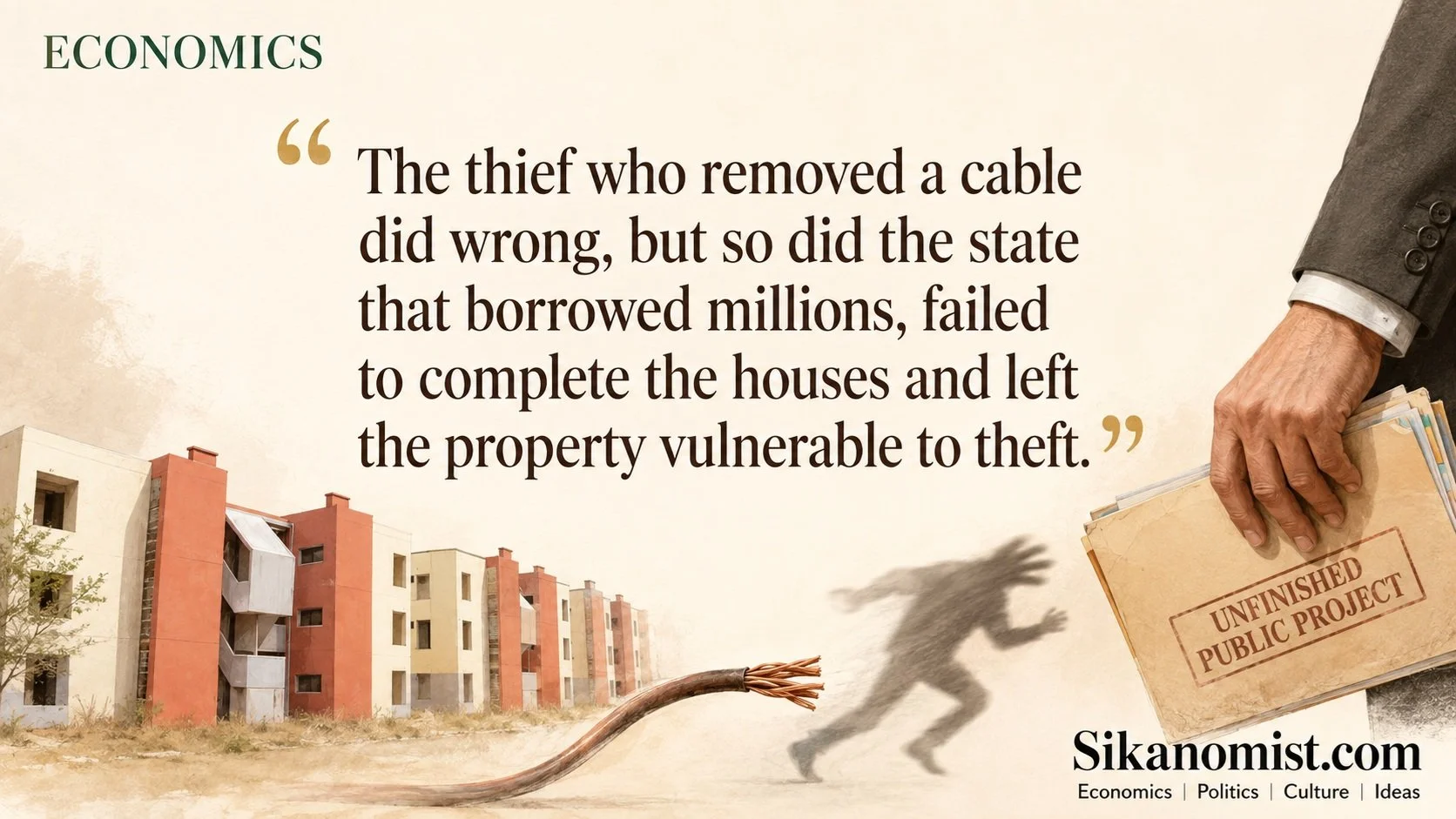
The thief who removed a cable did wrong, but so did the state that borrowed millions, failed to complete the houses and left the property vulnerable to theft.
Saglemi was supposed to finance itself
Saglemi was not conceived merely as another government expenditure. It was designed as a housing investment whose completed units would be sold through mortgage arrangements.
Parliament approved a US$200 million Credit Suisse facility in October 2012 for the construction of 5,000 affordable housing units. The houses were intended to be sold to members of the public through mortgages arranged by Ghana Home Loans. Daily Graphic
The financial projections presented to Parliament were relatively straightforward. Total debt service was estimated at approximately US$249.6 million, while proceeds from selling the houses were projected at about US$251.27 million. In principle, the sales would cover the principal, financing costs and interest, leaving a small surplus of approximately US$1.8 million. Hansard background report
This is why the failure to complete and sell the houses was not simply a construction problem. It damaged the project’s entire financial structure.
The loan still had to be serviced even though the houses were not generating sales revenue.
The buildings remained empty. Families continued paying high rents elsewhere. The Government received no expected mortgage proceeds. The structures deteriorated, fittings were stolen and the eventual completion cost increased.
Ghana may therefore end up paying for Saglemi several times: through the original loan, through interest and debt-service costs, through the replacement of stolen and deteriorated materials, and through additional investment required to make the estate habitable.
So who has been paying the loan?
This is the question that government must answer clearly.
The Ministry of Finance—not the future homeowners—was the borrower under the Credit Suisse facility. The loan reportedly had a two-year grace period, followed by a five-year repayment period and a total maturity of seven years. The original projection was that proceeds from selling the completed homes would help cover the debt-service cost. Ghana Business News
But Credit Suisse was not required to wait until ordinary Ghanaians bought the houses before receiving payment. Ghana remained legally responsible for its sovereign obligation.
Because the homes were not sold as planned, the burden would have remained with the state. That means taxpayers, government revenue, borrowing or other public financing arrangements had to carry an obligation that was supposed to be recovered through housing sales.
The original seven-year maturity suggests that the facility should ordinarily have reached final repayment around 2020, unless it was amended, refinanced, restructured or left with outstanding obligations. Yet the public still lacks a simple official account showing exactly what happened.
The Ministry of Finance should therefore publish a complete Saglemi loan statement showing:
The amount actually disbursed by Credit Suisse.
Transaction fees and other deductions.
The total principal and interest paid.
The dates and sources of repayment.
Any penalties, arrears, refinancing or restructuring.
The exchange-rate cost to Ghana.
Whether any amount remains outstanding.
How much future housing-sale revenue will return to the state.
Without this information, the Government may sell the completed houses and celebrate the revenue without telling Ghanaians how much they have already paid for the same project.
The first Mahama administration must answer for its part
Saglemi cannot be discussed honestly without examining what happened before January 2017.
The US$200 million facility was approved and largely disbursed during the previous NDC administration. The project was expected to deliver thousands of homes, with its first phase scheduled for completion before that administration left office.
Yet President Mahama completed his first presidency without handing over a functioning Saglemi community to homeowners.
Buildings had been constructed, but essential services—including water, electricity, drainage and sewage infrastructure—were incomplete. The project therefore could not generate the mortgage sales on which its financing model depended.
There were also serious disagreements over changes to the project’s scope, the number of units covered by the available money, payments to contractors and the value of work actually delivered.
Former officials maintained that the project was always intended to proceed in phases and that the first 1,500 units would generate money for subsequent phases. Prosecutors later alleged that the contract and scope had been improperly changed after Parliament approved financing for 5,000 units. Those allegations were disputed. Ghana Business News
The important point is that the Mahama administration cannot present itself only as the government returning to rescue Saglemi. It must also answer why a project financed during its earlier period in office did not become habitable, why the sales-and-mortgage model failed to begin and why so much of the facility had been exhausted before buyers could occupy the homes.
Completing Saglemi now would be commendable. It would not erase the need to account for its original implementation.
The Akufo-Addo administration also had eight years
The NPP administration inherited a troubled project in January 2017. It was right to investigate possible wrongdoing, conduct technical assessments and establish whether taxpayers had received value for money.
However, investigation and asset protection should have happened together.
By March 2021, the Works and Housing Minister said that 1,389 units had been completed to various levels and that 868 were structurally ready, although they could not be occupied because water, electricity and sewage services were missing. MyJoyOnline
That meant the country was not starting from an empty field. It possessed a substantial but incomplete public asset.
In 2023, President Nana Akufo-Addo argued that completing Saglemi would require significant additional expenditure. By 2024, the Government was pursuing a private-sector arrangement under which the value of the existing project would become the state’s equity and the selected developer would finance completion. GBC Ghana
But eight years is a long time to protect, audit and restructure an estate.
Even if legal proceedings prevented the Government from continuing the original contract, they did not prevent it from guarding the property, recording every fitting, sealing completed buildings, maintaining the grounds and investigating the organised removal of heavy materials.
Windows, security doors and underground cables do not normally disappear from a large government estate in silence. Removing them requires time, tools, vehicles, buyers and repeated access to the site.
The Akufo-Addo administration therefore cannot place responsibility entirely on the previous NDC government. Whatever problems it inherited, it also inherited a duty to protect the remaining national asset.
When a government inherits a leaking roof, it may investigate who removed the tiles—but it must still cover the house before the rains arrive.
Theft must not become a political escape route
There are different levels of wrongdoing in the Saglemi story.
A person who stole a washbasin committed theft. A person who bought stolen cable encouraged theft. A security official who permitted vehicles to remove fittings may have failed in his duty. A contractor who received money without delivering certified value should be investigated. A public official who approved an improper payment should be held accountable. A government that left the estate exposed for years must answer for administrative negligence.
One form of wrongdoing must not be used to hide another.
It would be unfair to blame only politicians while ignoring the citizens who physically looted the estate. Public property belongs to everybody, and stealing from government is stealing from the public.
But it would be equally dishonest for politicians to focus on the final thieves while ignoring the decisions that left hundreds of millions of dollars trapped in empty buildings.
The people who stole from Saglemi attacked the branches, but political and administrative failure weakened the roots.
The criminal case did not provide a final answer
Former ministers and other individuals were prosecuted in connection with the project. However, the Attorney-General withdrew the charges in 2025, and the High Court subsequently discharged the accused persons. Daily Graphic
Attorney-General Dominic Ayine later argued that aspects of the prosecution were defective, including the alleged failure to properly account for the value of the buildings that had actually been constructed. BusinessGhana
This means it would be wrong to declare the former officials guilty when no final court judgment established their guilt.
But ending the criminal case did not answer the economic questions.
Ghanaians still deserve to know how much money was disbursed, what was purchased, what was constructed, why the scope changed, whether every payment matched certified work and why the homes were not completed before the money ran out.
Criminal guilt requires proof beyond reasonable doubt. Public financial accountability requires something different: complete records, honest explanations and evidence that the state received fair value.
Even where criminal prosecution is not possible, the state can pursue civil recovery, administrative sanctions, professional discipline or contractual claims where credible evidence supports them.
Even the project’s basic history needs clarification
Many reports state that President John Evans Atta Mills granted executive approval for Saglemi on 15 August 2012. But President Mills died on 24 July 2012.
Both the date and attribution cannot be correct.
Other accounts attribute the August 2012 approval to President Mahama, who had succeeded President Mills. This may appear to be a small historical disagreement, but it demonstrates how confused and politicised the Saglemi record has become.
Government should publish the original executive approval, Parliamentary resolution, facility agreement, works agreement and every subsequent variation. Ghana should not have to reconstruct a US$200 million public project from conflicting political statements and newspaper reports.
Completion must come with a public account
The current public-private partnership offers Ghana an opportunity to rescue Saglemi. But completion alone is not enough.
Before the first homes are sold, the Government should publish:
The independent financial and technical audit of the original project.
The assessed value of the land, buildings and infrastructure contributed by the state.
The full financial structure of the arrangement with LMI Group.
The developer’s investment and expected return.
The formula for sharing sales proceeds.
The number, sizes and final prices of the homes.
The mortgage terms and eligibility requirements.
The cost of replacing stolen and deteriorated fittings.
The amount expected to return to the state.
A plan showing how the remaining 3,500 homes in the original vision will be delivered.
The completed houses must also remain reasonably affordable. A project financed in the name of affordable housing should not eventually become an exclusive estate available only to wealthy buyers.
The homes cannot be sold at prices that merely allow the state and private developer to recover every cost created by years of political delay. Ordinary buyers should not be made to pay directly for government failure.
Ghana must end the culture of abandoned projects
Saglemi is larger than one housing estate. It represents a national habit in which incoming governments suspend projects associated with their predecessors, investigations continue for years, public assets deteriorate and taxpayers eventually provide more money to rescue what should already have been completed.
Ghana needs a national public-project continuity law.
An incoming administration should be permitted to audit or renegotiate a questionable contract. But it should also be required to protect the site, publish the audit within a defined period and decide promptly whether to complete, restructure or legally terminate the project.
No national asset should remain in political suspension for eight years.
Major public projects should also have independent asset registers, professional security, insurance where practical and public digital dashboards showing expenditure, completion rates and outstanding work.
These measures will not remove corruption entirely. They will make it more difficult for politicians, contractors, officials and thieves to hide behind one another.
Let Saglemi become a lesson, not merely an estate
Ghana should welcome the return of construction workers to Saglemi. Completing the houses is better than allowing them to decay.
But the commissioning ceremony planned for 2027 must not become another occasion for a political party to claim victory while the deeper questions remain unanswered.
The NDC must account for the original financing, implementation and failure to deliver habitable homes before leaving office in 2017.
The NPP must account for why the estate remained unused and insufficiently protected throughout its eight years in government.
The current administration must explain the original loan repayments, publish the new development agreement and ensure that the completed homes remain accessible to the people for whom affordable housing was promised.
Those who stole the fittings must also be investigated and prosecuted wherever evidence permits.
This is not an NDC story or an NPP story. It is the story of how Ghana borrowed heavily to build homes, failed to complete and sell them, paid or carried the debt without the expected revenue, and then watched part of the national investment disappear.
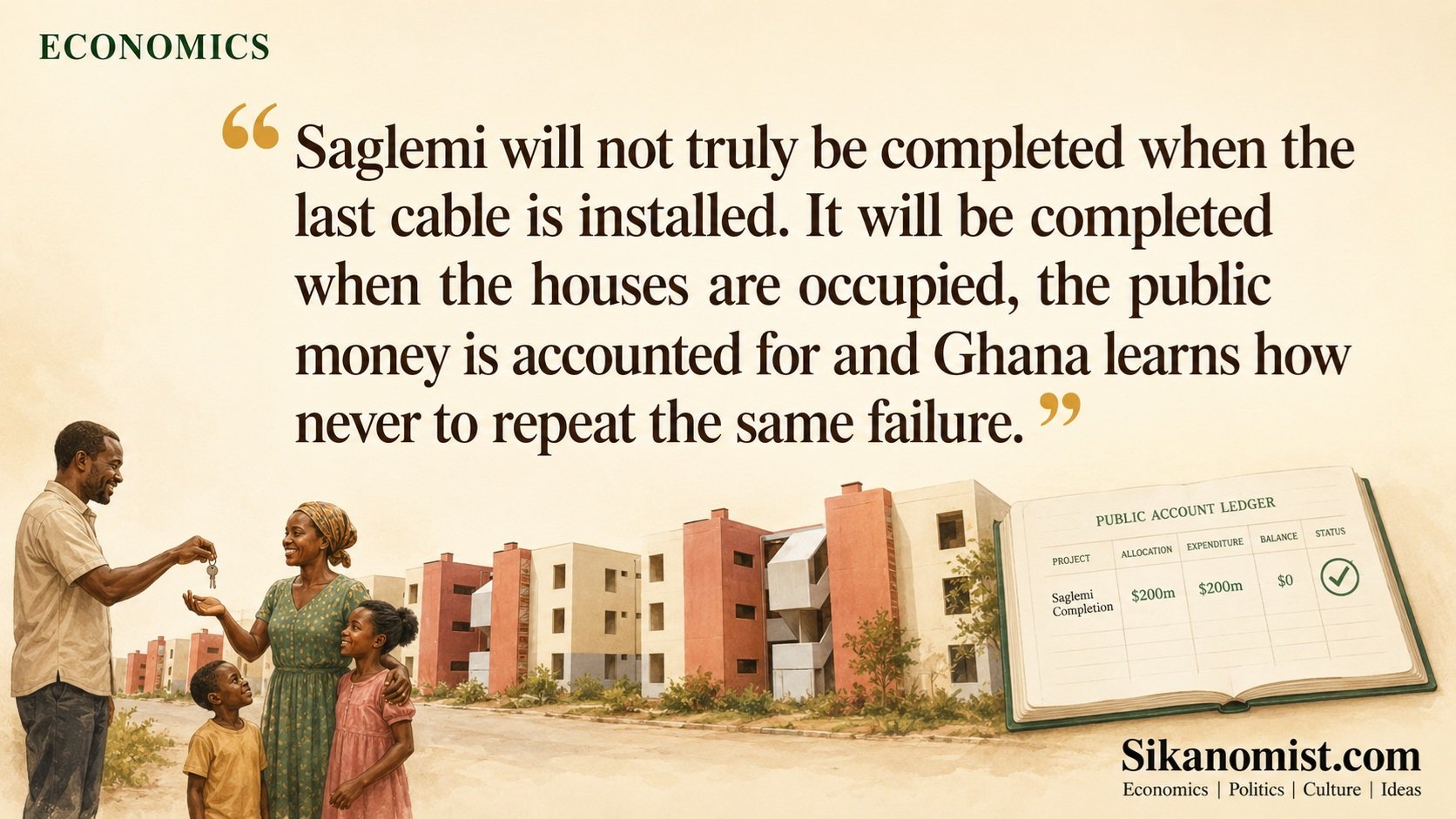
Saglemi will not truly be completed when the last cable is installed. It will be completed when the houses are occupied, the public money is accounted for and Ghana learns how never to repeat the same failure.
Reader’s Question
Who should bear the greatest responsibility for Saglemi’s losses: the thieves who stripped the buildings, the officials who managed the original contract or the governments that left the estate abandoned?