The Future Does Not Just Happen—It Is Built
The Ghana our children inherit will depend on the decisions, attitudes and investments we make today
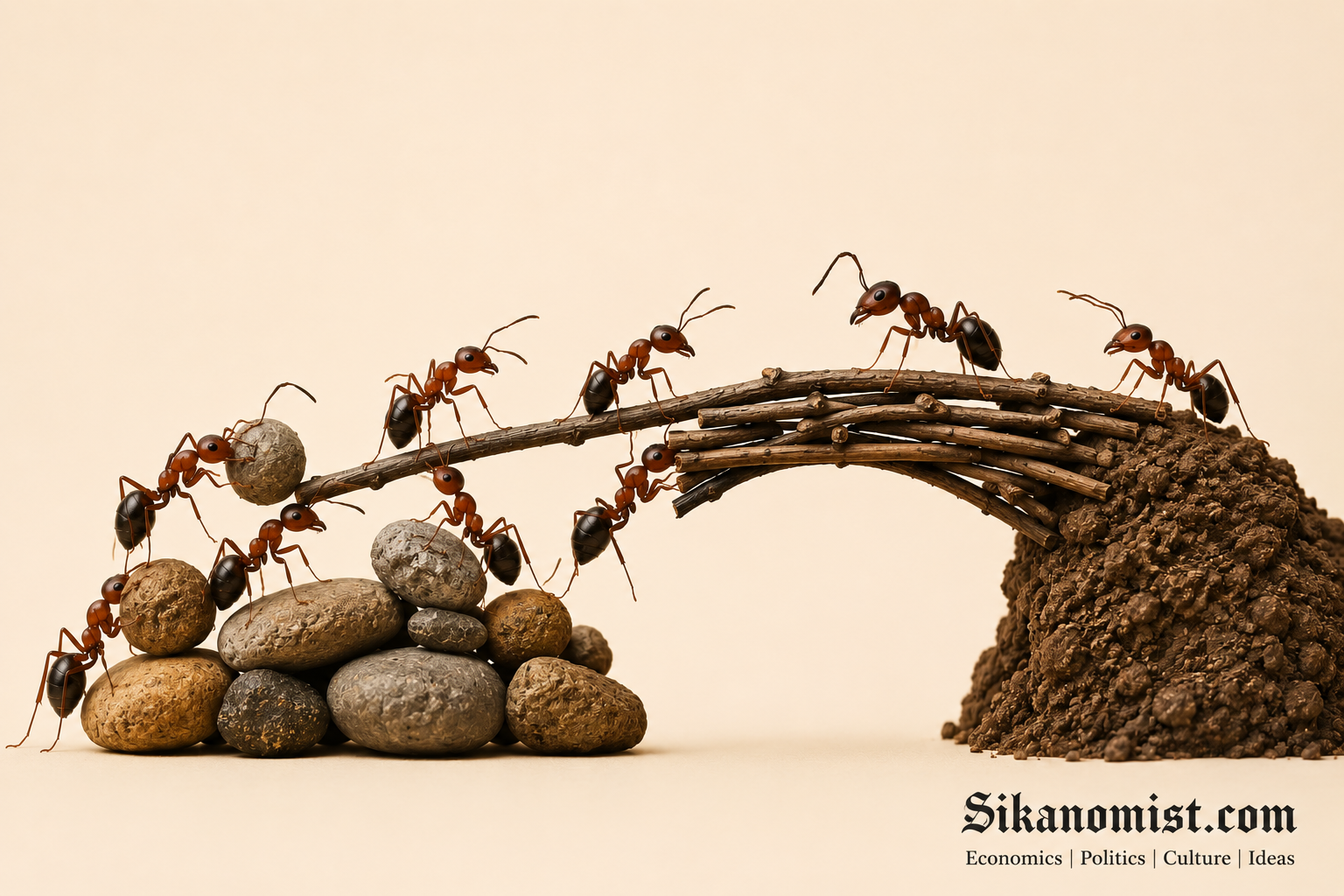
A colony of ants works together to build a bridge across an obstacle, symbolising how unity, planning and persistent effort can create a stronger future.
There is a popular saying that the future belongs to the young. While that is true, it tells only part of the story. The future actually belongs to those who build it. Every road, school, factory, hospital, business and institution that exists today was once someone's vision. Before there was a prosperous nation, there were people who chose to plan ahead, work hard and make sacrifices for generations they would never meet.
This is an important lesson for Ghana. The country we hope to see in twenty or thirty years will not appear by chance. It will be shaped by the decisions we make today as citizens, businesses, communities and governments. Every generation has the opportunity to leave its country either stronger or weaker than it found it. The question for our generation is simple: what kind of Ghana are we building?
History offers many examples of nations that transformed themselves because they decided to think beyond the present.
After the Second World War, Japan lay in ruins. Many of its cities had been destroyed, industries had collapsed and millions of people faced hardship. Yet Japan did not accept that this would be its permanent future. The country invested heavily in education, manufacturing, technology and quality. Japanese businesses became known around the world for producing reliable products, while workers developed a reputation for discipline and continuous improvement. Within a few decades, Japan had become one of the world's leading economies. That transformation did not happen overnight. It was built through consistent effort over many years.
South Korea tells a similar story. In the 1950s, it was one of the poorest countries in the world, with limited natural resources and widespread poverty. Instead of allowing these difficulties to define its future, South Korea invested in education, industry, infrastructure and innovation. It encouraged exports, developed skilled workers and supported businesses capable of competing globally. Today, South Korean companies produce products that are recognised in almost every country, from electronics and ships to cars and entertainment. The country's success was not an accident; it was the result of long-term planning and determination.
Singapore provides another powerful lesson. When it gained independence in 1965, many observers doubted whether the small island nation could survive. It had few natural resources and faced serious economic and social challenges. However, its leaders and citizens focused on building strong institutions, maintaining the rule of law, investing in education and creating a clean, efficient environment for business. Today, Singapore is widely recognised as one of the world's best-managed economies. Its greatest resource was never oil, gold or diamonds. It was the commitment of its people to build a better future.
Closer to home, Rwanda demonstrates that remarkable progress is possible even after immense tragedy. Following the 1994 genocide, the country faced enormous challenges. Yet over the years it has invested in public services, technology, tourism, healthcare and cleanliness while working to rebuild national unity. Rwanda still faces challenges, but its determination to improve year after year shows what can happen when a nation decides to focus on rebuilding rather than remaining trapped by its past.
None of these countries copied one another exactly. Each followed its own path based on its history, culture and circumstances. What they shared was a willingness to prepare for the future instead of simply hoping it would improve on its own.
Ghana has every reason to be optimistic. Our nation enjoys political stability, a strategic location in West Africa, abundant natural resources, a vibrant culture, entrepreneurial citizens and one of Africa's youngest populations. These are significant advantages. Yet advantages alone do not guarantee success. They must be matched with vision, discipline and consistent action.
Building the future begins with education. Every child who learns to read well, think critically and solve problems becomes an asset to the nation. Countries that consistently invest in quality education equip their people to compete in a rapidly changing world. Ghana must continue to improve not only access to education but also its quality, ensuring that students leave school with the knowledge, skills and character needed to contribute meaningfully to society.
Infrastructure is another investment in the future. Well-maintained roads, reliable electricity, efficient ports, modern railways, clean water systems and dependable digital networks make it easier for businesses to grow and for people to improve their lives. These are not simply construction projects; they are foundations upon which future prosperity is built.
A nation's future also depends on its attitude towards work. In many successful countries, people take pride in doing their jobs well, whether they are engineers, nurses, mechanics, teachers, farmers or shopkeepers. Excellence is not reserved for a few professions. It is a habit that can be practised in every workplace. When millions of people commit themselves to high standards, the reputation of the entire country rises.
Innovation will play an increasingly important role in Ghana's future. Around the world, many of today's largest companies began as small ideas. Encouraging young people to think creatively, embrace technology and solve local problems can create businesses that serve not only Ghana but the wider African continent and the global market. Every entrepreneur who creates jobs and every inventor who develops a useful solution contributes to national progress.
Equally important are honesty and strong institutions. Investors are more likely to commit their resources to countries where contracts are respected, public institutions function fairly and the rule of law is upheld. Citizens also flourish when they trust that systems work for everyone rather than for only a privileged few. Building trust is not the responsibility of government alone; it begins with individuals choosing integrity in their daily lives.
Families have an essential role in shaping the future as well. Children often learn their first lessons about honesty, discipline, kindness and responsibility at home. Parents and guardians who raise children with strong values are making one of the greatest investments any nation can receive. Schools reinforce these values, but families often plant the first seeds.
The media also has an important responsibility. While it is essential to report problems and hold leaders accountable, it is equally important to highlight solutions, celebrate innovation and inspire hope. A society that only hears about failure may begin to believe that success is impossible. A balanced national conversation should recognise challenges while also showing what is working and encouraging others to build upon those successes.
Perhaps the greatest lesson from history is that no nation becomes great by accident. Prosperity is usually the result of thousands of wise decisions made consistently over many years. It comes from leaders who think beyond their own time in office, businesses that invest rather than merely consume, teachers who inspire, workers who value quality and citizens who care about the common good.
The Ghana of 2050 is already being built. It is being built in today's classrooms, construction sites, farms, factories, laboratories, offices and homes. It is being shaped by the standards we accept, the values we teach, the investments we make and the responsibilities we choose to fulfil. Every generation writes a chapter in the nation's story. The chapter we write today will determine what future generations inherit.
The future does not simply happen. It is planned, built and protected by people who refuse to leave tomorrow to chance. Ghana has the talent, the resources and the opportunity to become one of Africa's great success stories. If we choose to invest in our people, strengthen our institutions, reward innovation and commit ourselves to excellence, we will not only build a better future for ourselves—we will leave a lasting legacy for generations yet to come.
The future of Ghana is not waiting somewhere ahead of us. It is already under construction, and every Ghanaian has a role to play in building it.
Reader's Question
If you could introduce one lasting change that would help build a better Ghana for future generations, what would it be and why?