The Locked Capital in Ghana’s Economy
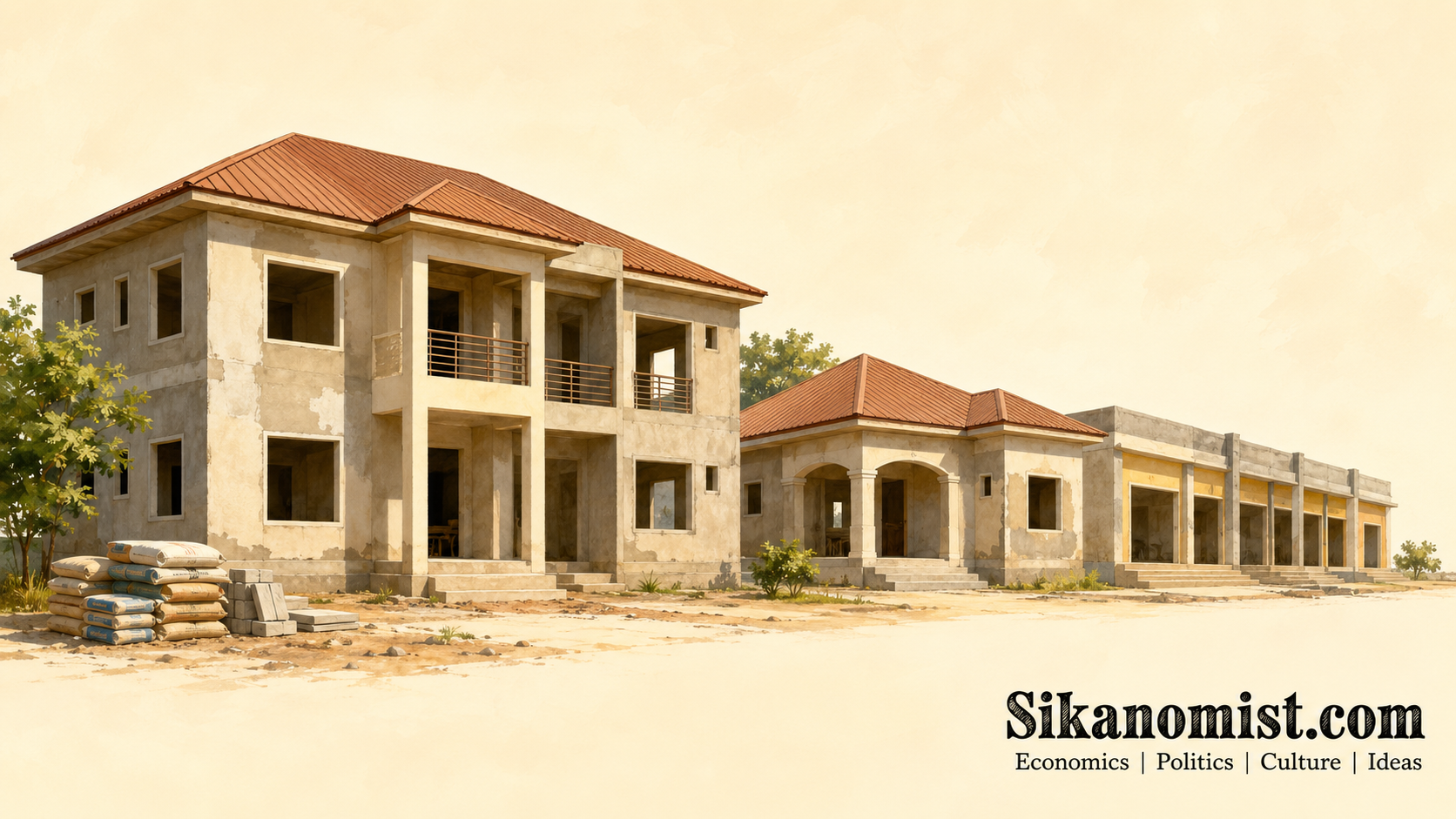
Across Ghana, unfinished buildings have become such a familiar part of the landscape that we hardly notice what they represent.
They stand beside major roads, inside residential communities and on the outskirts of rapidly growing towns. Some are family houses that stopped at foundation level. Others are nearly completed apartment blocks waiting for windows, plumbing, electrical work, flooring or paint. There are also unfinished shops, offices, warehouses, guest houses and public projects.
We commonly describe them as uncompleted buildings. Economically, however, they are something much more serious: investments that have absorbed money but are not yet delivering their intended value.
The land may have been purchased. Architects, engineers, masons and carpenters may have been paid. Cement, sand, blocks, iron rods and roofing materials may already be inside the structure. Yet the building provides no proper accommodation, produces no rental income and supports no active business.
The money has not disappeared. It has become trapped inside concrete, blocks and iron rods.
This is Ghana’s locked capital.
Ghanaians are already investing in housing
The large number of unfinished buildings reveals an important truth: Ghanaians are not unwilling to invest in accommodation.
Workers use salaries and pensions to build houses. Traders invest business profits in shops and apartments. Families combine their resources to start residential projects. Ghanaians living abroad send remittances home to purchase land and build houses for retirement or rental income.
The problem is that most people must build with whatever money becomes available at a particular time.
A worker may buy land this year, mould blocks two years later and begin the foundation after another year. The walls may be raised gradually, followed by another long pause before roofing. Completing the building may take ten, twenty or even thirty years.
During those years, thousands of cedis may already be sitting inside the structure without producing accommodation or income.
“Little by little, the bird builds its nest.” But the nest must eventually be completed before it can provide shelter.
Building gradually may be the only option available to many families. However, when gradual construction becomes the main national system for delivering housing, too many projects remain unfinished for too long.
The scale is larger than it appears
Ghana’s unfinished-building problem is not based merely on roadside observations.
The Ghana Statistical Service reported in the 2021 Population and Housing Census that approximately 825,367 structures—about 8 per cent of all structures counted—were uncompleted and without roofs. These included buildings at different stages, such as window, lintel, pillar and roofing levels. Ghana Statistical Service, 2021 Census Report
That figure does not capture the whole problem.
The same census found that about 15 per cent of residential structures had some form of roofing but were not fully completed. A building may have a roof yet still require doors, windows, plastering, plumbing, wiring, ceilings, flooring and sanitary facilities before it can be properly occupied.
The figures also do not include all construction projects started since 2021.
Ghana is therefore dealing not with a few abandoned structures, but with an enormous national collection of partially completed assets.
Behind every one of those buildings is money already spent.
Could hundreds of billions of cedis be locked away?
Ghana does not currently have a comprehensive national valuation of all its unfinished private and public buildings. The precise amount can only be established through a properly conducted audit.
However, simple illustrative calculations help us understand the possible scale.
If the average amount already invested in each of the 825,367 uncompleted and unroofed structures were GH¢100,000, the total would be approximately GH¢82.5 billion.
At an average investment of GH¢150,000, the total would rise to approximately GH¢123.8 billion.
At GH¢250,000 per structure, it would exceed GH¢206 billion.
These calculations are not a formal valuation. Some structures are at an early stage and may contain much less investment. Large apartment blocks, hotels, offices, warehouses and public projects, however, may each contain millions of cedis.
The calculations also exclude many roofed but unfinished buildings.
On that basis, The Sikanomist believes it is reasonable to investigate whether the combined private and public capital locked in Ghana’s uncompleted buildings runs into hundreds of billions of cedis.
That would make unfinished buildings one of Ghana’s largest overlooked pools of domestic capital.
The investment is valuable but economically silent
Consider an individual who has invested GH¢1 million in a block of rental apartments. The land has been purchased, the foundation completed, the walls raised and the building roofed.
The owner then runs out of money.
Perhaps another GH¢300,000 is needed for windows, plumbing, electrical work, flooring and basic finishing. Without that final amount, the apartments cannot receive tenants.
The GH¢1 million already invested produces no regular income. Without rental income, the owner struggles to raise the additional GH¢300,000 required for completion.
The project becomes trapped between expenditure and return.
The owner may possess a valuable physical asset and still lack available cash. From the outside, the person may appear wealthy because he or she owns an apartment block. In practice, the building may be generating nothing.
When an unfinished building cannot provide accommodation or generate income, the capital invested in it remains economically silent.
The same principle applies to commercial property. An unfinished shop cannot accommodate a trader. An incomplete warehouse cannot store goods. An abandoned office block cannot house businesses. An uncompleted guest house cannot receive visitors or employ workers.
The investment exists, but its productive journey has been interrupted.
Uncompleted apartments worsen the accommodation shortage
Ghana’s official housing deficit remains above 1.8 million units, according to the Ministry of Works, Housing and Water Resources. Ministry housing-sector update
This shortage contributes to high rents and difficult advance-payment conditions, particularly in Accra, Kumasi and other growing urban areas.
High rents have several causes, including land prices, construction costs, interest rates, infrastructure and the concentration of employment in a few cities. But the shortage of completed, affordable accommodation remains central.
An unfinished block containing six apartments may have enough physical space to accommodate six families. Until it is completed, however, those families must compete for accommodation elsewhere.
Multiply this situation across thousands of apartment projects and the connection becomes clear. Ghana may possess many physical buildings while still suffering from a shortage of habitable housing units.
This means the country does not always need to begin from the foundation.
A building that is already 70 or 80 per cent complete could enter the housing market much faster than a new project that has not yet acquired land, secured permits or started construction.
Completing existing viable buildings should therefore become part of Ghana’s housing policy.
The missing final money can unlock the entire investment
The most important economic feature of an advanced unfinished building is that the money required to complete it may be much smaller than the value already invested.
Suppose a project contains GH¢2 million in land and construction but requires GH¢500,000 to become operational. Financing the final GH¢500,000 does not activate only GH¢500,000 of value. It releases the productive power of the whole development.
Once completed, the property can provide accommodation, produce rental income, employ maintenance workers and generate property-rate revenue.
This is why a carefully managed fund of a few billion cedis could unlock assets worth many times that amount over several years.
It could not complete every unfinished building in Ghana, nor should it attempt to do so. Some projects have ownership disputes, structural problems, poor documentation or little immediate economic value.
The programme should begin with viable buildings that are already substantially complete and can quickly provide affordable accommodation or support business activity.
The key does not have to be as large as the door. It only has to unlock what is behind it.
Ghana needs a Building Completion Finance Programme
Ghana should establish a properly regulated Building Completion Finance Programme to connect viable unfinished projects with affordable, long-term funding.
The programme should not become a political giveaway or a source of free money for private property owners. It should provide repayable financing under strict and transparent conditions.
Owners seeking support would be required to present proof of ownership, approved building plans, permits, construction estimates and an explanation of how the property will generate income or provide needed accommodation.
Qualified engineers, architects, quantity surveyors and planners would inspect each property. They would determine whether the structure is safe, legally documented and capable of being completed within a reasonable cost and period.
Priority could be given to:
Apartment blocks capable of delivering several rental units quickly.
Family houses that require limited financing to become habitable.
Shops, offices and warehouses that can support immediate business activity.
Public buildings that can provide essential services after completion.
Properties close to employment centres, schools, hospitals, industrial areas and public transport.
Financing should be released in stages after completed work has been inspected. Money could be paid directly to approved suppliers and contractors instead of being handed to applicants as unrestricted cash.
For rental properties, repayment could be linked to the income generated after completion. An agreed proportion of monthly rent could pass through a controlled account until the loan is repaid.
This would turn completion finance into a revolving system. As one property owner repays, the same money could help complete another building.
Affordable finance must remain disciplined
Housing needs patient capital because its returns arrive over many years.
The Bank of Ghana reported that average bank lending rates had fallen to 19.2 per cent in February 2026 from 30.1 per cent a year earlier. Although this is a substantial improvement, borrowing can still be expensive for households and small property developers whose returns will come gradually through rent. Bank of Ghana Monetary Policy Report, March 2026
A completion-finance programme would therefore need longer repayment periods and carefully structured interest rates.
However, affordable finance must not mean careless finance.
Beneficiaries must repay their loans. Projects must be independently assessed. Applications must not be approved because of political connections, family relationships or party membership.
Government could provide part of the long-term capital or limited guarantees, while commercial banks, rural banks, credit unions and approved financial institutions conduct assessments and manage repayments.
Pension funds and insurance companies could participate under strict safeguards because they manage long-term money and require stable long-term investments. The Ghanaian diaspora could also invest through properly regulated housing-completion bonds or funds.
The government’s most important responsibility would be to establish a credible framework that protects borrowers, investors and public money.
Public uncompleted projects are also locked capital
The private sector is not alone in this problem.
Ghana has numerous delayed or abandoned public housing, office, school, hospital and commercial projects. These buildings contain taxpayers’ money and borrowed funds.
When a public project is abandoned, the intended service is lost while the structure deteriorates. Inflation increases the amount required for completion, exposed materials weaken and vandals may remove valuable fittings.
A change of government should not automatically sentence a useful project to years of decay.
Where corruption or contractual wrongdoing is suspected, investigations should proceed. But protecting and completing the physical asset should remain a national priority.
Public buildings belong to Ghana, not to the political party that started them.
Every major public project should have a completion or preservation plan, even when legal disputes delay further construction.
Unlocking the buildings would unlock jobs
A national completion drive would stimulate much more than the property sector.
It would create work for masons, carpenters, plumbers, electricians, welders, tilers, painters, architects, engineers, surveyors and building inspectors.
Demand would increase for locally produced cement products, blocks, roofing sheets, cables, doors, windows, paint, tiles, furniture and sanitary fittings.
Completed apartments would provide accommodation and rental income. Shops would allow businesses to open. Warehouses would support trade and distribution. Municipal assemblies would gain occupied properties from which they could collect rates.
Instead of remaining trapped in deteriorating structures, existing investment would begin circulating through the economy.
Completion finance should therefore be considered not merely a housing intervention, but an economic activation programme.
Ghana must count what it has already built
The first practical step should be a national audit of uncompleted private and public buildings.
Ghana needs to know where these properties are located, their stages of completion, their intended purposes, their structural conditions and the approximate amount required to make them usable.
Without reliable information, the country cannot design an effective financing system.
The Ghana Statistical Service, Ministry of Works, Housing and Water Resources, Lands Commission, metropolitan and municipal assemblies, financial institutions and professional property bodies should work together to create this national picture.
Not every unfinished structure should receive financing. But Ghana cannot continue ignoring hundreds of thousands of partially built assets while speaking constantly about accommodation shortages and limited investment.
The economic power is already here
Ghana often looks abroad when searching for investment. Foreign capital is important, but the country must also recognise the enormous sacrifices its own citizens have already made.
Inside Ghana’s uncompleted buildings are years of salaries, business profits, pensions, remittances, loans and family savings.
These structures are not empty. They contain capital waiting to become useful.
Government does not have to complete private buildings with free public money. It must create a disciplined system through which viable projects can obtain affordable, repayable and properly supervised completion finance.
A few billion cedis, circulated carefully over time, could activate assets worth many times that amount. It could place more accommodation on the market, reduce some of the pressure on rents, create employment and generate income for families, businesses and local authorities.
Ghana does not always need to search outside for new economic power.
Sometimes, that power is already here—locked inside the buildings we have failed to complete.
Reader’s Question
Should Ghana establish a regulated completion-finance programme to turn viable unfinished buildings into homes, businesses and productive economic assets?