What the Wontumi Judgment Actually Says—and What It Means for Ghana
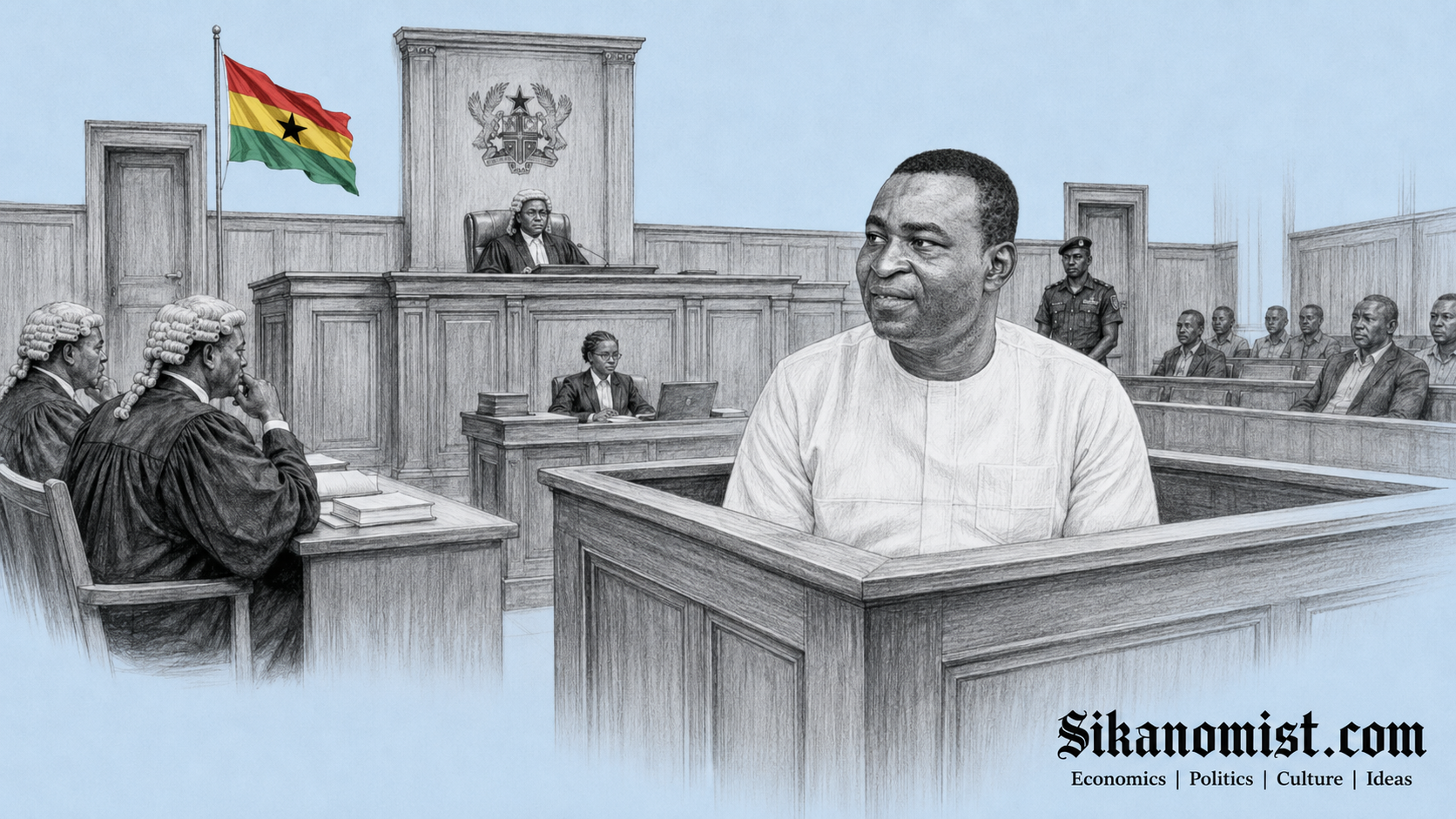
The imprisonment of Bernard Antwi Boasiako, popularly known as Chairman Wontumi, has naturally generated strong political reactions across Ghana. To many of his supporters in the New Patriotic Party, the case may appear to be another example of a powerful opposition figure being pursued under a new government. To his critics, the judgment may represent a long-awaited demonstration that wealth, political influence and party connections cannot protect anyone from Ghana’s mining laws. But neither political position is enough to explain what actually happened. The proper starting point is the judgment itself.
On 20 July 2026, the High Court in Accra, presided over by Justice Audrey Kocuvie-Tay, convicted Wontumi and Akonta Mining Company Limited of offences connected to the use of the company’s mining concession at Samreboi in the Western Region. Wontumi was found guilty of dealing with mineral rights without the prior written approval of the Minister responsible for lands and natural resources. He was also convicted of purposely facilitating an unlicensed mining operation. Akonta Mining was convicted on corresponding counts, while a second individual named in the case, Kwame Antwi, remained at large and did not appear before the court.
The judgment is detailed. It does not simply say that illegal mining occurred and then move directly to punishment. It explains the prosecution’s evidence, the defence presented by Wontumi, the applicable mining laws and the reasoning by which the court connected Wontumi personally to activities on Akonta Mining’s concession. Whether every part of that reasoning will survive an appeal is a separate question. But anyone seeking to understand the case must first understand what the court decided.
According to the judgment, the police carried out an anti-galamsey operation in the Western Region in April 2025. The operation led to the arrest of Michael Gyadu Ayisi and 28 others within and around a concession belonging to Akonta Mining Company. The court recorded that the arrested persons were occupying a structure bearing the name of Akonta Mining. The police also retrieved several items, including firearms, ammunition, pumping machines, motorcycles, vehicles, excavators, pieces of metal suspected to be gold and GH¢157,000.
Michael Gyadu Ayisi reportedly identified Henry Okum as his employer and said he had been assigned to supervise activities on the concession. The prosecution’s case was that Okum and his workers were simultaneously mining unworked portions of the concession and reclaiming areas that had already been damaged. Okum told investigators that he had reached an arrangement with Wontumi which permitted him to enter the concession and mine for gold.
The central issue was therefore not whether Okum entered the concession with Wontumi’s permission. Wontumi admitted giving him permission. The decisive disagreement concerned the purpose of that permission. Wontumi’s defence was that he allowed Henry Okum onto the concession only to carry out land reclamation. He maintained that Okum was expected to plant coconut seedlings on areas that had already been mined and degraded. He denied authorising him to extract gold or conduct mining operations.
That distinction was extremely important. Permitting someone to reclaim damaged land is not the same as authorising that person to mine. If the court had accepted Wontumi’s explanation entirely, the prosecution would have struggled to establish that he had dealt with or assigned the company’s mineral rights to Okum. However, the court did not accept that the arrangement was limited to reclamation. It accepted the prosecution’s argument that mining formed part of the agreement and that proceeds from mining were intended to finance the reclamation work.
One of the most important facts in the case is that the arrangement between Wontumi and Henry Okum was not written down. There was no signed mining contract transferring rights to Okum. There was no written reclamation agreement defining what he could and could not do. There was also no independent witness to the original conversation in which permission was given. The court therefore acknowledged that there was no direct evidence of the exact terms agreed between the two men.
The court instead relied heavily on circumstantial evidence. Circumstantial evidence allows a court to infer what happened from surrounding facts, even where there is no document, recording or eyewitness to the central event. In a criminal case, however, the inference must be strong. It must be inconsistent with the accused person’s innocence and must not leave a reasonable alternative explanation.
The court considered several surrounding circumstances. First, Henry Okum said he was an experienced small-scale miner. The court noted that there was no evidence showing that he had previously specialised in land reclamation. Second, reclamation costs money. Heavy equipment, labour, seedlings, earthworks and supervision are not free. According to Okum’s evidence, Wontumi did not give him money to carry out the reclamation. Okum said he was expected to mine unworked portions of the concession and use part of the proceeds to pay for reclaiming the damaged areas.
The judgment placed considerable importance on the fact that this part of Okum’s evidence was not directly challenged during cross-examination. Okum also admitted that gold was extracted from his operations. The court considered this consistent with his claim that mining was part of the arrangement. It also found it difficult to accept that a small-scale miner would enter a remote mining concession, reclaim land damaged by another operator and finance the entire exercise himself without receiving some economic benefit.
The court therefore concluded that the most reasonable explanation was that Okum had been permitted to mine the unworked portions and use some of the proceeds to finance the reclamation. It described Wontumi’s later suggestion that Okum would recover his expenses from the future sale of mature coconut trees as an afterthought.
The absence of ministerial approval was another major part of the case. Under Ghana’s Minerals and Mining Act, a mineral right cannot be transferred, assigned, mortgaged, encumbered or otherwise dealt with without the prior written approval of the responsible minister. The court found that Akonta Mining’s lease gave the company the exclusive right to work, develop and produce minerals within the concession. In the court’s interpretation, allowing another person to exercise that exclusive right amounted to dealing with or encumbering the mineral right.
The absence of ministerial approval was not seriously disputed. The Minerals Commission had no record of an application by Akonta Mining seeking approval to transfer or assign its rights to Henry Okum. The legal dispute was therefore not mainly about whether approval had been obtained. It had not. The dispute was whether the informal permission allegedly given to Okum amounted to a transfer, assignment, encumbrance or other dealing with Akonta Mining’s mineral rights.
The court adopted a broad interpretation. It held that the law would be defeated if a mineral-right holder could avoid regulation simply by giving oral permission instead of signing a formal agreement. In the court’s view, the purpose of the law is to ensure that the state knows who is actually exploiting Ghana’s mineral resources. Therefore, permitting a third party to mine within an exclusive concession could fall under the law even where the arrangement was verbal.
This interpretation has consequences beyond Wontumi. It sends a warning to concession holders that the absence of a written transfer does not necessarily protect them. Where another person is allowed to exercise the practical right to mine, the courts may treat the arrangement as a dealing with or encumbrance of the mineral right.
Another important issue concerned the separate legal identity of Akonta Mining. The mining lease was held by Akonta Mining Company Limited, not personally by Bernard Antwi Boasiako. Normally, a registered company has a legal identity separate from its shareholders and directors. The company owns its assets, holds its rights and bears its own liabilities. That principle is fundamental to company law.
The court nevertheless decided to lift, or pierce, Akonta Mining’s corporate veil. This means it looked beyond the company’s separate legal identity and examined the individual who actually controlled its relevant decisions. The court relied on evidence that the other director and shareholder, Kwame Antwi, had been outside Ghana and absent from the company’s affairs since around 2021 or 2022. It also found no evidence of a functioning board, proper executive structure or normal corporate decision-making process.
The dealings with Henry Okum were personal, verbal and undocumented. Okum told the court that, in practical terms, he understood Akonta Mining and Chairman Wontumi to be one and the same. On that basis, the court found Wontumi to be the company’s controlling mind and the true or de facto holder of the mineral right for the purpose of the disputed dealings.
This is one of the most legally significant and potentially controversial parts of the judgment. The court did not hold Wontumi liable simply because he owned shares in the company. It said the company’s weak governance, the absence of another active director and the wholly personal nature of the arrangement justified treating him and the company as one in relation to Okum.
The second major offence concerned purposely facilitating an unlicensed mining operation. The court had to do more than establish that Wontumi permitted Okum to enter the concession. It had to find that he purposely helped or facilitated conduct that breached the Minerals and Mining Act.
The judgment relied on several factors. Wontumi admitted allowing Okum to undertake reclamation. But reclamation is itself regulated as a mine-support service. The court found that Okum was not registered or licensed as a mine-support service provider. The court also accepted evidence that Wontumi helped connect Okum to a supplier of heavy equipment.
Okum claimed Wontumi had made an initial payment towards some equipment. Wontumi denied financing mining machinery but admitted helping Okum identify a supplier, saying the equipment was meant for reclamation. The court further relied on evidence that correspondence on Akonta Mining’s letterhead was used to seek assistance from the Western Regional Security Council in relation to activities on the concession.
The judgment also noted that Wontumi never visited the site to confirm that Okum was carrying out only reclamation and not mining. The court viewed these circumstances together and concluded that Wontumi’s assistance was purposeful. It found that he had facilitated Okum and his workers in carrying out activities for which they lacked the necessary licences and approvals.
Wontumi’s lawyers also asked the High Court to stay the judgment and refer constitutional questions to the Supreme Court. They argued, among other things, that parts of the mining law were vague or overly broad and might be inconsistent with the constitutional principle that a person may be convicted only of an offence clearly defined in written law.
The High Court rejected that request. It held that the relevant provisions defined the prohibited conduct and prescribed the penalties in writing. The judge considered the defence argument to be a disagreement over how Parliament had drafted the law rather than a genuine constitutional ambiguity requiring a Supreme Court reference. The court said any remaining disagreement could be pursued through the normal appeal process.
Wontumi was eventually convicted on Count One, dealing with or assigning mineral rights without prior written ministerial approval. He was also convicted on Count Four, purposely facilitating an unlicensed mining operation. Akonta Mining Company was convicted on Counts Three and Six, covering the corresponding corporate offences.
For Count One, the court found that Wontumi had permitted Okum to mine, that no prior ministerial approval had been obtained and that Wontumi could be treated as the de facto mineral-right holder after the corporate veil was lifted. For Count Four, the court found that Wontumi had facilitated the unlicensed activities through permission, assistance with equipment, engagement with the Regional Security Council and failure to ensure that the concession was used only for lawful reclamation.
The court sentenced Wontumi to 20 years’ imprisonment with hard labour on Count One and another 20 years with hard labour on Count Four. The two prison terms are to run concurrently. This means the effective custodial sentence is 20 years rather than 40 years, subject to any successful appeal or other lawful intervention.
The court also imposed a fine of 10,000 penalty units on each count. In default of payment on each fine, the judgment prescribed an additional three years’ imprisonment with hard labour. Akonta Mining was fined 15,000 penalty units on each of its two counts. The court also ordered the forfeiture to the state of the items recovered from the concession.
In sentencing, the judge referred to the seriousness of the illegal exploitation of the state’s mineral resources, the damage caused to mining regulation, environmental degradation and the need for deterrence. The court also acknowledged that Wontumi and Akonta Mining were first offenders and said it had considered the plea in mitigation.
Does the judgment prove that Wontumi was politically persecuted? The answer, based only on the judgment, is no. The judgment itself does not establish that he was imprisoned because he is a leading NPP figure or because the governing NDC wanted to weaken a political opponent. It contains a legal explanation for the conviction, identifies the evidence relied upon and deals with the principal arguments presented by the defence.
But the judgment also cannot, by itself, settle every concern about selective prosecution. Political motivation is normally tested by looking beyond one court ruling. Were politically connected people from other parties investigated for comparable conduct? Were similar mining offences prosecuted with the same urgency? Did government officials interfere in the investigation? Were established procedures followed? Did political actors publicly prejudge the case? Are the law and punishment being applied consistently?
The judgment does not provide all the evidence needed to answer those wider questions. It would therefore be irresponsible to declare, solely from the judgment, that this was political persecution. It would be equally irresponsible to assume that the existence of a detailed judgment makes concerns about selective enforcement impossible.
The fair conclusion is that the High Court presented a legal and evidential basis for the conviction. Any allegation of political motivation must be supported by separate evidence of interference, unequal treatment or selective prosecution.
The judgment may also face serious legal questions on appeal. Was the court correct to interpret oral permission as an assignment, encumbrance or dealing with a mineral right? Was it legally justified to treat Wontumi personally as the de facto holder of a right registered in the company’s name? Did the circumstantial evidence exclude every reasonable possibility that permission was limited to reclamation? Did the evidence establish purposeful facilitation, or did it establish poor supervision, negligence or recklessness?
There may also be questions about the weight given to Henry Okum’s evidence, considering his own involvement in the mining operation. An appellate court may also be asked whether the sentence was sufficiently individualised and explained within the statutory range.
Raising these questions does not mean the judge was wrong or that Wontumi is innocent. It means that serious criminal judgments should remain open to serious legal examination. The judgment itself does not state the outcome of any future appeal.
For mining companies, the ruling sends a powerful warning. A concession holder cannot simply allow another person to enter a licensed area, operate informally and later rely on the absence of a written agreement. The court’s approach suggests that substance matters more than paperwork. Where another person is allowed to exercise the practical right to mine, the arrangement may be treated as a dealing with or encumbrance of the mineral right, even if no formal transfer document exists.
Mining companies must therefore document every arrangement clearly. They must verify the licences and qualifications of contractors, reclamation firms and mine-support providers. They must obtain the approvals required by law, supervise their concessions and maintain functioning corporate structures. A company cannot hold a valuable state-granted right while treating its corporate responsibilities casually.
The judgment also warns directors who operate companies as personal extensions of themselves. Limited liability and separate corporate personality provide important protection, but those protections are weakened when a company does not behave like a genuine company. A functioning board, accurate records, written agreements, regulatory compliance and clear decision-making processes are not mere administrative formalities. They help demonstrate that the company has an identity and governance structure separate from one powerful shareholder.
Where every important decision is personal, verbal and undocumented, a court may be more willing to look through the company and hold the controlling individual directly responsible. This lesson extends beyond mining. It matters for construction, banking, procurement, real estate, transport and every regulated sector.
For years, Ghana has condemned illegal mining while struggling to hold influential people accountable. Communities have watched rivers polluted, forests destroyed and farmland damaged. Governments have launched task forces, made arrests and seized equipment, yet public suspicion has remained that powerful people often escape while labourers and small operators bear the punishment.
The Wontumi judgment challenges that perception by imposing a severe punishment on a nationally influential political and business figure. But one conviction will not prove equal justice. The real test is whether the same legal standard will be applied to every politically connected concession holder, financier, chief, company director and public official whose conduct supports unlawful mining.
Justice becomes credible through consistency. If the law is used forcefully against an opposition figure but becomes hesitant around governing-party allies, the judgment will deepen political suspicion rather than strengthen the rule of law. If the same law is applied without regard to party, wealth or status, this case could mark an important turning point.
The case also reveals a larger problem in Ghana’s political culture. Political parties have a habit of interpreting legal action through partisan identity. When an opposition figure is prosecuted, supporters often assume persecution. When a political opponent is convicted, government supporters may celebrate before examining the legal reasoning.
Both reactions weaken democratic institutions. The NPP has every right to defend Wontumi, support an appeal and challenge weaknesses in the judgment. But its strongest response will come from careful legal arguments, not merely declarations that the case is political.
The government and NDC supporters must also exercise restraint. A prison sentence against an opposition leader should never be treated as a party victory. Courts do not exist to reward governing parties or punish opposition parties. They exist to apply the law.
The Wontumi case requires Ghana to defend two principles at once. The first is that no powerful person should be above the law. The second is that no opposition figure should be subjected to selective or politically directed justice.
Both principles matter. Wontumi’s wealth, political position and influence cannot exempt him from mining laws. At the same time, his political identity must not expose him to treatment that would not be applied to a similarly placed person connected to the government.
The Wontumi judgment is therefore not simply about one politician or one company. It concerns the ownership of Ghana’s mineral resources, the responsibility of concession holders, the personal liability of controlling directors, the use of circumstantial evidence and the limits of political influence.
It is also a test of whether Ghana can discuss a major criminal judgment without reducing it to NPP versus NDC. Those who believe Wontumi is innocent should engage with the court’s reasoning. Those who believe he is guilty should still support his right to appeal and question any weakness in the legal process.
Those who celebrate the sentence should be prepared to demand the same punishment when comparable evidence points towards a person they support.
The judgment cannot honestly be reduced to the statement that an innocent opposition leader was simply jailed by his political enemies. It should also not be reduced to the claim that every legal and factual question has now been settled beyond further examination.
It is a serious judicial decision founded on contested testimony, circumstantial evidence, a broad interpretation of mining law and a severe statutory punishment.
Its meaning for Ghana will ultimately depend not only on what happens to Wontumi, but on what happens in the next similar case. Will the law remain equally strong when the accused is close to the government? Will mining companies now take regulation and corporate governance seriously? Will appeals be determined independently? Will politicians stop treating courts as extensions of party competition?
The lasting value of the judgment will be measured by consistency.
Wontumi should receive neither political protection nor political punishment.
He should receive the law.
And the same law must be ready for everyone.
Reader’s Question
Do you believe the Wontumi judgment represents equal enforcement of Ghana’s mining laws, or does the case raise legitimate concerns about selective justice against an opposition figure?