Ghana’s Constitution Must Not Be Changed in the Dark
Both the NDC and NPP Must Keep the Reform Process Clean and Non-Partisan
Ghana is preparing to make important decisions about the future of the 1992 Constitution.
President John Dramani Mahama has announced that proposed amendments to entrenched provisions of the Constitution will be submitted to a national referendum alongside the 2027 District Assembly Elections. The government has also published its position on recommendations made by the Constitution Review Committee.
This could become one of the most consequential political exercises since the beginning of the Fourth Republic. The decisions taken may influence the powers of the President, the structure of Parliament, local government, public institutions and the relationship between citizens and the state.
Constitutional reform is therefore not an ordinary government programme. It is not comparable to introducing a new tax, building a road or launching a social intervention. Governments may reverse policies, Parliament may amend ordinary laws and ministers may change administrative decisions. A constitutional amendment, however, can shape the country for generations.
Ghana must proceed carefully.
The greatest danger is not necessarily that the Constitution will be changed. Constitutions are not sacred documents that must never be improved. The danger is that important changes could be presented to citizens through party slogans, political pressure, incomplete explanations and an emotionally charged campaign.
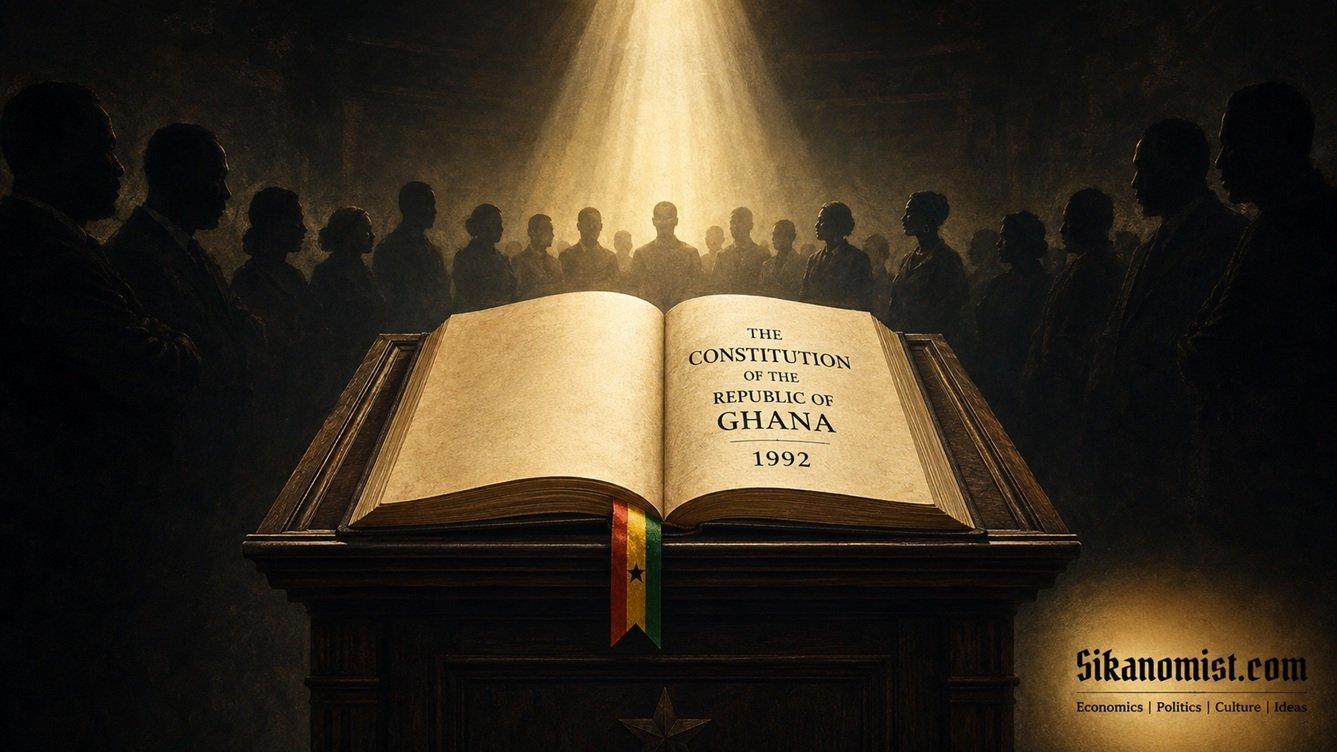
Ghana’s Constitution must not be changed in the dark.
The Constitution belongs to Ghana, not the government
The NDC currently forms the government, but the Constitution does not belong to the NDC. It does not belong to President Mahama, his ministers or the parliamentary majority.
In the same way, the Constitution does not belong to the NPP merely because it is the largest opposition party. Neither party should be permitted to turn the referendum into another opportunity to measure its popularity or prepare for the next general election.
The Constitution belongs equally to the NDC supporter, the NPP supporter, the smaller-party member and the Ghanaian who belongs to no political party. It belongs to every region, ethnic community, religious group and social class. It belongs to the present generation and to generations that have not yet been born.
The government has the responsibility to lead the legal and administrative process, but it must not behave as though its position paper represents the final opinion of the Ghanaian people.
A government position is exactly that: the position of the government. It must remain open to public examination, criticism and improvement.
If the government uses its control of state institutions, public communication platforms and national resources to promote only one side of the referendum, the process will lose credibility. Ministers should be able to defend the proposals, but state-funded public education must distinguish between neutral information and political advocacy.
Ghanaians must be allowed to understand the reforms before being asked to support them.
The NDC must resist the temptation to control the process
As the governing party, the NDC carries the greater institutional responsibility for ensuring that the process is transparent.
It must publish the proposed amendment bills early enough for proper public examination. The exact wording of every referendum question must be made available long before voting day. Citizens must know which constitutional provisions are being changed, the wording that will replace them and the practical consequences of each amendment.
The government must also resist the temptation to present support for the referendum as support for President Mahama or the NDC. A constitutional question should never be reduced to a test of loyalty to the government.
NDC communicators should not portray critics of particular proposals as enemies of progress. Lawyers, academics, journalists, civil society organisations and ordinary citizens must be free to question the reforms without being accused of doing the work of the opposition.
The government must also avoid using public projects, official tours, state vehicles, publicly funded advertisements or government institutions to create an unfair advantage for its preferred position.
A clean constitutional process requires more than obeying the minimum provisions of the law. It requires restraint from those who possess political power.
The NPP must not oppose for the sake of opposition
The NPP also has an important responsibility.
It must not automatically reject every proposal simply because the process is taking place under an NDC government. Opposition is essential to democracy, but opposition without careful reasoning can be as damaging as government control.
The NPP should examine each amendment on its merits. It should explain which proposals it supports, which it opposes and why. Where it disagrees with the government, it should offer clear alternatives rather than relying on fear, suspicion or partisan mobilisation.
The party must also be honest about positions it supported while in government. Ghanaian political parties often change their constitutional preferences depending on whether they control the presidency or sit in opposition.
A party may favour strong presidential powers while occupying the Jubilee House and suddenly demand restrictions when it loses an election. Another may condemn excessive presidential appointments while in opposition and then defend the same arrangement after returning to power.
This cycle must end.
A constitutional principle should remain sound whether the NDC or NPP is in office. Every party should therefore apply a simple test to each proposal: would we still support this amendment if our political opponent controlled the power it creates?
If the answer is no, the proposal requires further examination.
Every proposal must be explained separately
One of the greatest risks is that several unrelated reforms may be presented to citizens as a single political package.
A Ghanaian may support the election of Metropolitan, Municipal and District Chief Executives but oppose extending presidential and parliamentary terms. Another citizen may support changes concerning dual citizenship but disagree with reforms affecting the judiciary or the appointment of public officials.
These citizens should not be forced to approve a proposal they oppose merely to secure another reform they support.
Each major constitutional question should be clearly separated and explained. Where possible, unrelated amendments should be placed in distinct bills and presented through distinct referendum questions. The language on the ballot must be simple enough for the ordinary voter to understand.
The referendum cannot become a broad question asking Ghanaians whether they support “constitutional reform”. That would reveal very little about what the people actually want.
A vote should express informed consent to a particular change—not general support for reform, a political party or a sitting president.
Public education must begin before campaigning
Under Article 290 of the Constitution, an amendment to an entrenched provision must satisfy a demanding national test. At least 40 per cent of persons entitled to vote must participate, and at least 75 per cent of those voting must support the amendment.
These thresholds show that constitutional reform is intended to require broad national understanding and agreement—not a narrow partisan victory. Judicial Service of Ghana
The National Commission for Civic Education must therefore receive adequate funding and institutional freedom to conduct a comprehensive public education programme.
This education cannot consist only of distributing copies of a large legal document that most citizens will not have the time or training to study. Every major proposal should be accompanied by a short, clear explanation answering basic questions:
What does the Constitution currently say?
What change is being proposed?
Why has the change been recommended?
What benefits do its supporters expect?
What risks have critics identified?
When would the amendment take effect?
Would it apply to current officeholders or only to future ones?
These explanations should be translated into major Ghanaian languages and distributed through radio, television, newspapers, community information centres and digital platforms. Versions should also be made accessible to persons with visual, hearing and other disabilities.
Community discussions must extend beyond Accra. Farmers, traders, teachers, traditional leaders, organised labour, students, professional bodies, religious communities and Ghanaians living in rural areas must all have an opportunity to understand and discuss the proposals.
A constitutional referendum cannot be considered genuinely national if most of the serious conversation takes place among lawyers, politicians and television panellists in the capital.
Combining the referendum with local elections carries risks
Holding the referendum alongside the 2027 District Assembly Elections may reduce costs and help increase participation. However, it also presents a serious political risk.
District Assembly Elections are officially non-partisan. A national referendum campaign dominated by the NDC and NPP could bring party competition directly into the local elections, overshadowing community issues and weakening the non-partisan principle.
Candidates for local office may be pressured to declare support for one side. Political parties may attempt to use the referendum campaign to promote preferred Assembly candidates indirectly. Local development questions could disappear beneath a national partisan contest.
The Electoral Commission must anticipate this danger and establish clear rules separating referendum campaigning from the conduct of District Assembly Elections.
Citizens should be able to examine the suitability of their local candidates without being instructed to treat them as unofficial representatives of the NDC or NPP.
The media must illuminate, not inflame
Ghana’s media will carry an enormous responsibility.
Radio and television stations should not reduce the debate to noisy arguments between party communicators. Constitutional reform requires more than political accusations, selective quotations and declarations that one side is patriotic while the other is dangerous.
Media organisations should examine every proposal individually. They should invite constitutional lawyers, governance experts, local government practitioners, economists, civil society organisations and affected citizens to explain the likely consequences.
Journalists must fact-check campaign claims and distinguish between the existing Constitution, the committee’s recommendations, the government’s position and the final amendments placed before voters.
Headlines should inform rather than frighten. Presenters should challenge misleading claims from both government and opposition representatives.
The media must remember that the purpose of the referendum debate is not to produce winners during morning radio discussions. It is to help citizens make a decision that may shape Ghana long after today’s politicians have left office.
Campaign financing must be transparent
Constitutional campaigns cost money. Advertisements, rallies, vehicles, posters, media appearances and community mobilisation all require funding.
Ghanaians deserve to know who is financing the different campaigns and what interests they may have in the outcome. Political parties, civil society organisations, business groups and private individuals participating in organised campaigns should disclose major sources of funding and expenditure.
Anonymous money must not be allowed to influence the constitutional future of the country.
Public institutions must also account for money spent on voter education. Funds intended for neutral civic education should never be diverted into government propaganda.
A referendum can satisfy the technical requirements of voting while still being unfair in practice if one side controls public resources and the other depends on private contributions that remain hidden.
Reform should reduce excessive political power
The value of constitutional reform will not be measured by the number of articles amended. It will be measured by whether the changes improve the daily relationship between citizens and the state.
Ghana must ask whether the proposed reforms will strengthen independent institutions, make public officials more accountable, improve local government, protect citizens’ rights and reduce the winner-takes-all character of national politics.
The process should not merely extend political terms, redistribute appointments or create new positions for political elites. It should help build institutions that can work fairly regardless of the party in power.
The Constitution must protect the Ghanaian citizen when the citizen’s preferred party is in opposition—not only when that party controls the government.
It must make it difficult for any President, minister, parliamentary majority or public official to abuse power. It must strengthen the capacity of institutions to enforce the law without waiting for political permission.
If the reforms merely reorganise power among politicians without strengthening the citizen, Ghana will have changed the constitutional text without changing the country’s political culture.
Both parties must be willing to lose
A clean referendum requires the NDC and NPP to accept that the Ghanaian people may disagree with them.
If voters reject a proposal supported by the government, the NDC must respect the decision without blaming opposition propaganda or an ungrateful electorate.
If voters approve a proposal opposed by the NPP, the party must accept the result without automatically alleging manipulation.
Both parties should agree before the campaign that the Electoral Commission must remain independent, that public resources will not be misused, that intimidation will not be tolerated and that disputes will be resolved through lawful processes.
They must also condemn misinformation from their own supporters—not only falsehoods produced by their opponents.
The true test of democratic commitment is not how a party behaves when it expects to win. It is how it behaves when the people may choose another position.
Ghana needs an informed national decision
The 1992 Constitution has helped Ghana maintain constitutional rule and peaceful transfers of political power. It has also revealed weaknesses through more than three decades of practice. There is nothing wrong with reviewing it.
But constitutional reform must be guided by national interest, institutional experience and careful public reasoning.
The government must lead without controlling. The opposition must scrutinise without obstructing. The Electoral Commission must administer without favour. The NCCE must educate without campaigning. The media must explain without inflaming. Civil society must question without becoming an extension of a political party.
Most importantly, the Ghanaian citizen must be treated as the owner of the process—not merely a voter invited at the end to endorse decisions already made elsewhere.
The referendum should not ask Ghanaians to choose between the NDC and NPP. It should ask them to decide what constitutional arrangements can serve Ghana fairly under any future government.
The NDC will not remain in power forever. The NPP will not remain in opposition forever. Political fortunes will change, presidents will leave office and parliamentary majorities will rise and fall.
The Constitution will remain.
That is why it must not be amended through secrecy, haste, propaganda or partisan fear. Every proposed change must be placed in the light, examined openly and understood by the people.
Ghana’s Constitution belongs to the nation. The NDC must not control its reform, the NPP must not obstruct it for partisan advantage, and no Ghanaian should be asked to change it without first understanding exactly what the change will mean.