Ghana Cannot Create Jobs While It Remains Expensive to Produce
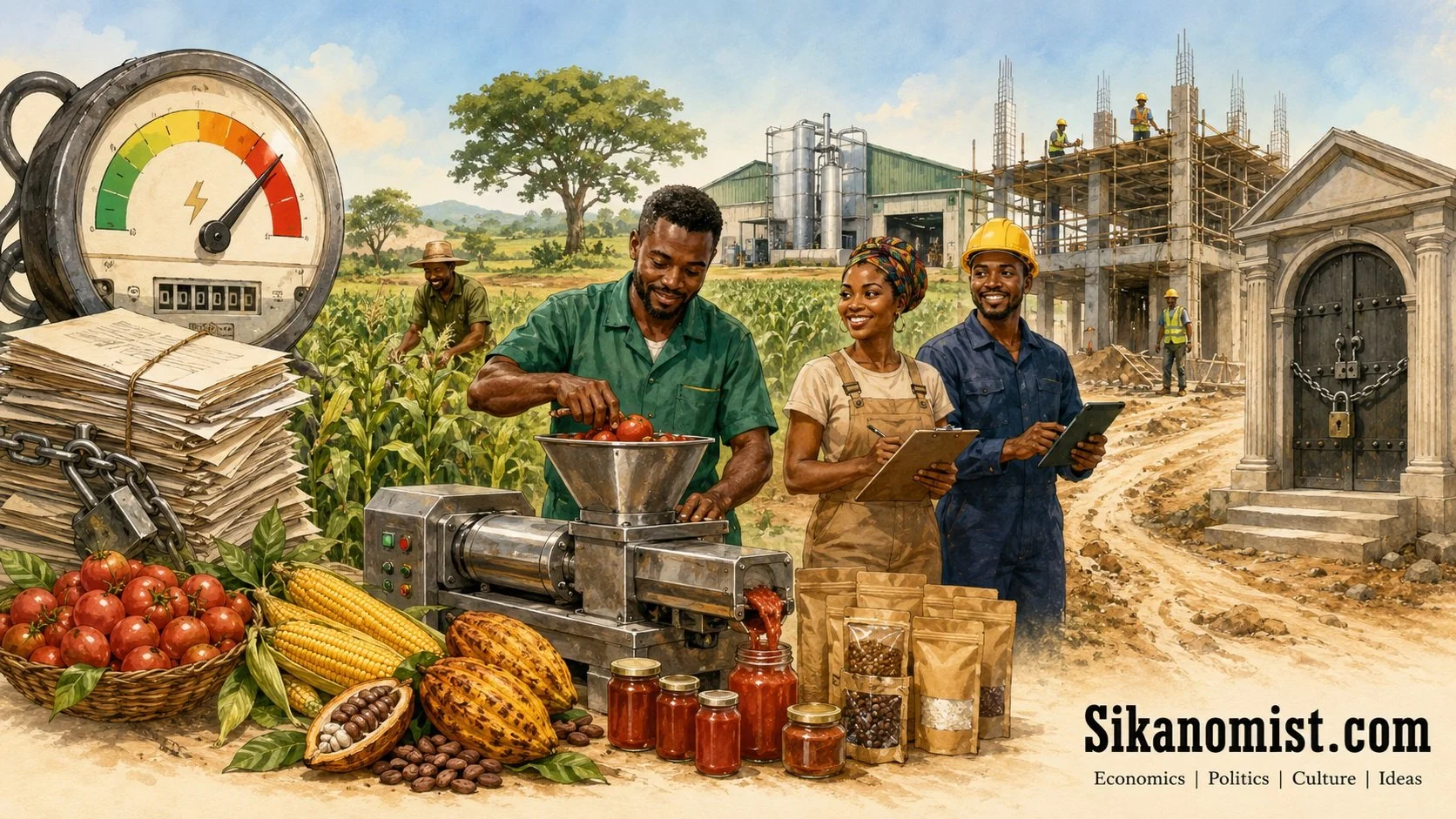
Ghana’s economy appears to be entering a new phase. Inflation has fallen significantly, the cedi has become more stable, foreign exchange reserves have improved and general business confidence is beginning to recover. These are important achievements. A country cannot build sustainable prosperity when prices are rising uncontrollably, its currency is collapsing and businesses cannot plan beyond the next week.
But economic stability is not the final destination. It is only the foundation.
The real test is whether stability will make it easier for Ghanaian farmers to grow more food, manufacturers to operate their factories, builders to complete houses, transport operators to renew their vehicles and small businesses to employ more people.
The Government has acknowledged this challenge. Deputy Minister of Finance Thomas Nyarko Ampem recently said the country was moving from restoring macroeconomic stability towards investment, production, exports and quality employment. He argued that stability must now produce industrial growth and jobs.
That is the correct direction. However, Ghana cannot create enough jobs while it remains unnecessarily expensive, uncertain and frustrating to produce goods and services within the country.
The numbers may improve before ordinary lives improve
Macroeconomic recovery often begins at the national level. It appears in inflation figures, exchange rates, interest rates, fiscal balances and foreign exchange reserves. These indicators matter because they shape the wider environment in which households and businesses operate.
But an improving national indicator does not immediately pay a worker’s salary or put food on a family’s table.
A stable cedi can reduce the cost of imported machinery and raw materials. Lower inflation can protect household incomes. Falling interest rates can eventually reduce borrowing costs. Yet these benefits must travel through banks, farms, factories, shops and workplaces before they become meaningful to ordinary people.
That transmission is not automatic.
If electricity remains expensive, credit remains difficult to obtain, roads remain poor and businesses continue to face several taxes, permits and inspections, the economy may become stable without becoming sufficiently productive.
Ghana must therefore avoid celebrating stability as though the work has been completed. Stability should be judged by what it enables the country to produce.
Agriculture is sending a warning
Recent data from the Ghana Statistical Service showed that agricultural growth slowed to 3.6 per cent in May 2026, compared with 9.8 per cent in May 2025. Agricultural output still expanded, and the comparison was influenced by the strong performance recorded a year earlier. Agriculture is also seasonal, so one month should not be treated as proof of a permanent decline.
Nevertheless, the loss of momentum deserves attention. Agriculture remains a major source of employment, food, rural income, industrial raw materials and export revenue. Prolonged weakness would eventually affect food prices, household welfare and the businesses that depend on agricultural products. Ghana Business News
Agriculture should not be treated merely as a social programme for poor rural communities. It is one of the foundations of national industry.
A tomato farmer supplies the processor who makes paste. A maize farmer supports poultry production. A cocoa farmer supplies factories and exporters. Livestock farmers support food processors, restaurants, traders and transport operators. Fishermen and fish farmers support markets, cold stores and hospitality businesses.
When agricultural production becomes unreliable, factories either operate below capacity or import raw materials. Both outcomes weaken Ghana’s ability to create employment.
The Akan proverb reminds us that “one head does not go into council.” Agriculture, manufacturing, transport, trade, finance and energy cannot be developed as separate economies. They must work together as one productive system.
Expensive electricity is an employment problem
The Association of Ghana Industries’ latest Business Barometer found that the high cost of electricity was the leading operating concern among businesses. Companies also identified raw-material costs, multiple taxes, limited access to credit and poor road infrastructure as serious difficulties. Ghana Business News
Electricity is not simply another household bill. It is an input in almost every modern economic activity.
A bakery needs power to produce bread. A cold store needs power to preserve food. A seamstress needs power to operate equipment. A welder needs power to fabricate doors and machinery. A hospital needs power to treat patients. A factory needs power to keep its production line operating.
When electricity becomes expensive, businesses have only a few choices. They can increase prices, reduce production, postpone expansion, employ fewer workers or close completely.
This means an expensive electricity system silently destroys jobs that have not yet been created.
Ghana must find a way to provide reliable and competitively priced power to productive businesses, particularly those engaged in manufacturing, agro-processing, cold storage, technology and other employment-intensive activities. Any special industrial tariff must be carefully designed and monitored so that it rewards genuine production rather than becoming a subsidy for politically connected companies.
The question should be simple: how much additional production and employment will Ghana receive in return for every energy incentive?
Regulation must protect without suffocating
Businesses must be regulated. Food must be safe. Buildings must be structurally sound. Factories must protect workers and communities. Taxes must be collected, and businesses must operate within the law.
However, necessary regulation can become destructive when several public institutions demand similar documents, conduct overlapping inspections and collect separate fees from the same small business.
A recent report on Ghanaian micro, small and medium-sized enterprises described entrepreneurs moving through a maze of registrations, licences, permits, renewals and inspections. Some businesses reported spending substantial portions of their limited capital on regulatory compliance. Time that could have been used to produce, sell and employ workers was instead spent following paperwork and visiting government offices. Ghana Business News
The solution is not to abolish safety and quality standards. It is to coordinate them.
Ghana should develop a genuine one-stop business compliance system. A business should have one regulatory account through which it can submit information, receive reminders, make payments and monitor applications. Where several agencies must inspect the same premises, they should conduct coordinated inspections or recognise one another’s verified information.
Digitisation alone will not solve the problem. A confusing process does not become efficient merely because it has been placed on a website.
The system must be simple enough for an ordinary Ghanaian entrepreneur to understand and use without constantly paying intermediaries.
When the path to formalisation is covered with thorns, we should not be surprised when businesses remain outside it.
Credit must reach production
Access to finance remains another obstacle. Even when the central bank reduces its policy rate, the small manufacturer, farmer or trader may still find commercial borrowing too expensive or impossible to obtain.
Banks have legitimate concerns. Small businesses may lack proper records, collateral, insurance or stable cash flows. Agricultural lending carries risks connected to weather, pests and price changes. Young businesses may have promising ideas without a long financial history.
But Ghana cannot build a productive economy if banks mainly prefer the safest and quickest returns while farms, factories and growing enterprises remain starved of capital.
The country needs financing systems that share risk without encouraging reckless lending. Credit guarantees, agricultural insurance, warehouse receipt systems, equipment leasing and properly governed development-finance programmes can help banks lend to productive enterprises more confidently.
Finance should also be connected to business support. Giving an entrepreneur money without helping that business improve its accounts, production standards, marketing and management may merely postpone failure.
The objective should not be to announce the largest possible loan fund. It should be to build businesses capable of borrowing, producing, employing people and repaying their loans.
Ghana needs a Production Compact
The next phase of Ghana’s recovery should be organised around a national Production Compact involving government, businesses, financial institutions, workers, universities, farmers and local authorities.
This compact should concentrate on a few practical priorities.
First, Ghana should reduce the cost and improve the reliability of electricity for genuine productive activity.
Second, agriculture should be connected directly to processing, storage and markets. Irrigation, improved seeds, livestock development, mechanisation and extension services must be supported by warehouses, cold-chain facilities and reliable purchasing arrangements.
Third, business regulation should be coordinated. Repeated information requests, unnecessary delays and overlapping inspections should be removed.
Fourth, productive enterprises should receive appropriately structured finance. Banks must remain responsible for assessing and recovering loans, but public policy can help reduce genuine risks.
Fifth, government procurement should give credible Ghanaian producers a fair opportunity to supply schools, hospitals, security institutions and public agencies. Local preference must not mean accepting poor quality or inflated prices. It should mean helping capable Ghanaian businesses compete under clear standards.
Finally, the country must measure results honestly. Government should publish regular information showing changes in production volumes, industrial electricity costs, agricultural yields, business registration times, domestic sourcing, private-sector lending and employment.
A programme should not be declared successful merely because money was allocated or a ceremony was held. Success must be visible in additional goods, stronger businesses and better jobs.
Production must serve the domestic economy too
Ghana’s economic ambitions should not be limited to producing for export. Exports are essential because they earn foreign exchange and connect Ghanaian businesses to larger markets. But the domestic economy also matters.
The houses built for Ghanaian families are part of the economy. So are the vegetables sold in Kejetia, the fish transported to Tamale, the furniture produced in Kumasi, the software developed in Accra and the repair services provided in Sunyani.
An economy becomes stronger when more goods and services change hands within the country, provided that production is efficient, lawful and valuable.
Ghana should certainly process more cocoa, gold, timber, fruits and other products for export. It must also produce more of the food, building materials, clothing, medicines, household goods and professional services needed by people living in Ghana.
Every useful product made locally can create a chain of income. The producer earns revenue, the worker receives a salary, the transporter gains business, the retailer makes a margin and the state collects taxes.
That is how production spreads prosperity.
Businesses and workers also have responsibilities
Government policy alone cannot build a productive country. Ghanaian businesses must improve quality, honour contracts, keep proper records, pay workers fairly and reinvest in their operations.
Some enterprises complain about the difficulty of accessing credit but do not maintain reliable accounts. Others receive support and divert the money into unrelated consumption. Some underpay workers while owners display wealth. These practices weaken trust and make financing more difficult for responsible businesses.
Workers must also recognise that productivity, punctuality, skills and care for equipment determine whether an enterprise can survive and expand.
Consumers have a role as well. Supporting Ghanaian products should not require people to accept inferior goods. Local businesses must earn loyalty through quality, consistency and good customer service. Ghanaian consumers, in return, should give competitive local products a fair opportunity.
Economic patriotism must be built on value, not guilt.
Stability must become something people can feel
Ghana has paid a heavy price for economic instability. Protecting the recent gains is therefore essential. Fiscal discipline must continue, public debt must be managed responsibly and the country must avoid returning to reckless borrowing and uncontrolled spending.
But discipline should create space for production, not permanent economic restriction.
The next chapter of Ghana’s recovery must be written inside farms, factories, workshops, construction sites, laboratories, offices and markets. It must appear in new products, completed houses, expanded businesses and reliable employment.
Ghanaians will believe that the economy has recovered when graduates can find meaningful work, farmers can sell profitable harvests, businesses can borrow at reasonable rates and families can afford locally produced necessities.
Economic stability prepares the ground, but only production can plant the jobs.
Ghana has begun to stabilise the numbers. It must now lower the cost of producing, investing and employing people. Otherwise, the country may achieve an impressive recovery on paper while leaving too many citizens waiting for recovery in their lives.
Reader’s Question
What must Ghana do first to make local production more affordable and turn economic stability into lasting jobs?