GoldBod Has Brought the Dollars—Now Ghana Must Count the Cost

Gold has become the most powerful force in Ghana’s economic recovery.
It has strengthened export earnings, increased foreign-exchange inflows and supported the rebuilding of the country’s international reserves. It has also provided the government with a compelling national story: Ghana is finally exercising greater control over the wealth beneath its soil.
At the centre of that story is the Ghana Gold Board—GoldBod.
Established to regulate, aggregate, assay, purchase and export gold, particularly from the artisanal and small-scale mining sector, GoldBod has helped channel transactions that previously occurred through fragmented or informal networks into an official national system.
That achievement should not be casually dismissed.
But neither should it be used to end the discussion about cost.
Recent figures have created what appears to be a contradiction. GoldBod reports a substantial financial surplus and points to record gold exports. Meanwhile, an International Monetary Fund analysis estimates that the rapid expansion of the Bank of Ghana’s Domestic Gold Purchase Programme generated losses exceeding US$1.7 billion in 2025.
Both claims can exist because they do not necessarily describe the same account.
Ghana must therefore move beyond the political contest between those shouting “success” and those shouting “scandal”. The country needs a complete and independently reconciled account of what it bought, what it sold, what it earned, what it spent and which public institution ultimately carried the risk.
GoldBod has achieved something important
Before GoldBod, a significant portion of Ghana’s small-scale gold trade operated through private and sometimes informal channels. Gold could leave the country without the corresponding foreign exchange passing transparently through Ghana’s banking system.
This weakened export reconciliation, encouraged smuggling and denied the country the full foreign-exchange benefit of its production.
GoldBod has helped centralise that system.
The IMF’s analysis of Ghana’s Domestic Gold Purchase Programme says the programme was instrumental in facilitating approximately US$10.9 billion in artisanal and small-scale gold exports during 2025. Total Ghanaian gold export earnings were reported at about US$20 billion, up from approximately US$10.3 billion in 2024. IMF analysis, GoldBod
Not all that increase can be attributed to GoldBod. Higher international gold prices, increased production and exports by established mining companies also contributed.
Nevertheless, GoldBod appears to have helped bring more small-scale gold and its associated foreign exchange into the formal economy.
That is a genuine national benefit.
The centralised system has also strengthened assaying, licensing, traceability and official oversight. GoldBod’s first-quarter 2026 report recorded approximately US$2.02 billion in artisanal and small-scale gold exports and detailed expanded inspections and enforcement operations. GoldBod’s first-quarter report
These are not imaginary achievements.
The dollars matter—but export earnings are not profit
The first mistake in the public debate is treating export earnings as though they were profits available to the state.
If Ghana exports US$20 billion worth of gold, it does not mean the government has earned US$20 billion.
Most of that amount represents the value of gold purchased from miners or produced by mining companies. Payments must be made to producers. Aggregators, transporters, assayers, refiners, financiers and off-takers may also receive fees or margins.
There may be currency-conversion costs, financing expenses, purity differences, insurance charges and valuation gains or losses.
The relevant national question is therefore not simply how many dollars passed through the system.
The question is:
After purchasing, financing, transporting, assaying, refining and selling the gold—and after accounting for all exchange-rate movements—what was Ghana’s net benefit?
High turnover can coexist with low profit. Strong foreign-exchange inflows can coexist with substantial public costs. A programme may achieve an important policy objective while still being unnecessarily expensive.
Ghana needs all three parts of the story.
There are three different accounts
Much of the confusion can be reduced by separating three financial ledgers.
First: GoldBod’s corporate account
GoldBod’s audited figures indicate an operational surplus of approximately GH¢909.7 million for 2025 and an overall surplus of about GH¢5.44 billion.
But the overall surplus included approximately GH¢4.55 billion in government seed capital or unutilised subvention provided to support gold purchasing and trading. That money was properly recognised under public-sector accounting rules, but it was not ordinary recurring income earned from commercial operations. Graphic Online
This does not mean GoldBod made a loss. Its operational income remained positive after removing the government injection.
It means only that the GH¢5.44 billion overall surplus should not be presented as though every cedi came from profitable gold trading.
Second: the Bank of Ghana’s account
Under the earlier structure, GoldBod operated partly as an agent within the Bank of Ghana’s Domestic Gold Purchase Programme. The Bank of Ghana financed or carried financial exposure arising from certain gold transactions.
Consequently, GoldBod could earn fees and report an operational surplus while trading losses, exchange-rate differences or reserve-acquisition costs appeared on the central bank’s balance sheet.
Reuters reported that the Bank of Ghana recorded an overall operating loss of about GH¢15.6 billion in 2025, driven largely by monetary-policy and reserve-building costs, including losses connected to gold purchases. Reuters
This does not automatically make GoldBod a loss-making institution. But it also means GoldBod cannot be assessed in complete isolation from the public programme within which it operated.
Third: Ghana’s national economic account
The final account is broader than either institution.
Ghana may have received benefits that do not appear as GoldBod’s corporate profit: stronger reserves, reduced gold smuggling, increased foreign-exchange liquidity, improved traceability and a more stable currency.
But Ghana may also have incurred costs outside GoldBod: Bank of Ghana losses, taxes surrendered, purchasing premiums, exchange-rate exposure and environmental destruction associated with higher small-scale mining activity.
The proper assessment must combine all three accounts.
What exactly does the US$1.7 billion represent?
The IMF analysis has become the most controversial part of the debate.
It estimated that the rapid scaling up of the Domestic Gold Purchase Programme in 2025 resulted in losses exceeding US$1.7 billion—approximately 1.5% of Ghana’s GDP—almost entirely connected to artisanal gold purchases under the Gold-for-Reserves programme.
GoldBod disputes describing this amount as its corporate loss. It argues that the figure represents central-bank policy and accounting costs associated with reserve accumulation, currency movements and liquidity provision—not an operational deficit recorded by GoldBod itself. GoldBod’s response
That distinction is important.
The country should not attach the entire figure directly to GoldBod without explaining how the programme was financed and where the losses were recognised.
But describing the figure as a “policy cost” does not make it disappear.
Every public policy has a cost. Even when the cost is incurred deliberately to achieve currency stability or build reserves, it remains a cost borne by a public institution and, ultimately, by the country.
The correct response is not to deny the figure or sensationalise it. It is to reconcile it.
Why does the IMF estimate exceed the losses that appear under particular lines in the Bank of Ghana’s accounts? Does it include exchange-rate valuation, off-taker fees, forgone taxes, financing costs or other quasi-fiscal expenses? Over what period was it calculated? Which components have already been recovered through subsequent sales or revaluations?
These questions require a technical answer, not a political insult.
A policy cost can be justified—but it must pass a test
Governments regularly spend money to achieve broader economic objectives.
The Bank of Ghana incurs costs to control inflation and manage liquidity. The government subsidises agriculture, education, energy and transport because the wider social benefits may justify the expenditure.
Gold reserve accumulation can also justify reasonable costs.
The country may decide that spending a certain amount to capture foreign exchange, discourage smuggling, build reserves and reduce currency instability is worthwhile.
But a cost becomes defensible only when three conditions are satisfied.
First, the public must know its complete size.
Second, the government must demonstrate that the benefits exceeded the cost.
Third, officials must show that the same benefits could not have been achieved more efficiently.
It is not enough to say that US$10.9 billion in foreign exchange entered the formal system, because Ghana gave up gold of roughly corresponding value. The real benefit lies in the portion of foreign exchange that would otherwise have escaped the official system, together with the reserve, tax, regulatory and currency-stability gains.
That counterfactual must be estimated carefully.
If most of the gold would have been exported through official channels anyway, the additional benefit may be smaller than claimed. If GoldBod genuinely prevented large-scale smuggling and secured foreign exchange that would otherwise have remained abroad, the benefit may be substantial.
The evidence should decide.
GoldBod cannot take all the credit and none of the cost
GoldBod’s defenders understandably resist attempts to place every Bank of Ghana loss on the institution.
But they must also avoid the opposite inconsistency.
GoldBod cannot claim responsibility for the stronger cedi, increased reserves and wider macroeconomic stability while insisting that all programme costs belong exclusively to the Bank of Ghana.
Benefits and costs must be assessed using the same boundary.
If GoldBod is only an agent when losses are discussed, it cannot suddenly become the sole architect of national economic stability when achievements are announced.
Ghana’s recovery has been supported by several factors: fiscal consolidation, debt restructuring, monetary policy, high gold prices, increased exports, improved reserves and greater confidence.
GoldBod has contributed, but no single institution should claim the entire recovery.
The IMF’s recommendation points towards the solution
The IMF has called for the Domestic Gold Purchase Programme to be transferred fully away from the Bank of Ghana and for quasi-fiscal activities to be discontinued at the central bank. It has emphasised that protecting the Bank of Ghana’s independence and balance sheet is essential to sustaining economic stability. IMF
This is sensible.
The central bank should not become a hidden financing vehicle for government commercial programmes. If the state wishes to subsidise gold purchases for strategic reasons, the cost should be approved transparently through the national budget.
That allows Parliament and the public to see it.
GoldBod should increasingly finance its trading activities through its own capital, commercial banks, properly structured off-taker arrangements and clearly authorised government equity.
Risk should not be quietly transferred to the Bank of Ghana.
Ghana needs a consolidated gold account
The solution is not another press conference.
GoldBod, the Bank of Ghana, the Ministry of Finance, the Auditor-General and Parliament should produce a consolidated annual account of the national gold-purchasing programme.
For every major component, the report should disclose:
The quantity and purity of gold purchased.
The average domestic purchase price.
The international benchmark price.
The amount paid to aggregators and off-takers.
Assay, insurance, transport and refining costs.
The source and cost of financing.
Foreign exchange received and returned to Ghana.
Gold retained as reserves.
Trading and exchange-rate gains or losses.
Taxes and royalties collected or surrendered.
GoldBod’s operational income and expenditure.
Costs appearing on the Bank of Ghana’s balance sheet.
The final fiscal cost to the government.
Estimated reductions in smuggling.
Environmental and traceability compliance.
The public should be able to follow the financial journey from the cedis used to purchase a gram of gold in Ghana to the dollars received after that gold is exported or the bullion added to national reserves.
GoldBod’s website currently provides audited financial statements and quarterly reports, but its dedicated trade-report page states that no trade reports have yet been published. That gap should be closed as the institution’s commercial role expands. GoldBod trade reports
More gold must also mean better mining
Financial accounting is only part of the national cost.
If record gold purchases encourage more illegal mining, destroy farms and pollute rivers, Ghana cannot count the foreign exchange as a pure economic gain while ignoring the environmental liability.
GoldBod must therefore ensure that every gram it purchases can be traced to a legal and environmentally responsible source.
A formal buyer should not become a clean exit route for illegally mined gold.
District purchasing centres, digital traceability and compulsory assaying should be supported by reliable mine identification, environmental compliance and sanctions against licensed buyers who accept illegally sourced gold.
Ghana should not stabilise its currency by destabilising the land and water on which its people depend.
Protect GoldBod through transparency
GoldBod is potentially one of Ghana’s most important economic institutions.
It can reduce smuggling, formalise small-scale gold trading, improve foreign-exchange retention, develop refining and help Ghana capture more value from its natural resources.
That is precisely why it must not be protected from scrutiny.
Institutions are not strengthened by applause alone. They are strengthened by sound rules, independent audits, transparent reporting and the correction of design weaknesses.
If GoldBod’s benefits exceed its costs, a consolidated account will prove it and build public confidence. If parts of the programme are too expensive, the same account will show where reform is required.
Either outcome will help GoldBod.
Count both the gold and the cost
Ghana should neither condemn GoldBod as a failure nor celebrate it as an unquestionable miracle.
The institution has brought more gold trade and foreign exchange into the formal economy. It has strengthened the country’s ability to monitor and participate in a sector that was too fragmented for too long.
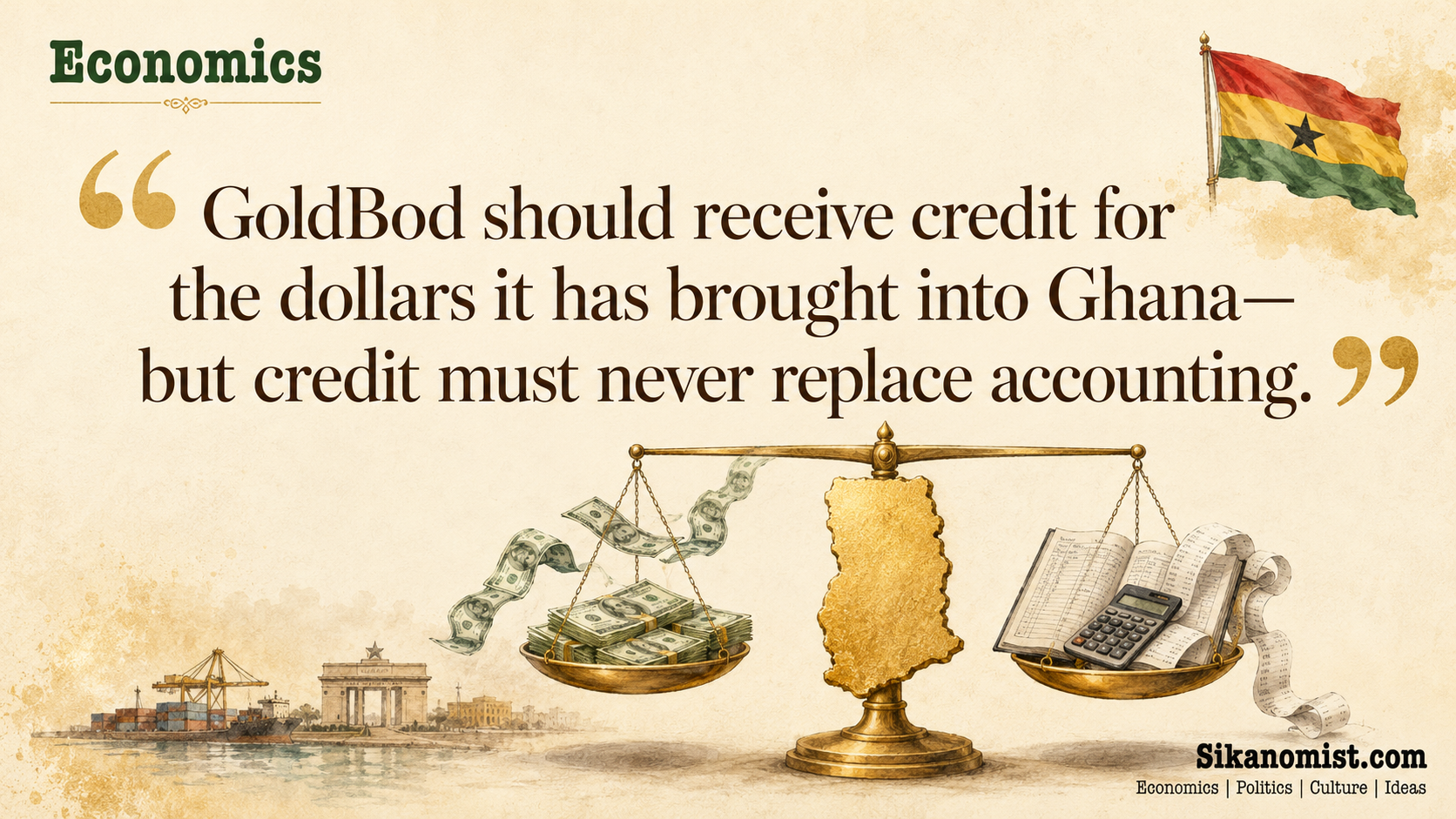
But national pride cannot replace accounting.
Export earnings are not profits. Reserve accumulation is not free. A surplus in one public institution does not cancel a loss recorded in another. And macroeconomic benefits do not justify avoidable inefficiency.
GoldBod has helped bring the dollars.
Now Ghana must count every cost required to bring them—and ensure that the country receives more value from its gold than it gives away.
Reader’s Question
Do GoldBod’s foreign-exchange, reserve-building and anti-smuggling benefits justify the reported public costs—or could Ghana have achieved the same results more efficiently?