Ghana’s Culture Is Making Billions—But Is the Money Reaching Its Custodians?
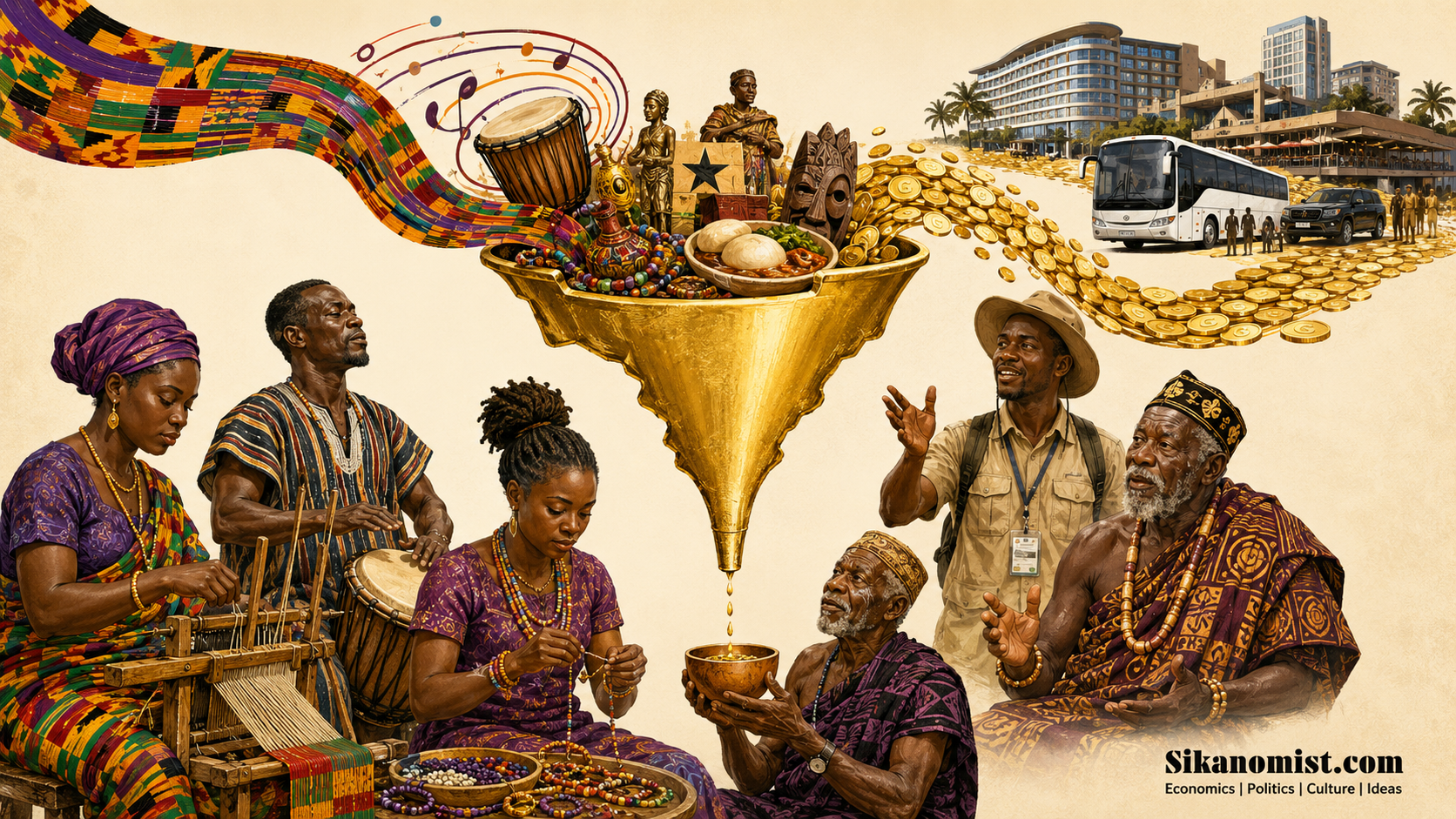
Ghana’s tourism sector appears to be entering an encouraging period of growth.
According to figures announced by the Ministry of Tourism, Culture and Creative Arts, Ghana welcomed approximately 1.3 million international visitors in 2025, while international tourism generated an estimated US$4.34 billion. Domestic tourism visits also increased from about 1.68 million in 2024 to 1.79 million in 2025.
The country’s ten most visited attractions recorded approximately 1.38 million visits, representing about 77 per cent of all visits to tourist attractions during the year. The Kwame Nkrumah Memorial Park, Kakum National Park, Bonsu Arboretum and Eco Park, Cape Coast Castle, Manhyia Palace, Kumasi Zoo, Accra Zoo, Elmina Castle, Shai Hills Resource Reserve and Aburi Botanical Gardens dominated the list. MyJoyOnline
These numbers deserve recognition. They show that Ghana’s history, environment, hospitality and cultural identity have considerable economic value.
But they should also lead us to ask a more difficult question: Who is receiving the money?
Tourists do not come to Ghana only because there are hotels, airports and restaurants. Many come because Ghana possesses a living culture that cannot be reproduced elsewhere. They come for our festivals, traditional leadership, music, food, textiles, architecture, historical sites, communal warmth and connection to the African story.
If this culture is helping Ghana earn billions of dollars, the people who preserve it should not remain among the poorest participants in the tourism economy.
Tourism revenue is not the same as community prosperity
The reported US$4.34 billion represents activity across the wider tourism economy. It may include spending on accommodation, transport, food, shopping, entertainment, telecommunications and other services. It would therefore be inaccurate to suggest that all this money was generated directly by cultural attractions.
However, culture remains one of the foundations upon which Ghana’s tourism appeal is built.
A visitor may sleep in a large hotel, travel in a commercial vehicle and eat at an urban restaurant, but the reason for making the journey may be Cape Coast Castle, an Akwasidae celebration, a traditional festival, a craft village or a connection to African ancestry.
The cultural community creates the attraction, but other businesses may capture most of the expenditure surrounding it.
This is not necessarily wrong. Tourism naturally supports many sectors. The concern arises when the people preserving the traditions, stories and places that attract visitors receive only occasional tips, small trading opportunities or temporary work.
A tourism industry can grow nationally while its host communities remain economically unchanged. More visitors do not automatically produce better schools, sanitation, roads, healthcare, conservation or permanent employment in the places being visited.
Ghana must therefore measure more than arrivals and total spending. It must measure how tourism changes the lives of the people living around its attractions.
The custodians of culture are producing economic value
Culture does not preserve itself.
Festivals survive because traditional leaders, families, priests, queen mothers, drummers, dancers, cooks and community organisers carry responsibilities from one generation to another. Traditional textiles survive because farmers, dyers, designers, seamstresses and weavers continue to practise skills that can take years to master.
Historical memory survives because elders, historians, teachers and storytellers continue to explain what places and ceremonies mean.
These people are not merely colourful additions to the tourism industry. They are cultural producers. They create and preserve something of economic value.
Yet many remain outside the formal tourism economy. Their participation may not come with contracts, pensions, insurance, intellectual-property protection or predictable income. Their communities may receive attention during festivals and official visits but see little permanent investment afterwards.
When culture generates income without strengthening its custodians, preservation becomes more difficult. Young people may abandon traditional crafts because the work cannot provide a livelihood. Historic buildings may deteriorate because communities lack restoration funds. Sacred ceremonies may be shortened, distorted or commercialised to satisfy visitors.
Eventually, Ghana could find itself promoting a culture whose foundations it failed to protect.
Ghana needs a transparent map of tourism money
The tourism figures are promising, but Ghanaians need more information about how the sector’s value is distributed.
Government should publish an annual tourism value-chain report showing where visitors travelled, what they spent money on, how many permanent jobs were created and how much income reached local businesses and host communities.
The report should also show:
Revenue collected at major tourist attractions.
The proportion reinvested in maintenance and conservation.
The number of local people employed at each site.
Contracts awarded to businesses within host communities.
Regional distribution of tourism investment.
Support given to artisans, performers and cultural organisations.
The number of women, young people and persons with disabilities benefiting from tourism programmes.
Such transparency would help Ghana distinguish between tourism publicity and tourism development.
A successful festival should not be judged only by the number of dignitaries who attended, the size of the crowd or the attention it attracted on social media. We should also ask how many local traders earned income, how much performers were paid, whether sanitation and security improved and what permanent facilities remained after the celebration.
Host communities must have a visible share
Ghana should establish clear community-benefit arrangements around major cultural and heritage attractions.
A defined portion of appropriate site revenue could support conservation and agreed community priorities. This should not become an opaque fund controlled by a few individuals. It must be governed transparently, independently audited and used for projects that residents can see.
Depending on local needs, the money could support public toilets, waste management, street lighting, heritage restoration, community museums, apprenticeship programmes and small-business facilities.
Tourism authorities should also encourage hotels, restaurants and event organisers to buy from local suppliers. Food, textiles, furniture, artwork, toiletries, uniforms and souvenirs can be sourced from Ghanaian producers, particularly businesses near tourist destinations.
This would allow tourism income to circulate within local economies instead of quickly leaving them.
A busload of visitors should mean more than entrance fees. It should create opportunities for trained local guides, food vendors, photographers, transport operators, craft producers and storytellers.
Cultural workers must be treated as professionals
Ghanaian performers and artisans are often expected to contribute their work in exchange for “exposure”. This attitude weakens the creative economy.
A drummer, dancer, poet, sculptor, filmmaker, guide or traditional textile producer is offering skilled labour. Exposure cannot pay for food, tools, healthcare or education.
Publicly funded cultural events should therefore operate with transparent fees and written agreements. Organisers must budget properly for creative labour rather than treating performers as ceremonial decorations.
The country must also strengthen protection for traditional designs, music, symbols and stories. Communities should not discover that elements of their heritage have been commercially reproduced elsewhere without acknowledgement or benefit.
Culture can be shared with the world without surrendering the rights and dignity of those who created it.
Tourism must extend beyond a few celebrated attractions
The concentration of about 77 per cent of recorded visits among ten attractions reveals both success and imbalance.
Ghana possesses significant cultural, natural and historical assets across all sixteen regions, but many remain difficult to reach, poorly maintained or inadequately promoted. Some lack trained guides, reliable roads, clean washrooms, signage, emergency services and suitable accommodation.
The answer is not to abandon the popular attractions. They require continued investment and protection. But Ghana must use their success to build wider tourism circuits.
Visitors travelling to a famous attraction should be introduced to nearby towns, craft centres, traditional food businesses, landscapes and lesser-known historical sites. This can lengthen their stay and distribute their spending more widely.
Tourism development should not mean constructing the same artificial attraction in every region. Each community should be supported to present what is authentic and distinctive about its own history and environment.
Culture must not become a performance without meaning
Commercialisation carries another risk: traditions can gradually be altered until they exist mainly to entertain visitors.
Festivals are not simply outdoor concerts. Many carry spiritual, historical, agricultural or communal meaning. Traditional institutions are not theatre companies, and sacred spaces are not ordinary commercial venues.
Communities must retain authority over how their traditions are presented. Tourism officials and private investors should consult them before packaging ceremonies, images or sacred practices for commercial purposes.
Visitors should be welcomed, but they should also be educated. Responsible tourism must encourage respect for community rules, appropriate photography, sacred areas, local dress expectations and the deeper meaning of cultural practices.
The objective should not be to freeze Ghanaian culture in the past. Culture naturally evolves. The objective is to ensure that change is shaped by the people who live the culture—not imposed solely by commercial demand.
The new cultural ambitions must produce lasting benefits
Ghana is preparing to host the maiden Africa Festival of Arts and Creatives from 9 to 12 December 2026. The Government says the festival could create opportunities for more than 20,000 people across tourism and the creative arts. MyJoyOnline
Ghana has also secured a five-year partnership with South Korea, involving approximately US$4.5 million in financial and technical support for tourism, culture and the creative arts. The cooperation includes training for heritage-site managers and institutional capacity building. Ministry of Tourism, Culture and Creative Arts
These initiatives are welcome, but their success should be measured through lasting outcomes.
How many sustainable businesses will be created? How many cultural workers will secure decent contracts? Which heritage sites will be restored? How many young people will be trained and supported to earn a living? What proportion of expenditure will reach communities beyond Accra?
These are the measurements that can turn cultural celebrations into cultural development.
The people behind the culture must prosper
Ghana should be proud that more people want to visit, explore and experience the country. Tourism can create employment, strengthen national identity, attract foreign exchange and help communities recognise the value of their heritage.
But rising visitor numbers must not become the only definition of success.
The true achievement will come when a young weaver can earn a respectable income from preserving an inherited craft; when a historical community can maintain its heritage without begging for support; when cultural performers are properly paid; and when residents can point to better livelihoods and public facilities created by tourism.
Ghana must not build a tourism economy that sells the people’s culture while leaving its custodians poor.
If our culture is valuable enough to bring billions into the national economy, then the people who preserve, practise and protect it must be visible among its greatest beneficiaries.
Reader’s Question:
Do you believe Ghana’s cultural communities and creative workers are receiving a fair share of the country’s growing tourism income?