Stonebwoy at Wembley Is a Victory—But Ghana Must Build an Industry Bigger Than Its Stars
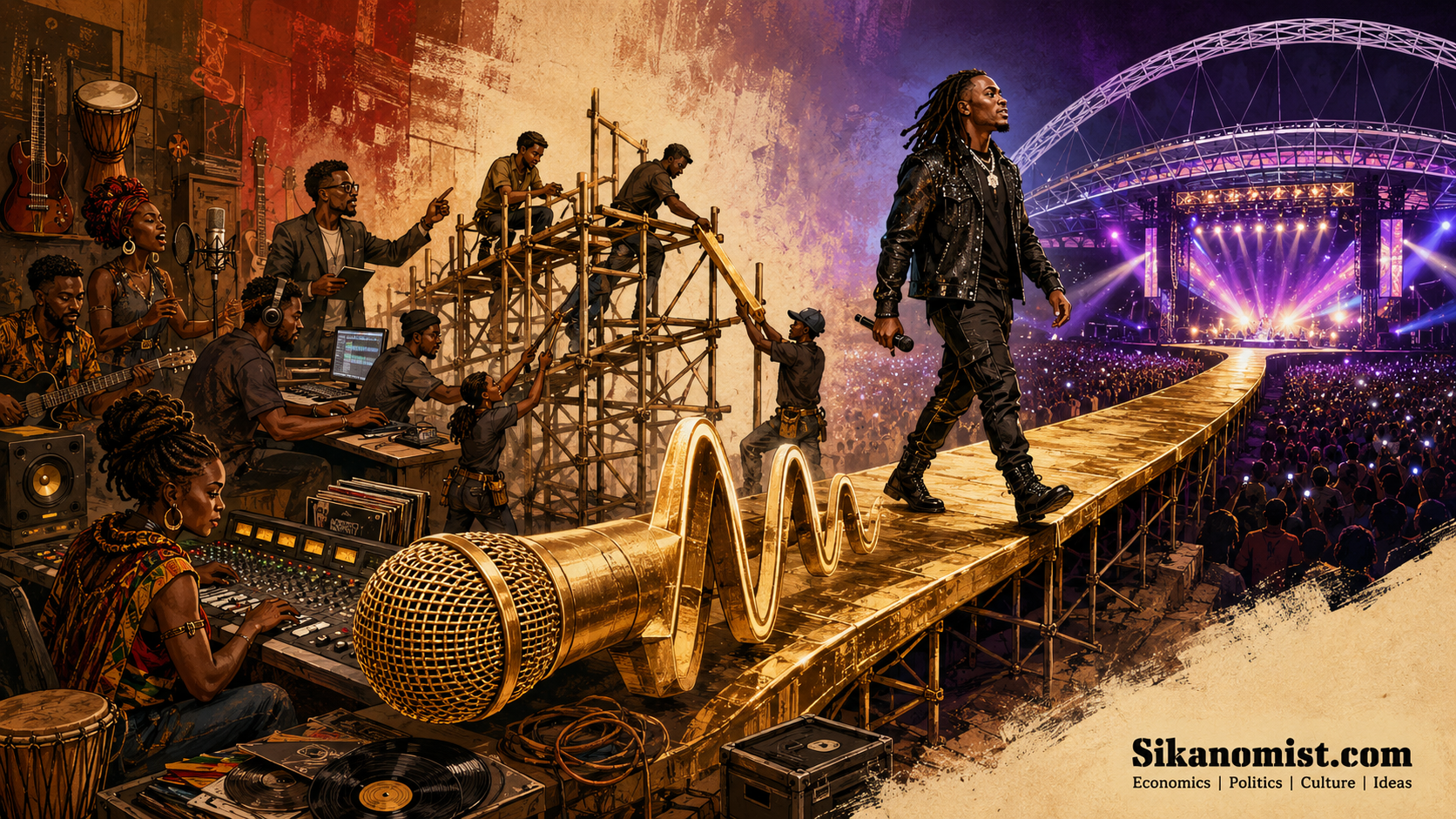
Artistic impression of Stonebwoy makes history at OVO Arena Wembley in London
Stonebwoy’s successful performance at London’s OVO Arena Wembley was more than another international concert by a Ghanaian musician. It was a significant cultural achievement and an important demonstration of what Ghanaian talent can accomplish when artistic discipline is combined with professional planning, strong production and a loyal international audience.
The 15 August 2026 edition of the BHIM Festival reportedly made Stonebwoy the first Ghanaian musician to headline a sold-out concert at the 12,500-capacity venue.
The festival brought Ghanaian music, fashion, history and visual symbolism into one of Britain’s most recognised entertainment arenas. The stage design drew inspiration from Black Star Square, while the programme honoured the foundations of Ghanaian Highlife and presented Afro-Dancehall as a distinctive sound with international potential.
Stonebwoy was joined by Ghanaian performers including Samini, Kwabena Kwabena, Ofori Amponsah and DopeNation. Other African and Caribbean performers helped position the event as a meeting point between Ghana, the wider African continent and the global Black diaspora. MyJoyOnline
This was a proud moment for Ghana.
But national pride should not prevent national reflection.
Stonebwoy has shown that a Ghanaian musician can command a major international stage. The larger question is whether Ghana has built an industry capable of helping hundreds of other talented musicians develop sustainable international careers.
This achievement did not happen overnight
Major concerts are won long before the performer steps onto the stage.
They require rehearsals, production planning, contracts, marketing, ticketing, security, transportation, visas, sound engineering, stage design, sponsorship, media relations and financial risk management.
The official OVO Arena description presented the concert as a self-produced headline performance reflecting years of global touring and strategic positioning. It also described BHIM Festival as an established platform that had already delivered ten editions and attracted tens of thousands of patrons in Ghana and beyond. OVO Arena Wembley
That history matters.
The Wembley milestone was not created by sudden excitement on social media. It was built through years of releasing music, cultivating audiences, maintaining a recognisable identity, performing internationally and turning BHIM Festival into an exportable cultural product.
Stonebwoy and his team deserve credit not only for artistic success but also for the organisational work behind it.
However, when one Ghanaian musician succeeds internationally, the country often celebrates the individual without studying the system that made the achievement possible.
We congratulate the star, share photographs, raise the Ghanaian flag and move on to the next headline. We rarely ask how the experience can become a blueprint for strengthening the whole industry.
A concert is also an export
When a Ghanaian musician fills an international venue, Ghana is exporting more than songs.
The artist is exporting language, fashion, choreography, visual identity, cultural memory and national reputation. The event creates income through tickets, merchandise, hospitality, transportation, technical services, broadcasting, sponsorship and digital content.
A successful international concert may create work for musicians, backing vocalists, dancers, stylists, photographers, videographers, designers, publicists, managers, sound engineers, security professionals and event organisers.
It can also increase interest in Ghanaian food, tourism, fashion and other creative products.
Music is therefore not a side activity that becomes important only during awards ceremonies or political campaigns. It is an economic product capable of generating employment, foreign exchange and international influence.
Countries that understand the creative economy do not merely celebrate their stars. They build institutions around them.
Ghana must do the same.
Our stars are often stronger than our systems
Ghana has produced generations of influential musicians. Highlife helped shape popular music across West Africa. Hiplife created a powerful bridge between Ghanaian language, storytelling and modern urban sound. Gospel, Afro-Dancehall, Afrobeats and other forms continue to find audiences at home and abroad.
Yet the business structures surrounding Ghanaian music remain weaker than the talent they are expected to support.
Many musicians still struggle to find professional managers. Contracts are sometimes entered without adequate legal advice. Royalty collection remains a source of frustration. Record keeping is poor, and reliable industry data are difficult to obtain.
Some emerging artists are expected to finance recording, promotion, videos, performances and transportation from their personal income. They may become popular without becoming financially secure.
A song can be heard everywhere while the person who created it remains unable to account for how much money it generated.
This is not a shortage of talent. It is an institutional failure.
Stonebwoy’s Wembley achievement should therefore inspire more than applause. It should remind Ghana that individual determination is carrying responsibilities that should also be supported by a functioning industry.
Ghana needs professional music management
A talented musician is not automatically an accountant, lawyer, marketing specialist, tour manager, negotiator and digital strategist.
Artists need professional teams.
Ghana must deliberately develop music managers who understand branding, contracts, publishing, touring, sponsorship, audience data and international markets. Universities, technical institutions and creative organisations should introduce practical courses in music business and entertainment management.
These programmes must not remain theoretical. Students should work with practising artists, organise real events, study royalty statements, negotiate sample contracts and learn how tours are financed.
The music industry also needs specialised lawyers, accountants and investment advisers who understand the risks and revenue models of creative businesses.
When professional services are absent, artists become vulnerable to unfair agreements, poor financial decisions and disputes that can destroy promising careers.
Royalties must become reliable income
Ghana cannot build a serious music industry while creators remain uncertain about royalties.
Musicians, songwriters, producers and other rights holders must be able to understand where their work is being used, how revenue is calculated and when they will be paid.
Royalty institutions must operate transparently. Collection and distribution systems should be digitised, regularly audited and explained to members in language they understand.
Radio stations, television networks, event organisers, streaming platforms, restaurants, hotels and other commercial users of music must comply with copyright obligations.
Artists must also be educated about publishing rights, master recordings, licensing, digital distribution and ownership. A musician should know the difference between becoming famous and controlling a valuable catalogue.
The country should measure the success of its music not only by views and streams but also by how much income returns to Ghanaian creators.
The next generation needs infrastructure
A major international performance requires world-class preparation. Ghanaian musicians should not have to travel abroad before gaining regular access to suitable rehearsal facilities, sound equipment, technical expertise and professional performance spaces.
The country needs affordable rehearsal studios, live-music venues, creative-business centres and production facilities capable of supporting artists at different stages of their development.
Such facilities should not be concentrated only in Accra.
Kumasi, Tamale, Takoradi, Cape Coast, Ho, Sunyani and other cities contain young musicians and creative professionals who deserve opportunities to develop without first relocating to the capital.
Local performance circuits can help musicians build audiences gradually. Smaller venues, university concerts, regional festivals and professionally managed cultural centres can prepare artists for larger national and international stages.
Wembley should be the peak of a long professional journey—not the first place where an artist encounters world-class production.
Ghana must learn to market its sounds globally
Ghanaian music should not be treated as a single sound.
Highlife, Hiplife, Gospel, Afro-Dancehall, traditional music, contemporary Afrobeats and emerging experimental forms all have different histories and potential audiences.
A serious export strategy would identify markets for each genre, support international collaborations and promote Ghanaian performers at festivals, conferences and industry showcases.
Ghanaian diplomatic missions could help provide market information, promote legitimate cultural events and connect artists with diaspora organisations. They should not select favourites or attempt to control the industry. Their role should be to make legitimate international engagement easier.
The country also needs better data.
How much revenue does Ghanaian music generate? Which countries stream it most? How many people are employed by the sector? What are the major barriers facing international tours? Which artists and genres are attracting new audiences?
Without reliable information, public policy becomes guesswork.
The diaspora is an economic and cultural partner
Stonebwoy’s Wembley success also demonstrates the value of the Ghanaian and wider African diaspora.
Ghanaians abroad are not merely spectators waiting to celebrate successful artists. They can be promoters, investors, media partners, technical professionals and market connectors.
Diaspora audiences provide musicians with communities that understand the language, humour and cultural references within their work. From this foundation, artists can expand towards wider international audiences.
Ghana should create stronger links between its creative industry and diaspora professionals in entertainment, technology, law, finance and marketing.
But the diaspora should not be treated only as a source of money. Collaboration must be professional and mutually beneficial. Artists must arrive prepared, promoters must honour contracts and audiences must receive productions worthy of the prices they pay.
Strong diaspora support cannot permanently compensate for weak organisation.
Government should enable—not control—the music industry
Government has a role in strengthening the creative economy, but that role must be carefully defined.
Politicians should not determine which musicians succeed. Artists should not need political connections to receive opportunities, and public programmes should not become rewards for entertainers who support the governing party.
Government’s responsibility is to create a fair environment: enforce copyright, improve venues, support professional training, simplify legitimate business processes, strengthen cultural institutions and provide transparent financing mechanisms.
Public support should be accessible through clear criteria and independent assessment.
Creative financing should also be treated as investment rather than charity. Banks and financial institutions need better ways to evaluate music catalogues, tours, festivals, production companies and other creative assets.
An artist with a strong audience, reliable streaming history and professional management may possess a viable business even without traditional physical collateral.
Success must create opportunities beyond the headline artist
Stonebwoy deserves the rewards of his work. Building an industry around his achievement does not mean diminishing his individual success or demanding that he carry every emerging musician.
It means ensuring that major cultural achievements create wider learning and opportunity.
The professionals who worked on the Wembley production should be encouraged to document their experience. Ghanaian event organisers, students, managers and technical professionals can learn from how the concert was planned, financed, promoted and delivered.
The event should help establish higher standards for performance preparation, stage design, audience experience and financial accountability.
It should also strengthen the confidence of younger musicians. Stonebwoy’s presence at Wembley makes the international stage appear less distant—but inspiration without opportunity can quickly become frustration.
Young artists need pathways through which ability can be discovered, trained, financed and connected to markets.
The industry must become bigger than any single star
Ghana has often depended on exceptional individuals to carry its name internationally. This produces proud moments, but it does not automatically produce a sustainable industry.
A strong music nation should be able to generate new performers, managers, producers, composers, technicians and entrepreneurs continuously. When one artist retires, the system should remain capable of producing another generation.
That is what Ghana must build.
Stonebwoy’s Wembley performance should be remembered as a cultural milestone. It demonstrated that Ghanaian music can command a large international audience without abandoning its identity.
But the greater tribute to this achievement would be to create the conditions under which it becomes less unusual.
The goal should not be for Stonebwoy to remain the only Ghanaian musician capable of filling such a venue. The goal should be for his success to mark the beginning of a stronger period for Ghanaian music.
A Ghanaian star can conquer Wembley through courage, preparation and individual excellence. But only a functioning music industry can turn that victory into lasting employment, stronger institutions, export income and opportunities for thousands.
Ghana must therefore celebrate Stonebwoy—but it must also build beyond him.
Reader’s Question:
What must Ghana do to turn the international success of its musicians into lasting opportunities for the entire creative industry?