Ghana Must Turn Research into Medicines, Jobs and Industry
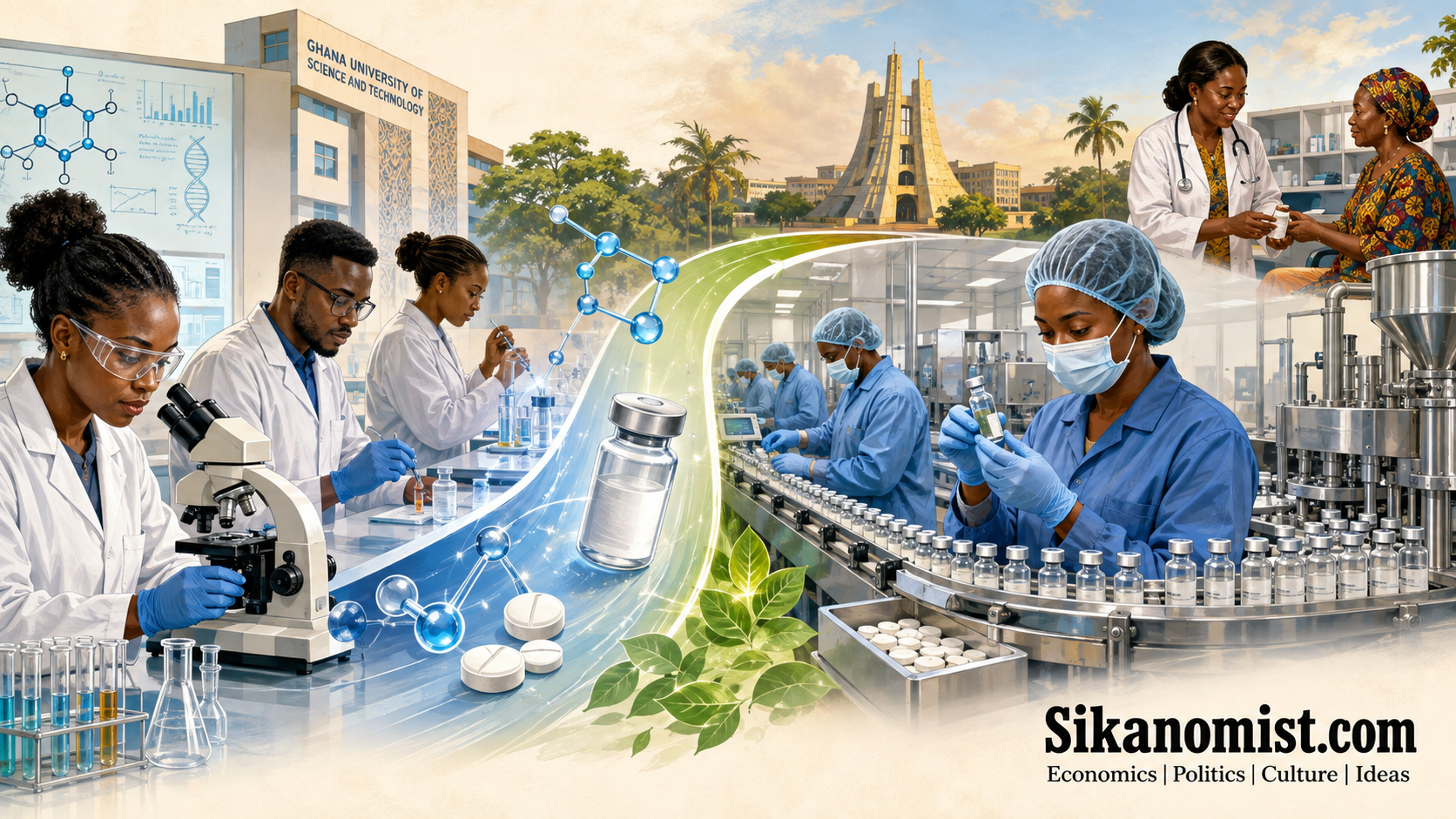
Ghana has universities, scientists, pharmacists, laboratories and pharmaceutical companies capable of solving important health problems. What the country has often lacked is a reliable bridge connecting scientific research to commercially manufactured products.
That bridge is beginning to receive attention.
Eight partnerships involving Ghanaian research institutions and pharmaceutical manufacturers have received €2 million in grants to support the development of medicines, vaccines and diagnostic technologies. Ghanaian partners are contributing an additional €425,000, bringing the combined investment to €2.425 million.
The projects cover important national health needs, including malaria treatment for children, tetanus-diphtheria vaccines, snake antivenom, hypertension treatment, herbal medicines and artificial-intelligence-assisted diagnostics. The participating institutions include KNUST, the University of Cape Coast, the University of Ghana, the Ghana Atomic Energy Commission, the Centre for Plant Medicine Research and several Ghanaian pharmaceutical companies. Ghana Business News
This is encouraging news. But Ghana should not measure the programme’s success by the number of projects selected, the size of the grant or the prominence of the institutions involved.
The real test will come when a medicine developed in a Ghanaian laboratory passes rigorous testing, receives regulatory approval, enters commercial production, reaches a hospital or pharmacy and improves the life of a patient.
A discovery that never leaves the laboratory may earn praise, but it cannot treat a patient or employ a worker.
Ghana does not lack scientific ability
Ghanaian universities and research institutions have produced valuable knowledge for decades. Scientists have studied malaria, infectious diseases, medicinal plants, agriculture, nutrition, water, engineering and public health.
The country also has respected institutions such as the Noguchi Memorial Institute for Medical Research, the Kumasi Centre for Collaborative Research in Tropical Medicine, the Centre for Plant Medicine Research, the University of Ghana, KNUST, the University of Cape Coast and the Council for Scientific and Industrial Research.
The challenge is that too much promising research ends with a conference presentation, academic publication, graduation ceremony or final report.
Academic publication is important. It allows researchers to share knowledge, defend their findings and contribute to wider scientific understanding. However, research intended to solve a practical problem must eventually move beyond the printed page.
A promising medicine must undergo further development. Its ingredients must be standardised. Its safety, stability and effectiveness must be tested. Manufacturing methods must be developed. Regulatory requirements must be satisfied. Intellectual property must be protected. Investment must be secured, and production must reach a scale that makes the medicine affordable.
Each stage requires different skills, institutions and sources of finance.
The scientist who discovers a promising treatment may not know how to build a commercial factory. The manufacturer may not have the resources to finance several years of research. The investor may consider the project too risky. The regulator cannot approve a product without sufficient evidence. Meanwhile, the university may reward researchers more for publications than for patents, licensed technology or commercial products.
This is the space in which promising Ghanaian discoveries too often become stranded.
The laboratory and the factory must meet earlier
One important feature of the new projects is the partnership between researchers and manufacturers.
This relationship must become normal across Ghana’s research system. Manufacturers should not wait until a university has completed a project before asking whether it can be produced commercially. Researchers should not develop products without understanding the production standards, market conditions and regulatory requirements they will eventually face.
The laboratory and the factory must meet from the beginning.
A manufacturer can help researchers understand whether raw materials are consistently available, whether a production method can be expanded and whether the eventual product can compete in price and quality.
Researchers, in turn, can help manufacturers develop original products instead of depending permanently on imported formulations and foreign technology.
Ghana needs more scientists who understand commercialisation and more businesspeople who understand scientific research. Universities should develop professional technology-transfer offices capable of managing patents, licensing agreements, industrial partnerships and university-based companies.
Researchers must also receive a fair share of the value created from their work. When intellectual-property rules are unclear or unfair, scientists may have little reason to pursue commercial development.
As the proverb reminds us, “knowledge is like a baobab tree; one person’s arms cannot embrace it.” Scientists, manufacturers, investors, regulators and hospitals must work together if Ghanaian research is to reach Ghanaian patients.
Medicine production is also economic production
Local pharmaceutical manufacturing should not be treated only as a health-sector ambition. It is also an industrial and employment strategy.
A functioning pharmaceutical industry creates work for pharmacists, chemists, biologists, laboratory scientists, engineers, technicians, packaging companies, transporters, software developers, quality-control professionals and machine-maintenance specialists.
It creates demand for laboratories, warehouses, cold-chain systems, clean water, reliable electricity and specialised education. It can also support the development of glass, plastics, printing, packaging and chemical industries.
The economic effect therefore extends beyond the medicine factory.
Ghana currently imports all its vaccines and most of its pharmaceutical products, according to the programme supporting Ghana’s pharmaceutical and vaccine industry. This exposes the country to foreign-exchange pressures and disruptions in international supply chains. GIZ
The COVID-19 pandemic demonstrated the danger of excessive dependence on foreign production. When global demand became urgent, countries naturally placed their own populations first. African countries with limited manufacturing capacity had to wait for supplies, donations and international distribution arrangements.
Health security does not require Ghana to manufacture every medicine or medical device it uses. That would be unrealistic and economically wasteful.
It requires the country to identify essential products it can produce safely, consistently and competitively. Ghana should build strength in selected areas where its health needs, scientific expertise and commercial opportunities meet.
Malaria treatments, antivenoms, selected vaccines, diagnostic products, maternal-health medicines and properly standardised plant-based treatments may offer such opportunities.
Ghana must finance the difficult middle
Scientific research and mass production do not require the same type of financing.
A laboratory may need a grant to test an idea. A clinical trial may require patient capital that accepts uncertainty. A pharmaceutical company may need a long-term loan to acquire equipment and expand production. A successful product may later attract commercial investment.
Ghana must therefore develop a financing system that supports the different stages of the journey.
The first experiment should not be financed like an established factory. At the same time, public funds should not continue supporting a project indefinitely when it has no realistic scientific or commercial future.
Funding should be released according to clear milestones. These might include successful laboratory results, completion of safety studies, regulatory progress, manufacturing readiness and evidence of market demand.
Projects that meet their targets should receive further support. Those that fail should be honestly evaluated so that future researchers can learn from them.
Failure is a normal part of scientific development. Concealing failure, exaggerating progress or continuing to fund a weak project for political reasons is not.
Ghana must also prevent promising research programmes from becoming dependent permanently on foreign grants. International partnerships are valuable because they bring finance, technology and experience. But Ghanaian institutions, pension funds, banks, companies and government agencies must gradually develop the ability to finance commercially promising research.
The country cannot speak seriously about scientific sovereignty while expecting foreign taxpayers to finance every step.
The regulator must enter the process early
Medicines cannot be treated like ordinary consumer products. A defective shirt may disappoint its buyer, but an unsafe medicine can destroy a life.
Ghana’s Food and Drugs Authority must therefore maintain rigorous standards. The country has an important foundation: the FDA has achieved Maturity Level 3 under the World Health Organization’s regulatory benchmarking system. This classification describes a stable, well-functioning and integrated regulatory system for medical products. World Health Organization
This regulatory strength can become an economic advantage. International investors and neighbouring countries are more likely to trust products manufactured under a credible regulatory system.
However, strong regulation should not mean that researchers encounter the regulator only after spending years developing a product.
The FDA should provide early scientific and regulatory guidance without compromising its independence. Researchers need to understand the evidence, manufacturing standards and documentation required before they reach the final stages of development.
This can prevent expensive mistakes and reduce unnecessary delays.
The objective must not be to approve Ghanaian medicines because they are Ghanaian. It must be to help Ghanaian products meet the standards required of safe and effective medicines anywhere in the world.
Public procurement can help create a market
Even after a medicine has been approved, a local manufacturer may struggle to secure sufficient demand to justify large-scale production.
Government is one of Ghana’s largest purchasers of medicines through public hospitals, health programmes and the National Health Insurance Scheme. Public procurement can therefore become an important part of industrial development.
Where a Ghanaian medicine meets the required standards and offers competitive value, public institutions should give it a fair opportunity. Long-term purchasing agreements for selected essential products could give manufacturers the confidence to invest in equipment, training and production capacity.
However, local preference must never become permission to supply poor-quality or overpriced products.
The public should not be forced to choose between supporting Ghanaian industry and receiving safe medical treatment. Local manufacturers must compete on quality, reliability, affordability and service.
Procurement must also remain transparent. Contracts should not be awarded to politically connected companies with little manufacturing capacity. Ghana has previously seen industrial programmes weakened by favouritism, abandoned factories and expensive announcements that produced little lasting value.
The objective is not to create protected pharmaceutical businesses that survive only through government contracts. It is to help serious Ghanaian manufacturers become efficient enough to serve both domestic and international markets.
Ghana can serve West Africa
Ghana’s market alone may not support every specialised pharmaceutical product. The wider West African market creates a larger opportunity.
A Ghanaian company capable of manufacturing reliable antivenom, paediatric malaria medicines, diagnostics or selected vaccines could serve neighbouring countries facing similar health challenges.
The programme’s ambition is therefore not merely “Made in Ghana for Ghana”, but also production from Ghana for West Africa.
To achieve that ambition, Ghanaian products must meet international standards. Manufacturers must invest in quality control, documentation, skilled personnel, modern equipment and dependable supply chains.
Regional success will not come from patriotic slogans. It will come when doctors, hospitals, regulators and patients in other countries trust Ghanaian products.
That trust will take years to build and only a few incidents to destroy.
Universities must redefine achievement
Ghanaian universities should not abandon fundamental research simply because every project cannot become a commercial product. Some discoveries have value even when their immediate economic use is not visible.
But institutions should broaden their understanding of academic achievement.
A lecturer who helps develop an affordable medicine, improves a manufacturing process or establishes a successful scientific company should be recognised alongside one who publishes extensively.
Students should also receive opportunities to work inside pharmaceutical companies, regulatory institutions and commercial laboratories. Courses in pharmaceutical science, chemistry, biology and engineering should include practical exposure to manufacturing, quality assurance, intellectual property and entrepreneurship.
If Ghana wants a knowledge economy, it must produce graduates who can move comfortably between the classroom, laboratory and factory.
The country must also retain its scientists. Ghana cannot invest heavily in training researchers and then leave them with outdated equipment, uncertain contracts and limited opportunities. Skilled professionals will naturally move to countries where their abilities are supported and rewarded.
Better laboratories, research careers and industrial opportunities are therefore part of the fight against brain drain.
The grants must become products
The eight newly funded projects offer Ghana an opportunity to demonstrate what research-commercialisation can achieve.
But the public should be given more than announcements. Each project should have clear objectives, timelines and measurable stages. Periodic reports should explain what has been achieved, what difficulties have emerged and what further support may be required.
Commercial confidentiality and patient privacy must be protected, but public money and international grants still require public accountability.
Within the coming years, Ghanaians should be able to ask:
How many projects completed their research successfully?
How many reached clinical or regulatory evaluation?
How many products received approval?
How many entered commercial production?
How many skilled jobs were created?
How much imported medicine was replaced?
How many products entered other African markets?
Did patients receive safe medicines at better prices?
These are the results that will determine whether the programme becomes an industrial turning point or another collection of promising launch ceremonies.
From knowledge to national prosperity
Ghana’s future will not be secured only by exporting gold, cocoa and crude oil. Natural resources remain important, but the most prosperous countries also export knowledge, technology, specialised services and manufactured products.
A medicine developed by Ghanaian scientists and manufactured by a Ghanaian company represents more than a tablet or vial. It combines education, research, regulation, engineering, finance, industry and public health.
It shows what becomes possible when a country does not merely consume knowledge produced elsewhere but uses its own intelligence to solve problems.
Ghana must therefore treat the new research grants as the beginning of a permanent system—not a temporary project. Universities, pharmaceutical companies, regulators, financial institutions and government purchasers must build a clear path from discovery to production.
The country already possesses much of the human ability required. What it needs is coordination, patient financing, credible regulation, industrial discipline and the determination to complete the journey.
Ghana’s laboratories must not become warehouses for unfinished ideas. They must become starting points for medicines, factories, skilled employment and healthier lives.
Reader’s Question
What must Ghana do to ensure that promising research moves beyond the laboratory and becomes safe, affordable medicine for patients?