Ghana Has Completed Its IMF Bailout—But the Hardest Test Begins Now
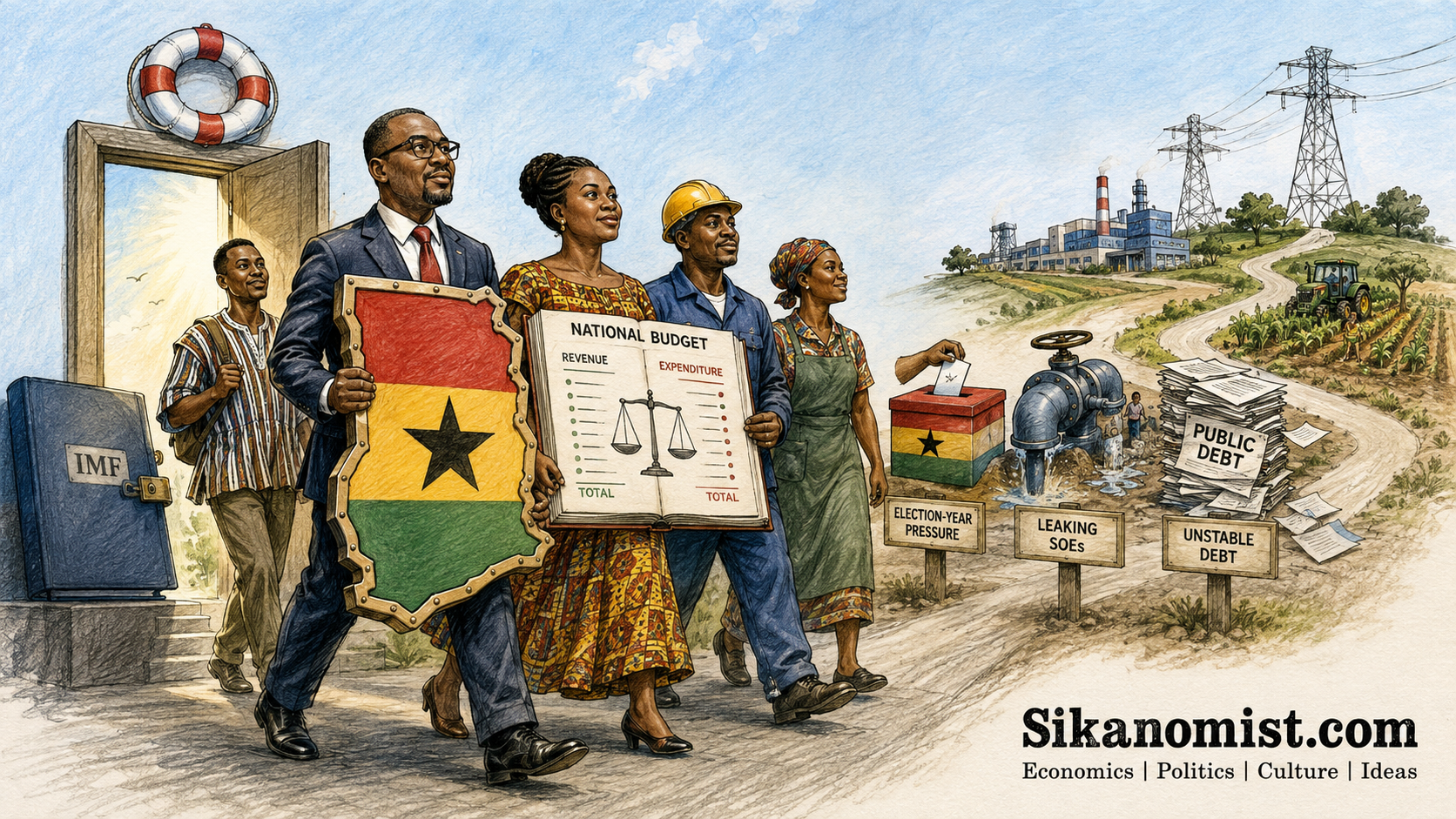
Ghana has reached an important point in its economic recovery.
On 27 July 2026, the Executive Board of the International Monetary Fund completed the sixth and final review of Ghana’s US$3 billion Extended Credit Facility programme. The decision made approximately US$371 million available as the final disbursement and brought total programme disbursements to about US$3 billion.
For a country that entered the programme after defaulting on much of its debt, suffering severe currency depreciation and recording inflation above 50 per cent, this is a significant achievement.
The latest figures provide genuine reasons for encouragement. Ghana’s economy grew by 6 per cent in 2025 and by 6.4 per cent year on year in the first quarter of 2026. Inflation fell further to 4.6 per cent in July 2026. Gross international reserves reached US$11.9 billion at the end of 2025, while the primary fiscal balance moved from a deficit of 4.3 per cent of gross domestic product in 2022 to a surplus of 2.1 per cent in 2025. The IMF has also upgraded Ghana’s risk of debt distress from high to moderate. International Monetary Fund and Ghana Statistical Service
These improvements did not happen by accident. They came through debt restructuring, tighter public spending, strong monetary policy, better reserve accumulation, favourable gold earnings and difficult reforms that imposed real costs on households, businesses, pensioners and investors.
The country should recognise the progress without pretending that the work is finished.
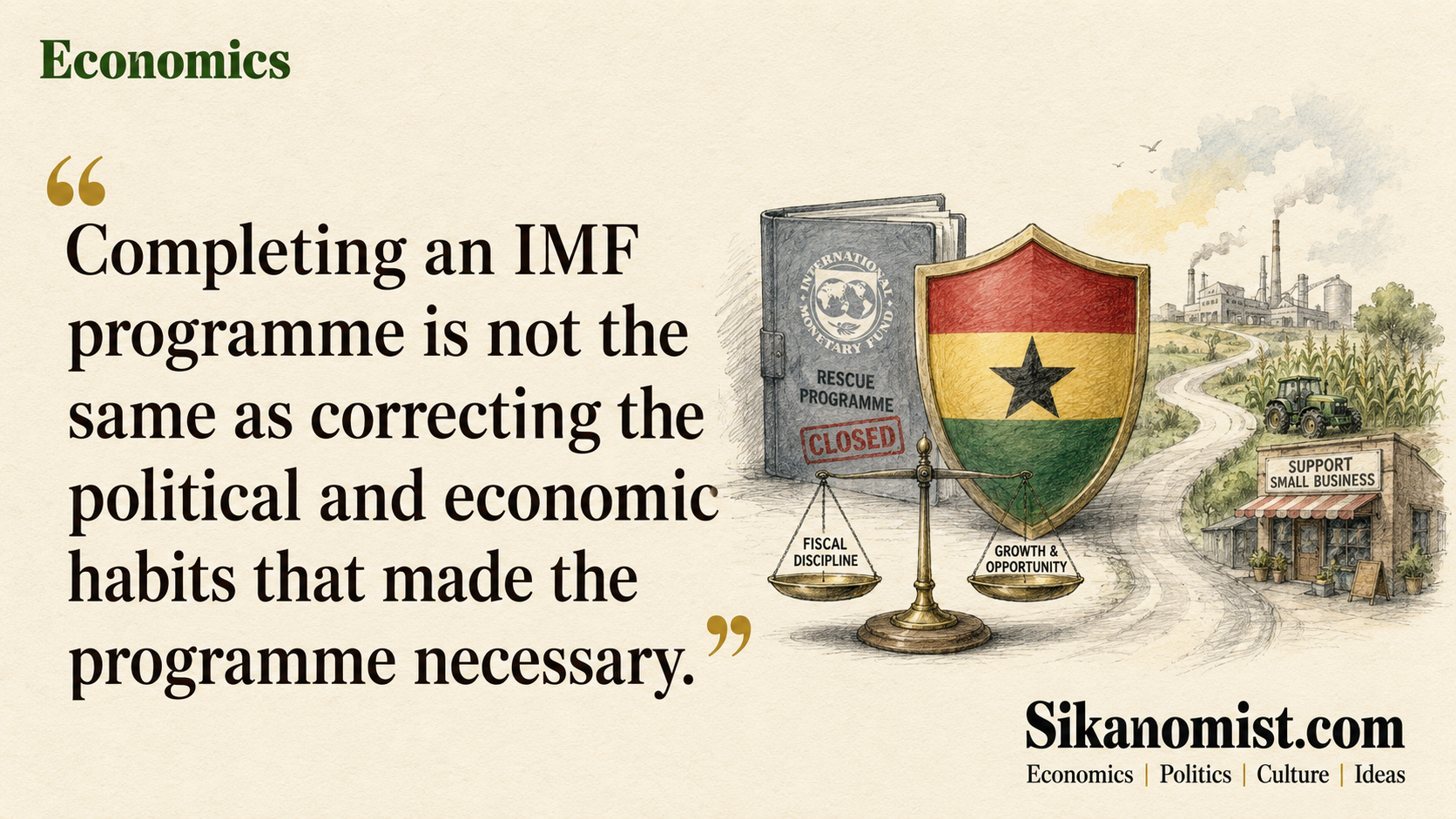
Completing an IMF programme is not the same as correcting the political and economic habits that made the programme necessary.
The final review is therefore not a graduation ceremony at which Ghana receives a certificate declaring that all its economic problems have been solved. It is the moment when the country must prove that it has learnt enough to avoid returning to the same condition.
What Ghana has actually completed
Public discussion often describes an IMF programme as though it were simply a loan. The money matters, but the programme involved much more than money.
The Extended Credit Facility provided financing while requiring Ghana to meet targets and undertake reforms involving the budget, debt, inflation, public financial management, the Bank of Ghana, the energy sector, cocoa, state-owned enterprises and the financial system.
The sixth review confirmed that Ghana’s performance had been broadly satisfactory. Inflation fell sharply, reserves improved, the primary balance moved into surplus and progress was made on the restructuring of public debt.
This deserves credit. The current Government completed the programme, while important parts of the adjustment began under the previous Government. The Bank of Ghana, Ministry of Finance, Parliament, public institutions, businesses and citizens all carried part of the burden.
Economic recovery should not be reduced to a party slogan. The crisis damaged the whole country, and the work of recovery has crossed administrations.
But Ghana should also be precise about what has ended. The final review of the lending programme has been completed, and the Extended Credit Facility is due to expire in August 2026. Ghana is not, however, ending its policy relationship with the IMF.
At the Government’s request, the country is moving into a 36-month Policy Coordination Instrument. This new arrangement does not provide another IMF loan. It is designed to monitor and support the continuation of reforms, strengthen policy credibility and help Ghana attract financing from development partners and eventually return to international capital markets.
The IMF report says the new arrangement will extend beyond the 2028 election and help reduce the risk of policy slippages during the electoral cycle. IMF 2026 Ghana Country Report
That detail is important.
Ghana has completed the bailout, but it has not yet reached the point where international lenders, investors or even its own citizens can confidently assume that fiscal discipline will survive political pressure.
The hardest test is what happens without an emergency
Ghana is often capable of acting decisively during a crisis.
When the cedi is falling rapidly, inflation is rising and creditors are refusing to lend, government accepts difficult reforms. Spending is controlled. Revenue measures are introduced. Officials pay greater attention to financial targets. Political leaders speak about sacrifice and national responsibility.
The more difficult test comes when conditions improve.
Once inflation falls, the cedi strengthens and international confidence begins to return, pressure grows to relax discipline. Ministries want larger budgets. Political groups demand rewards. New programmes are announced. Projects are selected without proper financing. Government may begin borrowing again because the immediate danger appears to have passed.
This is how yesterday’s rescue can quietly prepare tomorrow’s crisis.
Ghana has completed IMF programmes before. The country completed another Extended Credit Facility programme in 2019 after receiving praise for macroeconomic gains. Yet only a few years later, it returned to the IMF following one of the most serious economic crises in its recent history.
The lesson is not that IMF programmes are useless. The lesson is that temporary external discipline cannot substitute for permanent domestic institutions.
If we forget why we fell, we prepare ourselves to fall again.
Election-year spending remains Ghana’s great danger
The latest IMF report contains a warning that Ghanaians should not ignore.
At the end of 2024, the ceiling on the accumulation of government payables was missed by a large margin—equivalent to 3.9 per cent of GDP. According to the report, the slippage reflected pre-election commitments made by ministries outside the Ghana Integrated Financial Management Information System.
In simple language, public bodies made commitments outside the main system intended to control and record government spending. The bills did not disappear. They became arrears and were inherited by the state. IMF 2026 Ghana Country Report
This is one of the most dangerous weaknesses in Ghana’s public finances.
A government can appear to meet its official deficit target while contractors, suppliers and public institutions are waiting for money that has already been committed. The unpaid bill is still a public obligation even if it has not yet appeared as a cash payment.
This practice harms more than the national accounts. A Ghanaian contractor who completes work but waits years for payment may be unable to pay employees, service a bank loan or begin another project. Banks then record bad loans, workers lose jobs and projects deteriorate.
The state transfers its financial indiscipline to private citizens and businesses.
The 2024 experience also demonstrates why Ghana’s post-IMF success will be tested most severely during the next election cycle. Every government finds fiscal discipline easier in its first years than in the months before an election.
The 2028 election must not become another season of hurried contracts, unbudgeted recruitment, politically timed payments and projects designed mainly for campaign announcements.
Ghana needs a rule that no ministry, department or public agency can commit the state to expenditure without verified budgetary authority and registration in the official financial-management system. Any official who deliberately bypasses that rule should face a real personal sanction.
A public officer should not be able to create millions of cedis in liabilities and leave the consequences for taxpayers without accountability.
Fiscal discipline must become Ghanaian policy
There is a risk that fiscal responsibility will continue to be presented as something the IMF demands from Ghana.
That is the wrong understanding.
The IMF does not suffer when Ghana overspends, accumulates arrears or weakens its currency. Ghanaians suffer. Workers see their salaries lose purchasing power. Businesses struggle with unstable costs. Pensioners become poorer. Young people face fewer job opportunities. The state spends more on interest and less on roads, schools, hospitals and water.
Fiscal discipline is therefore not an IMF punishment. It is protection for the Ghanaian citizen.
The country now has a stronger fiscal-responsibility framework and a debt anchor intended to bring public debt towards 45 per cent of GDP by 2034. The 2026 budget targets a primary surplus of 1.5 per cent of GDP, while the IMF considers a lower surplus from 2027 compatible with debt sustainability only if Ghana strengthens revenue, public financial management, public investment and oversight of state-owned enterprises. International Monetary Fund
These rules must apply regardless of which party forms the government.
When an administration wishes to depart from the fiscal rule because of a war, pandemic, natural disaster or genuine national emergency, it should explain the reason publicly, state the cost and provide a clear timetable for returning to the rule.
Political convenience should never be disguised as a national emergency.
Discipline cannot mean starving development
Ghana must also avoid a second mistake: believing that good economic management means simply spending less on everything.
The IMF acknowledges that recent fiscal adjustment has depended heavily on spending compression even though Ghana has large development, social and security needs. Some of the strong 2025 fiscal result also reflected slower-than-expected execution of capital projects.
A road that was not built may improve the year’s spending figure, but it does not improve transport. A delayed hospital may reduce expenditure temporarily, but it does not treat patients. An irrigation system that remains on paper will not increase food production.
The purpose of discipline is not to prevent development. It is to make development affordable and sustainable.
Ghana must collect revenue more efficiently, reduce waste and direct public money towards projects that raise productivity. This includes dependable electricity, water, transport, digital infrastructure, agricultural systems, technical education, healthcare and industrial facilities.
The country should borrow mainly for investments that create lasting economic capacity, not for recurring political promises or prestige projects with little public value.
The correct question is not merely, “How much did government spend?” It is, “What lasting public benefit did Ghana receive for the money?”
State-owned enterprises can reopen the crisis
Some of Ghana’s largest fiscal risks sit outside the central government budget.
State-owned enterprises can accumulate losses and debt for years before the final bill is transferred to taxpayers. By the time the problem becomes visible, the amount may be too large for government to ignore.
The energy sector remains the clearest example. The IMF estimates that the sector’s financing shortfall could reach about US$1.1 billion in 2026. High commercial and technical losses, weak collections, costly power-generation contracts and legacy debt continue to require public support. Although reforms and debt renegotiations have produced progress, the underlying problem has not disappeared. IMF 2026 Ghana Country Report
If electricity is supplied but bills are not fully collected, somebody eventually pays. That person is often the taxpayer.
Tariffs must be fair and sensitive to vulnerable households, but political leaders must also be honest about the cost of producing electricity. Government cannot promise cheap power, allow losses to continue and then hide the unpaid balance in public debt.
ECG must improve metering, billing, collections and loss reduction. Public institutions should pay for the power they consume. Power contracts should be published and subjected to professional review. Quarterly audits of revenue and collections should be released in a form citizens can understand.
COCOBOD also requires serious attention. Cocoa is too important to Ghana’s economy and rural communities for its finances to be managed through repeated emergency interventions. The Board must pay farmers promptly, reduce unnecessary costs, disclose its obligations and operate within a financially sustainable model.
The wider principle is simple: a state-owned company should not be allowed to behave as though its debt belongs to nobody.
The Bank of Ghana must be protected from political assignments
The Bank of Ghana helped bring inflation down and rebuild Ghana’s foreign-exchange reserves. Its independence and credibility must now be protected.
The IMF reports that the central bank’s domestic gold-purchasing activities generated losses of about GH¢22 billion in 2025, equivalent to 1.5 per cent of GDP. Together with other costs and valuation effects, this contributed to the Bank’s negative equity position. The domestic gold-purchasing programme has since been transferred to GoldBod, and the Government has committed to recapitalising the Bank of Ghana by 2032. IMF 2026 Ghana Country Report
Ghana should learn from this experience.
The central bank should not become a convenient financing institution for policies that properly belong in the national budget. When government wants to subsidise fuel, purchase commodities or support an industry, the cost should be approved, recorded and reported transparently through the budget.
Using the central bank can make a policy look cheaper today while leaving losses that the public must cover tomorrow.
The Bank of Ghana must concentrate on price stability, financial stability, sound reserves and the health of the currency. Its leadership should be professionally independent, while remaining accountable to Parliament and the public.
Central-bank independence does not mean freedom from scrutiny. It means freedom from improper political instruction.
The banking system is improving—but credit remains a problem
The health of Ghana’s banks is another part of the unfinished work.
The Bank of Ghana reported that the industry-wide non-performing-loan ratio had declined to 16.1 per cent by mid-2026 from 23.1 per cent a year earlier. This is progress, but it still means that a large share of bank loans is not being repaid as agreed. Bank of Ghana
The IMF remains particularly concerned about vulnerabilities in some state-owned and private banks and specialised deposit-taking institutions.
High bad loans weaken the ability of banks to lend to productive businesses. They encourage banks to price risk more aggressively, making credit expensive for firms that genuinely want to invest and expand.
Ghana must therefore improve loan recovery, insolvency procedures, credit information, commercial-court efficiency and the governance of state-owned banks. Politically connected borrowers should not be permitted to treat public banks as sources of money that need not be repaid.
At the same time, banks must improve how they assess viable Ghanaian businesses. A system that lends easily to government but cautiously to manufacturers, farmers and small businesses cannot support economic transformation.
The purpose of financial stability is not merely to keep banks open. It is to allow savings to reach productive investments safely.
Lower inflation must reach the household
Ghana’s macroeconomic numbers have improved, but many households will judge the recovery through a simpler question: is life becoming easier?
Inflation of 4.6 per cent does not mean prices have returned to their 2021 or 2022 levels. It means the general price level is rising much more slowly than before.
A family that exhausted its savings during the crisis, a pensioner whose income lost value or a business that closed because of high interest rates may not feel restored simply because inflation has fallen.
The next stage of recovery must therefore move from stabilisation to rebuilding purchasing power and productive opportunity.
That requires sustained low inflation, stable electricity, falling lending rates, stronger private investment and jobs that pay enough to support decent living. It also requires better public transport, housing, healthcare and education so that families do not spend most of their income overcoming failures in public services.
Ghana’s economic recovery will not be complete when the IMF praises the figures. It will be complete when those figures begin producing greater security in ordinary homes.
Gold has helped—but Ghana needs a broader foundation
The recovery has benefited greatly from historically high gold prices and stronger export earnings. Gold supported the current-account surplus, reserve accumulation and confidence in the cedi.
This advantage should be welcomed, but it should not be mistaken for complete economic transformation.
Commodity prices are determined internationally. Ghana cannot command gold prices to remain high. A sudden fall would reduce export earnings, weaken reserve accumulation and place new pressure on the cedi.
The IMF’s assessment is therefore a reminder that Ghana must use the present period of stability to expand agriculture, manufacturing, tourism, digital services, logistics and value-added exports.
Gold should give Ghana time to build other sources of foreign exchange. It should not give the country another reason to postpone diversification.
The new IMF arrangement should not become a hiding place
The Policy Coordination Instrument can help Ghana maintain credibility. Because it does not provide new IMF financing, it may also demonstrate that the country wants policy support without waiting for another balance-of-payments emergency.
That is sensible.
However, Ghana should not use the new arrangement as another way to outsource responsibility.
Government should publish the targets, reviews and missed commitments in plain language. Parliament should debate the reports. Civil-society organisations, universities, business associations, trade unions and the media should examine whether reforms are working.
Citizens should not hear about important economic commitments only from press conferences in Washington.
The programme belongs to Ghana because the consequences belong to Ghana.
The strongest sign of success would be for government to do the right thing before an IMF review requires it—not afterwards as a prior action needed to secure approval.
Build institutions that make another bailout less likely
Ghana cannot promise that it will never face another external shock. Wars, pandemics, commodity-price changes and global financial crises can damage even well-managed economies.
What Ghana can do is reduce the likelihood that domestic political choices will turn a manageable shock into a national emergency.
The country should use the next three years to establish several permanent protections.
First, the Fiscal Council must be genuinely independent, properly resourced and empowered to publish credible assessments of budgets, borrowing and fiscal risks.
Second, government should maintain a complete public register of arrears, contracts, guarantees and major projects. Hidden liabilities must not be allowed to surprise the nation after an election.
Third, every large state-owned enterprise should publish timely audited accounts, debt, government guarantees and clear performance targets.
Fourth, Parliament should receive independent technical support to examine budgets, tax proposals, loans and public-private partnerships before approval.
Fifth, the Government should publish a simple quarterly economic scorecard showing revenue, spending commitments, arrears, public debt, reserves, inflation, employment and the financial position of major state-owned enterprises.
Sixth, any escape from the fiscal rule should require public justification, parliamentary scrutiny and a defined return path.
Seventh, officials who authorise unlawful or unbudgeted commitments should face sanctions that reach the individual—not only the institution.
Finally, Ghana should develop a long-term national economic plan that survives changes of government. Fiscal responsibility should not disappear because a new political party wants different slogans.
These reforms may appear less exciting than a major announcement. But strong economies are built through rules that continue working when public attention moves elsewhere.
Ghana must own the next chapter
The completion of the IMF lending programme is worthy of cautious celebration.
Ghana has moved from a period of extreme instability towards lower inflation, stronger reserves, improved growth and a more sustainable debt outlook. Those gains matter, and the officials and citizens whose work and sacrifices made them possible deserve recognition.
But the country should not organise a victory parade while the foundations remain vulnerable.
Energy-sector losses, state-owned-enterprise debt, bad loans, domestic arrears, central-bank weakness, dependence on gold and election-year spending can still reverse the recovery.
The hardest phase begins when there is no emergency deadline forcing leaders to act.
Will Ghana continue publishing the truth about public finances when the figures are uncomfortable? Will government refuse unbudgeted political promises in an election year? Will Parliament challenge waste even when the governing party is responsible? Will state-owned companies be required to pay their way? Will public institutions protect the national interest when political pressure becomes intense?
These questions will determine whether 2026 becomes the beginning of durable stability or simply the quiet interval before another crisis.
Ghana should not aim merely to complete IMF programmes. It should aim to build an economy that does not repeatedly need them.
The final disbursement closes one chapter. It does not write the next one.
That responsibility now belongs to Ghana.
Reader’s Question
What permanent rule should Ghana adopt now to prevent election-year overspending and another return to the IMF?