Inflation Is Falling, but Prices Are Not Going Backwards
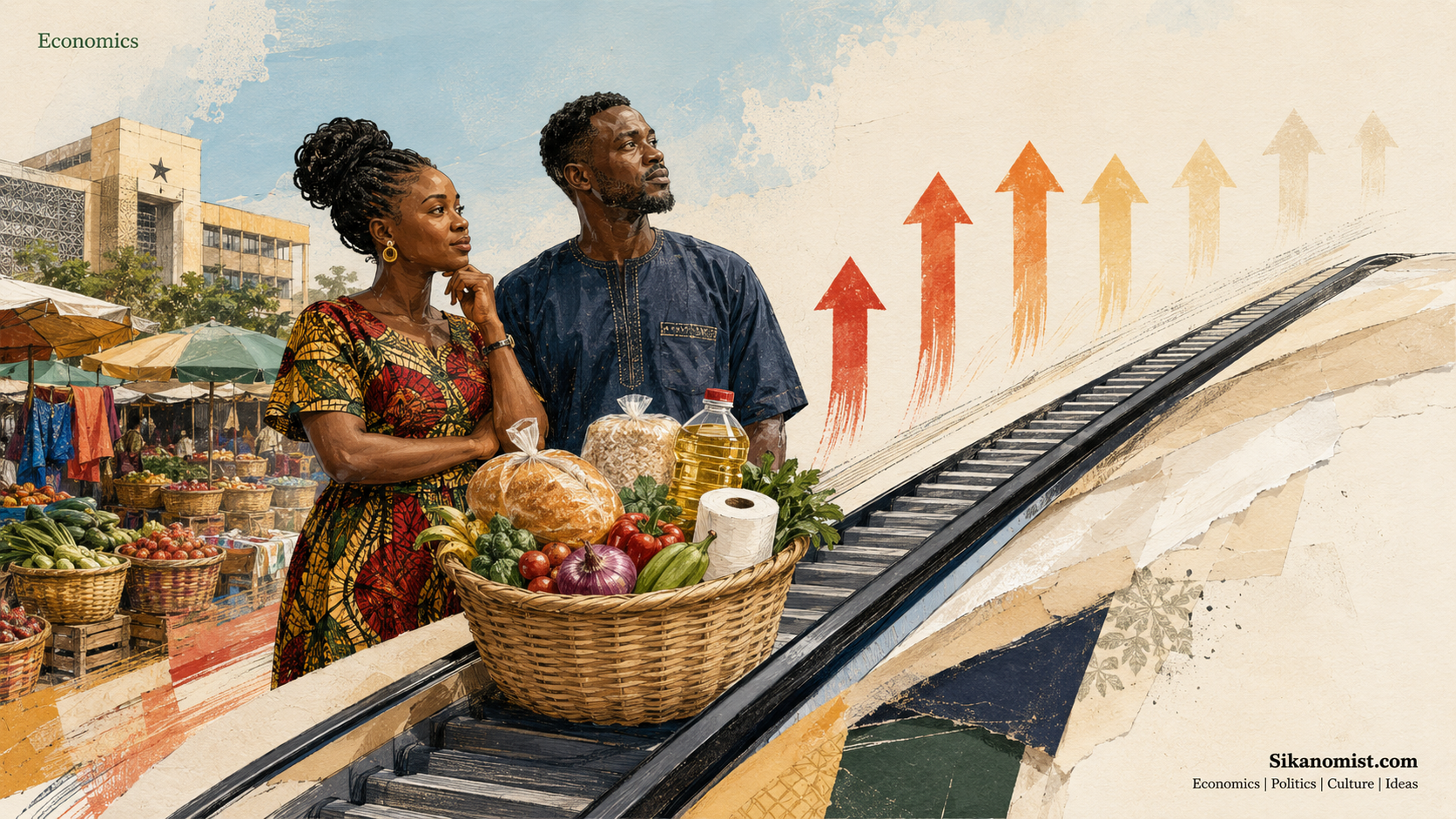
Ghana has received some encouraging economic news. The country’s annual inflation rate declined from 5.3 per cent in June to 4.6 per cent in July 2026, according to figures from the Ghana Statistical Service. It was the first decline recorded since March. Reuters
This is a positive development. Lower inflation can bring greater stability to households, businesses and the wider economy. It can make financial planning easier, protect the value of incomes and eventually create conditions for lower interest rates.
However, many Ghanaians may look at the official figure and ask a reasonable question: if inflation is falling, why are food, rent, transport, school fees and other necessities still expensive?
The answer is that falling inflation does not necessarily mean prices are falling. It usually means prices are increasing more slowly than they were before.
Understanding this difference is important. It allows Ghanaians to recognise genuine economic progress without pretending that the cost-of-living problem has disappeared.
Inflation measures the speed of price increases
Inflation is the rate at which the general prices of goods and services change over time. When inflation rises, prices are generally increasing more quickly. When inflation falls, prices may still be increasing, but at a slower rate.
Consider a simple example.
Suppose a basket of household goods increased from GH¢300 to GH¢450 during a period of high inflation. If inflation later falls to 4.6 per cent, the basket does not automatically return to GH¢300. It may instead increase more slowly from GH¢450 to about GH¢471.
The speed of the increase has fallen, but the earlier price increases have not been reversed.
For prices to fall generally, Ghana would have to experience deflation. This is different from disinflation, which simply means that inflation is slowing.
That distinction explains why a government can correctly report that inflation has fallen while a family can also correctly say that life remains expensive. The national statistic and the household’s experience are not necessarily contradicting each other.
Ghanaians are still carrying the weight of earlier increases
Ghana experienced a severe inflationary period during which the cost of food, transport, building materials, medicines, utilities and other essentials rose sharply.
These increases accumulated over time. Even when inflation slows, households continue buying goods and services from a much higher price level.
A worker whose salary increased only slightly during the high-inflation period may have permanently lost part of his or her purchasing power. A monthly income that previously bought enough food, paid transport fares and covered basic bills may no longer do so.
Small businesses face a similar problem. Many borrowed at high interest rates, paid more for imported goods and absorbed rising electricity, fuel, rent and transport costs. These expenses may remain embedded in their prices even after general inflation begins to fall.
This is why improving economic statistics can take time to become visible in ordinary life. The economy may be stabilising, but households and businesses must first recover from the damage caused by the earlier instability.
Every household experiences inflation differently
The official inflation rate is calculated from a broad basket of goods and services purchased by households across Ghana. It gives the country an important national picture, but no individual family buys everything in that basket in exactly the same proportion.
A low-income household may spend most of its earnings on food, transport, rent and electricity. If those particular expenses continue rising, that family may experience a much higher personal cost of living than the national inflation figure suggests.
A farmer in the Upper East Region, a trader in Kumasi, a teacher in Cape Coast and an office worker in Accra may also face very different prices because of transport costs, local supply conditions and access to markets.
This does not make the national inflation figure inaccurate. It means the headline number cannot tell every part of the story by itself.
Ghana therefore needs to pay greater attention to the prices that affect ordinary households most directly. Food, housing, transport, electricity, water, healthcare and education carry more importance in people’s lives than many other items included in the general calculation.
Economic recovery will feel incomplete if the prices of these essentials remain beyond the comfortable reach of working families.
Falling inflation is still important progress
The fact that prices remain high should not lead Ghana to dismiss the importance of lower inflation.
High and unpredictable inflation damages almost every part of the economy. It makes it difficult for families to budget, businesses to set prices and investors to plan for the future. It reduces the value of savings and can force lenders to charge higher interest rates to protect themselves against uncertainty.
Stable inflation creates a better environment for long-term decision-making. A business can estimate its future costs more confidently. A household can plan its expenditure with less fear that prices will suddenly rise. Banks can eventually provide loans at more reasonable rates if other financial risks also decline.
Lower inflation can also protect the cedi by improving confidence in the economy. When businesses and investors trust that prices and public finances are being managed responsibly, they are less likely to rush towards foreign currencies merely to protect the value of their money.
Ghana should therefore recognise the July decline as good news. But good news should encourage disciplined progress, not premature celebration.
Lower inflation must eventually produce lower borrowing costs
One of the strongest benefits of sustained low inflation should be a gradual reduction in the cost of credit.
Ghanaian businesses have operated for years under very high borrowing costs. Many small and medium-sized enterprises cannot expand because the interest charged on commercial loans makes productive investment too risky. Entrepreneurs may have good business ideas but cannot afford the financing required to purchase equipment, increase stock or employ additional workers.
When inflation becomes stable, banks face less uncertainty about the future value of repayments. Government borrowing costs can also decline if fiscal discipline is maintained. These improvements should gradually make it possible for credit to become more affordable.
However, lower interest rates should not be forced carelessly. Banks must still consider the risk of default, operating expenses and the health of their loan portfolios. The better solution is to improve the wider economic conditions that make lending safer.
A fall in inflation becomes more meaningful when it helps a manufacturer buy machinery, a farmer invest in irrigation, a transport operator acquire a safer vehicle and a small trader expand without being trapped by impossible repayments.
Ghana must reduce the actual cost of producing and moving goods
Monetary and fiscal discipline can slow inflation, but lasting price stability also depends on how efficiently Ghana produces and distributes what it consumes.
Food prices are influenced by more than the quantity harvested. Poor roads, inadequate storage, unreliable transport and weak market connections can make food expensive even when farmers produce enough.
Large quantities of vegetables and other produce may be lost after harvest because they cannot be stored or transported quickly. These losses reduce supply in the markets and push prices upwards. Farmers earn less, while consumers pay more.
Investment in irrigation, warehouses, cold storage, feeder roads, food-processing facilities and organised wholesale markets can therefore do more than support agriculture. It can reduce the cost of living.
Ghana must also strengthen domestic manufacturing. When businesses depend heavily on imported raw materials, machinery and packaging, changes in the exchange rate and international shipping costs quickly enter local prices.
Producing more essential goods locally will not remove every price increase, but it can make the country less vulnerable to external shocks.
Businesses should pass genuine savings to consumers
Prices often rise quickly when fuel, electricity, transport or the exchange rate becomes unfavourable. They may come down much more slowly when conditions improve.
Some of this delay is understandable. Businesses may still be selling stock purchased at higher prices. They may be repaying expensive loans, paying increased rent or dealing with other costs that have not declined.
But competition should eventually compel businesses to pass genuine cost reductions to consumers. Where import costs, transport expenses or financing rates fall significantly, customers should receive part of the benefit.
Government must promote fair competition and take action against price manipulation, collusion and abuse of market power. This does not mean controlling every price from Accra. It means ensuring that markets are open, transparent and competitive enough for efficiency to benefit the consumer.
Consumers should also be given reliable price information. Digital platforms that compare the prices of essential goods across markets could help families make better decisions while encouraging sellers to remain competitive.
Wages and incomes must recover
A country can have low inflation while many of its people remain poor. Price stability is important, but it is not a substitute for employment, productivity and rising incomes.
What ultimately matters to a household is not only the price of goods but also how much income the household earns.
If prices rise by 4.6 per cent while a worker’s income remains unchanged, that worker still loses purchasing power. If income rises faster than prices because productivity and economic opportunities are improving, the household becomes better off.
Ghana must therefore connect macroeconomic stability to productive job creation. Lower inflation should become the foundation for investment in agriculture, manufacturing, technology, housing, transport and other sectors capable of creating dependable employment.
Public-sector salaries cannot be increased without regard to government finances. Private businesses cannot pay higher wages without improved productivity and stronger revenues. The sustainable answer is to build an economy in which each worker can produce more value and receive a fairer share of that value.
Government must not declare victory too early
Inflation can rise again.
Fuel-price changes, exchange-rate weakness, poor harvests, higher utility tariffs, international conflicts and excessive government spending can quickly create new pressure.
Ghana must therefore protect the progress already made. Government expenditure must remain disciplined. The Bank of Ghana must continue making careful monetary-policy decisions. Agricultural supply chains must be strengthened, and risks to the cedi must be managed responsibly.
The country must also resist the temptation to use short-term spending simply to create political excitement. Economic stability built through difficult sacrifice can be lost quickly if public finances return to indiscipline.
At the same time, policymakers should avoid communicating the lower inflation figure as though every Ghanaian’s economic difficulties have ended. People know what they pay in the market. If official statements appear to dismiss their daily experience, public trust will decline.
The better message is honest and balanced: Ghana has made important progress, but the work of rebuilding household purchasing power is not finished.
Stability is the beginning, not the destination
The decline in inflation to 4.6 per cent is encouraging. Ghana should welcome it because stable prices are necessary for savings, investment, affordable credit and long-term economic growth.
But inflation is only one part of economic wellbeing.
Families need incomes that can meet their basic expenses. Businesses need affordable credit and dependable electricity. Farmers need storage, transport and access to markets. Young people need productive jobs. Consumers need fair competition and protection from avoidable costs.
Falling inflation tells us that prices are no longer rising as quickly as before. It does not tell us that the cost of living has returned to where it was.
The real test of Ghana’s recovery will come when lower inflation leads to more affordable borrowing, stronger businesses, better jobs and rising purchasing power.
That is when the improvement in the national statistics will begin to feel like improvement in the lives of the people.
Reader’s Question
What changes would help you feel the benefits of Ghana’s falling inflation in your everyday life?