Ghana’s Economy Is More Than What It Exports
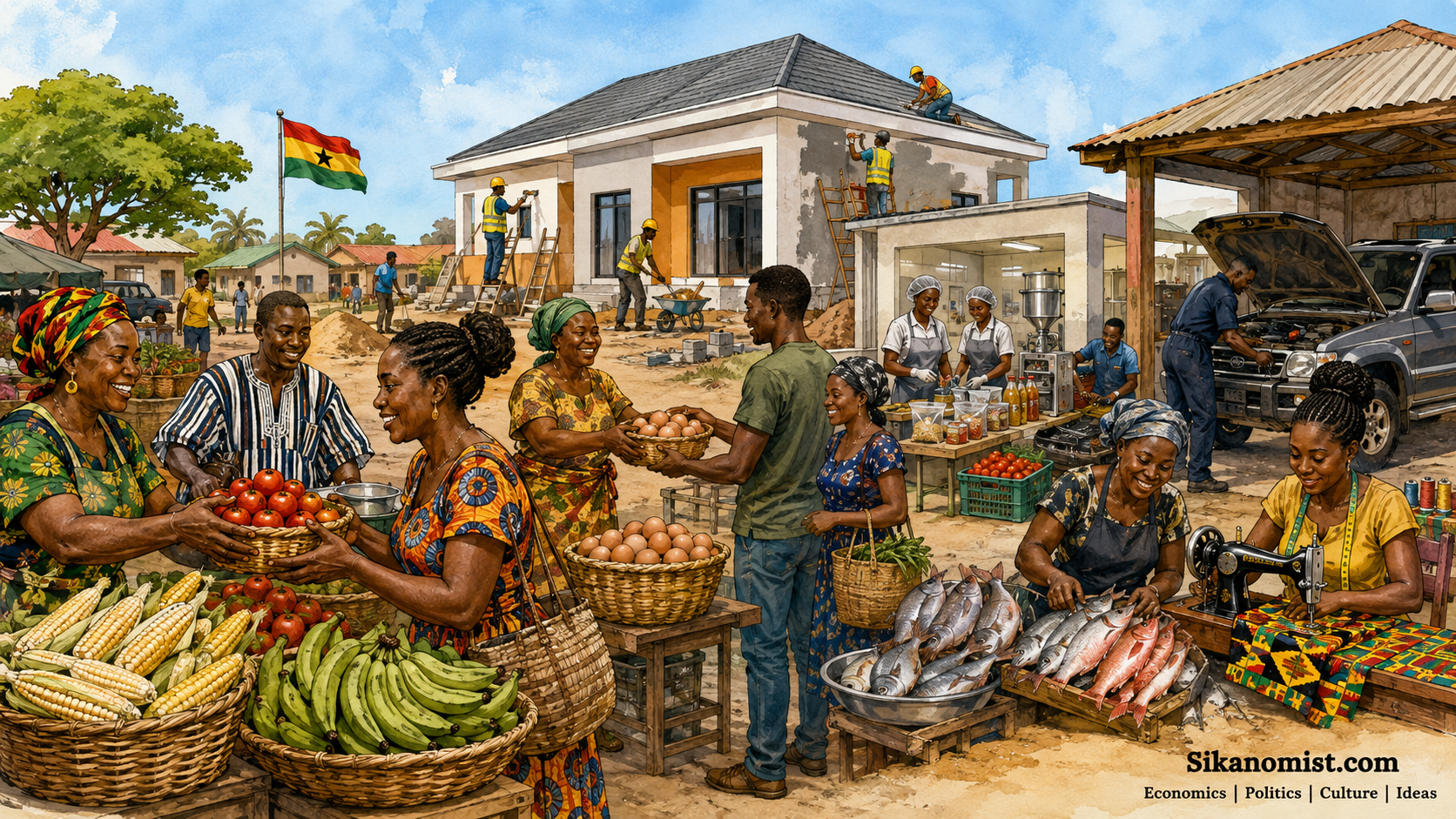
When Ghana’s economy is discussed, attention often turns immediately to gold, cocoa, crude oil, foreign exchange and the value of goods passing through the country’s ports. A rise in exports is celebrated. A trade surplus is presented as a sign of strength. A decline in commodity prices is treated as a national threat.
These indicators matter. Ghana needs exports to earn the foreign currency required to import machinery, medicines, fuel, vehicles, technology and industrial materials. Gold, cocoa and oil remain valuable national assets, and the country should manage them wisely.
But Ghana’s economy is much bigger than the commodities it sells to the rest of the world.
An economy must also be understood by what people produce for one another within the country. It includes the houses built for families, the food grown for local markets, the fish harvested for restaurants, the clothes sewn for schoolchildren, the transport services that carry workers and the thousands of everyday transactions taking place in shops, markets, workshops and homes.
These activities may not always earn dollars, pounds or euros, but they create income, employment and a better quality of life. They are not secondary economic activities. They are at the heart of the economy.
The economy must serve the people within it
The first purpose of an economy should be to meet human needs.
Ghana’s economy must work for all the people living within the country—Ghanaians and non-Ghanaians alike. Everyone needs food, shelter, transport, healthcare, clothing, education, energy, communication, recreation and financial services.
When these needs are met through productive activity within Ghana, the country becomes stronger.
A farmer growing tomatoes in Techiman for sale in Accra is contributing to the economy. A mason completing a family house in Kumasi is contributing. A seamstress producing school uniforms in Tamale, a mechanic repairing a taxi in Takoradi and a restaurant feeding workers in Tema are all participating in the creation and exchange of economic value.
The goods may never cross Ghana’s borders, but they still matter.
A country does not become prosperous merely by selling more goods abroad. It becomes prosperous when its people can produce, earn, trade, save, invest and live with dignity.
Economic reports are broader than exports—but public discussion is not
Official national accounts already recognise many domestic activities. Agriculture, construction, wholesale and retail trade, transport, financial services, communication, hospitality and other services are included when the economy is measured.
The deeper problem is how Ghana’s economic performance is discussed publicly.
News reports and political debates frequently place greater emphasis on export earnings, international reserves, exchange rates, debt negotiations and foreign investment. These matters are important, but their dominance can create the impression that Ghana’s economy exists mainly to produce commodities for other countries and earn foreign currency.
Meanwhile, the condition of the domestic economy receives less sustained attention.
How many affordable homes did Ghana complete during the year? How much of the food eaten in Ghana was grown and processed locally? How many small businesses expanded? How much income circulated between districts and regions? How many households gained reliable access to electricity, water, transport and healthcare?
These questions should be treated as seriously as the value of gold exported through Ghana’s ports.
The houses we build are part of the economy
Housing is one of the clearest examples of domestic economic activity.
When a house is built, many people benefit. Architects, engineers, surveyors, masons, carpenters, electricians, plumbers, painters, transport operators and building-material suppliers all receive work. When the house is completed, it provides accommodation and may generate rental income for many years.
Housing therefore creates both immediate and long-term value.
Yet Ghana continues to face serious accommodation difficulties. Many working families struggle with high rents and demands for several months—or even years—of advance payment. At the same time, large numbers of buildings remain unfinished because their owners cannot obtain affordable long-term financing.
Cement, steel, labour and personal savings may already have been invested in these structures, but the buildings provide neither accommodation nor income while they remain incomplete.
This is a form of economically silent capital.
A stronger domestic economy would make it easier to complete viable housing projects, expand rental supply and help households secure decent accommodation. It would also treat home construction as an important productive sector rather than simply a private struggle for individual families.
Food produced for Ghana matters
Ghana cannot describe its economy as strong if basic food remains unaffordable or if large quantities of products that could be grown locally must be imported.
Agriculture is often discussed mainly through cocoa exports. Cocoa is extremely important, but the Ghanaian farmer produces much more than cocoa.
Maize, rice, cassava, yam, plantain, tomatoes, onions, vegetables, poultry, eggs, meat and fish feed the population and support thousands of traders, transporters, processors and retailers. These products keep families alive and businesses operating.
A crate of tomatoes transported from a farming community to an urban market may appear ordinary, but it connects farmers, drivers, market traders, food vendors, restaurants and households. Money changes hands at every stage.
When Ghana produces more food locally, several benefits follow. Farmers earn income, transporters find work, traders make sales, consumers gain access to food and the country reduces pressure on foreign exchange.
But producing the raw food is only the beginning. Ghana must also improve storage, refrigeration, packaging and processing.
Tomatoes that would otherwise spoil can become paste and sauces. Maize can be processed into animal feed and packaged foods. Cassava can support flour, starch and industrial products. Fruits can become juices, dried snacks and ingredients for other businesses.
This is how domestic production develops into domestic industry.
As the proverb reminds us, “Little drops of water make a mighty ocean.” Thousands of small local transactions, repeated daily across the country, can build a large and resilient economy.
Animals and fish belong in the national economic story
Ghana’s economic conversation should also pay greater attention to livestock, poultry and fishing.
The chicken sold at a neighbourhood market, the eggs supplied to a boarding school, the fish served by a restaurant and the milk used by a food processor are all part of the economy.
These activities create opportunities for farmers, fishermen, feed producers, veterinary professionals, transport operators, cold-store owners and market traders.
If Ghana depends heavily on imported poultry, fish, meat and animal feed, it is not only importing food. It is also allowing potential Ghanaian jobs and business income to be created elsewhere.
Building domestic capacity does not mean closing Ghana’s borders or rejecting international trade. It means identifying products that can be produced competitively within the country and giving local businesses the conditions needed to succeed.
Those conditions include affordable finance, reliable electricity, suitable land, irrigation, disease control, extension services, storage facilities and predictable government policies.
The economy moves through everyday trade
The economy does not live only in government reports, corporate offices or international conferences. It lives in daily exchanges between people.
A trader buys produce from a farmer. A restaurant buys from the trader. A worker buys lunch from the restaurant. The restaurant owner pays employees and purchases supplies. Those employees use their wages to pay rent, transport fares and school expenses.
The same money can support several livelihoods as it moves through the economy.
This circulation is essential. When people have reliable income, they can buy goods and services from other people. Businesses then gain the confidence to employ workers, expand operations and invest.
But when unemployment is high, wages are weak and household debt is growing, domestic demand suffers. Traders may have goods but too few customers. Artisans may have skills but too little work. Farmers may produce food but struggle to find profitable markets.
A successful economic policy must therefore support both production and purchasing power. Ghana needs people who can make goods and provide services, but it also needs households capable of buying those goods and services.
Services are real economic production
There is sometimes a tendency to treat physical goods as more economically important than services. But services are an essential part of modern life.
Teachers, nurses, software developers, drivers, mechanics, hairdressers, tailors, caterers, cleaners, security workers, accountants, lawyers and technicians all provide value.
A mechanic who keeps a commercial vehicle on the road helps passengers reach work and allows the vehicle owner to earn income. A teacher develops the abilities of future workers. A nurse helps restore the health of someone who may return to productive employment. A software developer can help a small business reach customers and organise its operations.
These contributions may not be loaded into containers and shipped abroad, but they are economically significant.
Ghana must improve the quality and productivity of its service economy while ensuring that service workers can earn decent incomes and build sustainable businesses.
Informal businesses must not remain economically invisible
A considerable part of Ghana’s economic life takes place in the informal sector.
Market traders, roadside vendors, small farmers, artisans, food sellers, mechanics, transport operators and home-based businesses keep communities functioning. Yet many lack formal records, affordable credit, insurance, pension coverage and adequate business support.
Their activity may be difficult to measure fully, but it cannot be dismissed.
The solution is not to burden small businesses suddenly with complicated regulations and taxes. Ghana should help them grow gradually into stronger and more organised enterprises.
Simple digital bookkeeping, accessible business registration, mobile payments, suitable market facilities and fair financing could help small businesses build reliable records. These records could then improve their access to credit, insurance and larger contracts.
Formalisation should offer visible benefits. It should be a bridge to growth, not another barrier to survival.
A trade surplus can coexist with household hardship
Ghana can record strong exports and still have families struggling to pay rent. The country can earn more from gold while importing food it could produce. Foreign reserves can improve while young people remain unemployed.
This does not make exports unimportant. It simply means that export success does not automatically become household prosperity.
The connection must be deliberately built.
Revenue and foreign exchange earned from exports should help Ghana acquire machinery, strengthen local processing, improve infrastructure and support productive domestic businesses. Commodity earnings should help the country develop capabilities that will remain valuable even when commodity prices fall.
Gold should help Ghana build; cocoa should help Ghana process; oil should help Ghana diversify.
If export earnings leave only limited improvements in housing, food production, employment, transport and industry, the country will have traded successfully without transforming sufficiently.
Ghana needs better measures of everyday economic progress
The country should continue reporting traditional economic indicators, but it should also make people-centred measures more prominent.
Alongside export earnings, trade balances and foreign reserves, Ghana’s economic discussion should regularly consider:
The number of affordable homes completed.
Changes in food production and food prices.
Growth in local food processing.
Employment and income by region.
The survival and expansion of small businesses.
Access to affordable credit.
The proportion of locally produced goods used in homes, schools and hospitals.
Household savings and debt.
Transport reliability and cost.
Improvements in basic services and living conditions.
These indicators would not replace gross domestic product, trade statistics or fiscal reports. They would help explain what economic growth actually means in the lives of people.
Build an economy in which people prosper together
Ghana should continue exporting gold, cocoa, oil and other products. It should also expand manufactured exports and take full advantage of opportunities within Africa and the wider world.
But the country must not define its economic ambition only by what leaves its ports.
The strength of Ghana’s economy can also be seen in a completed house providing shelter, a cold store preventing fish from spoiling, a local factory processing farm produce, a bus carrying workers safely and a small business earning enough to employ another person.
A tree is judged not only by how tall it grows, but also by the shade and fruit it gives.
In the same way, Ghana’s economy must be judged not only by the size of its exports, but by the security, opportunity and dignity it creates for the people living within the country.
The essential economic question is not simply: how much did Ghana sell to the world?
It is also: how much did Ghana produce for the people within Ghana, how widely did that production create income, and how successfully did it improve everyday life?
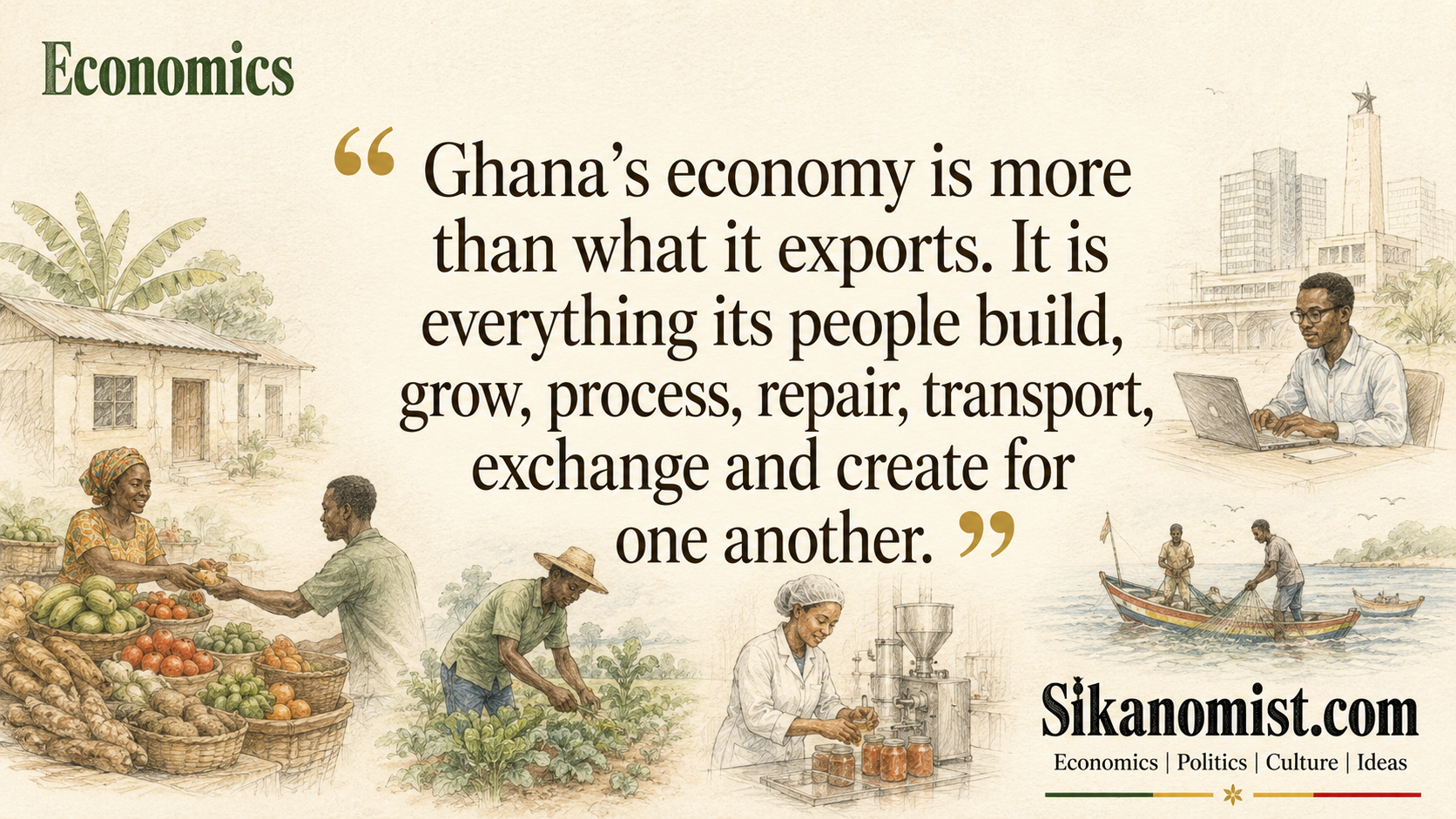
Ghana’s economy is more than what it exports. It is everything its people build, grow, process, repair, transport, exchange and create for one another. Strengthening that domestic economy is not an alternative to international trade. It is the foundation that will allow Ghana to trade with the world from a position of genuine prosperity.
Ghana’s exports are important, but they are not the whole economy. The country’s economic strength must also be judged by the homes it builds, the food it produces, the services it provides and the opportunities it creates for everyone living within its borders.
Reader’s Question:
What should Ghana measure—beyond exports—to determine whether the economy is genuinely improving everyday life?