Accra's Flooding Can Be Stopped. Let's Do It Now.
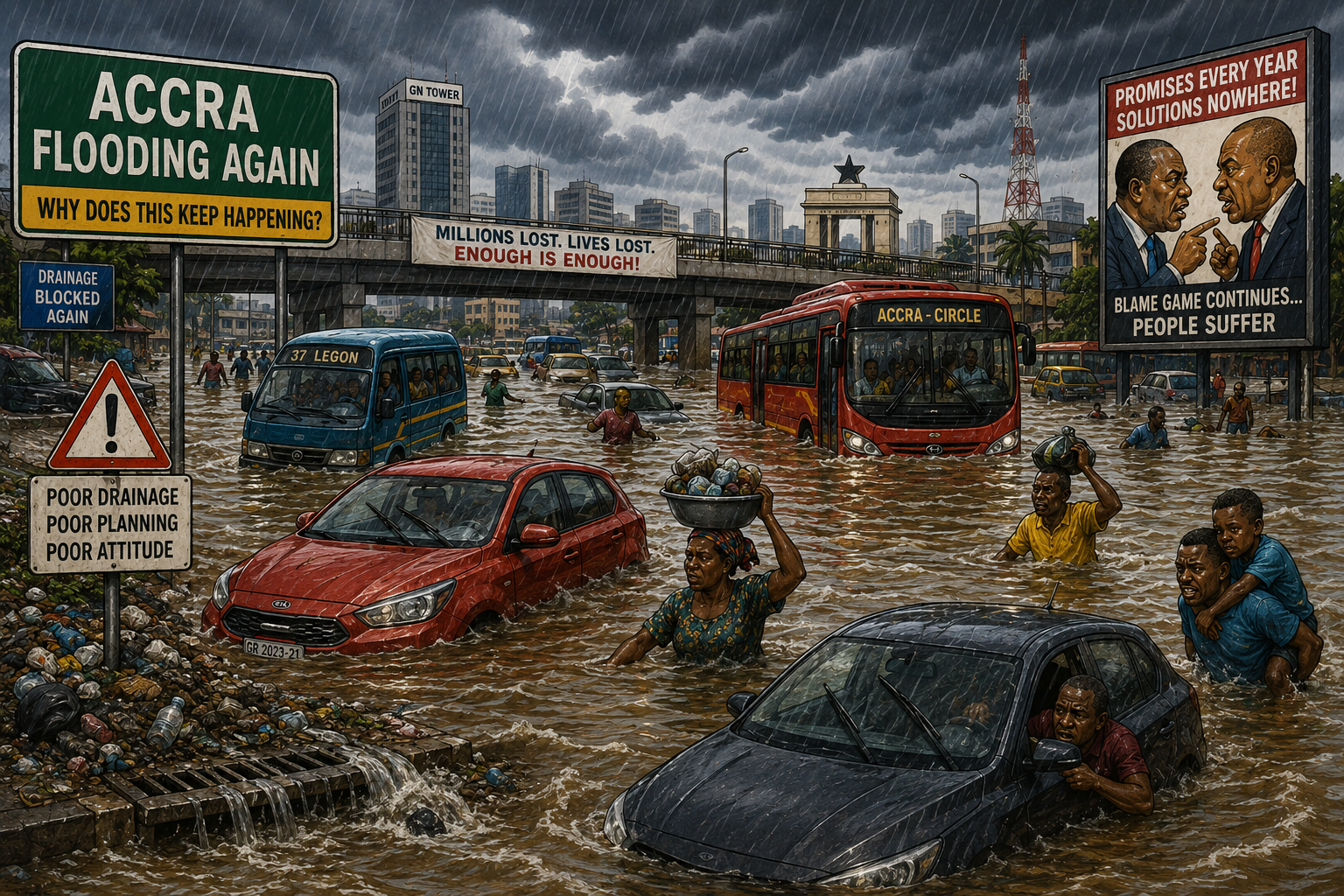
Every rainy season, Accra tells the same painful story. Roads become rivers, homes disappear beneath muddy water, businesses count enormous losses, and families mourn loved ones whose lives are cut short by floods that many believe could have been prevented.
The flooding that struck Accra at the end of June once again left behind damaged property, interrupted livelihoods and tragic loss of life. For many Ghanaians, it was another reminder that what should be an occasional natural event has become a recurring national emergency.
Yet there is another story that deserves to be told. It is the story of a country that possesses talented engineers, capable planners, dedicated public servants and determined young professionals who have the knowledge to solve this problem if they are given the opportunity.
At the Sikanomist, we believe Accra's flooding can be stopped. The question is not whether it is possible. The question is whether Ghana is ready to let the right people lead the solution.
The Rain Is Not the Real Problem ( Don’t bBlame God )
Heavy rainfall is not unique to Ghana. Many cities around the world receive far more rain than Accra, yet they experience far fewer destructive floods.
Rain exposes weaknesses; it does not create them.
Accra's flooding results from several well-known challenges working together. In many areas, drains are too small, poorly maintained or completely absent. Some waterways have become dumping grounds for refuse. Illegal construction has narrowed or blocked natural water channels. Rapid urban growth has outpaced infrastructure development, while maintenance of existing drainage systems has often been inconsistent.
None of these challenges appeared overnight, and none can be solved by emergency responses alone.
Three Decades of Politics Have Not Delivered a Permanent Solution
For more than thirty years, Ghana has witnessed successive governments promising to address flooding in Accra. Different administrations have introduced drainage projects, desilting exercises, demolition campaigns and emergency relief programmes.
Some projects have improved local conditions, but none has produced a permanent city-wide solution.
After the recent floods, President John Dramani Mahama conducted an aerial inspection of the affected areas by helicopter. He identified two important issues requiring attention: engineering and public attitudes towards issues such as illegal building and waste disposal. He also directed that emergency funds be released for relief and mitigation, while warning that illegal structures on waterways would face demolition.
These are significant actions in response to an emergency. However, the broader challenge remains. Ghana has experienced repeated flooding under different governments over many years. This suggests that the country needs a long-term national strategy that extends beyond any single administration or political party.
Flood prevention should become a continuous national engineering programme rather than a seasonal political discussion.
Let Engineers Lead the National Conversation
One of Ghana's greatest assets is its people.
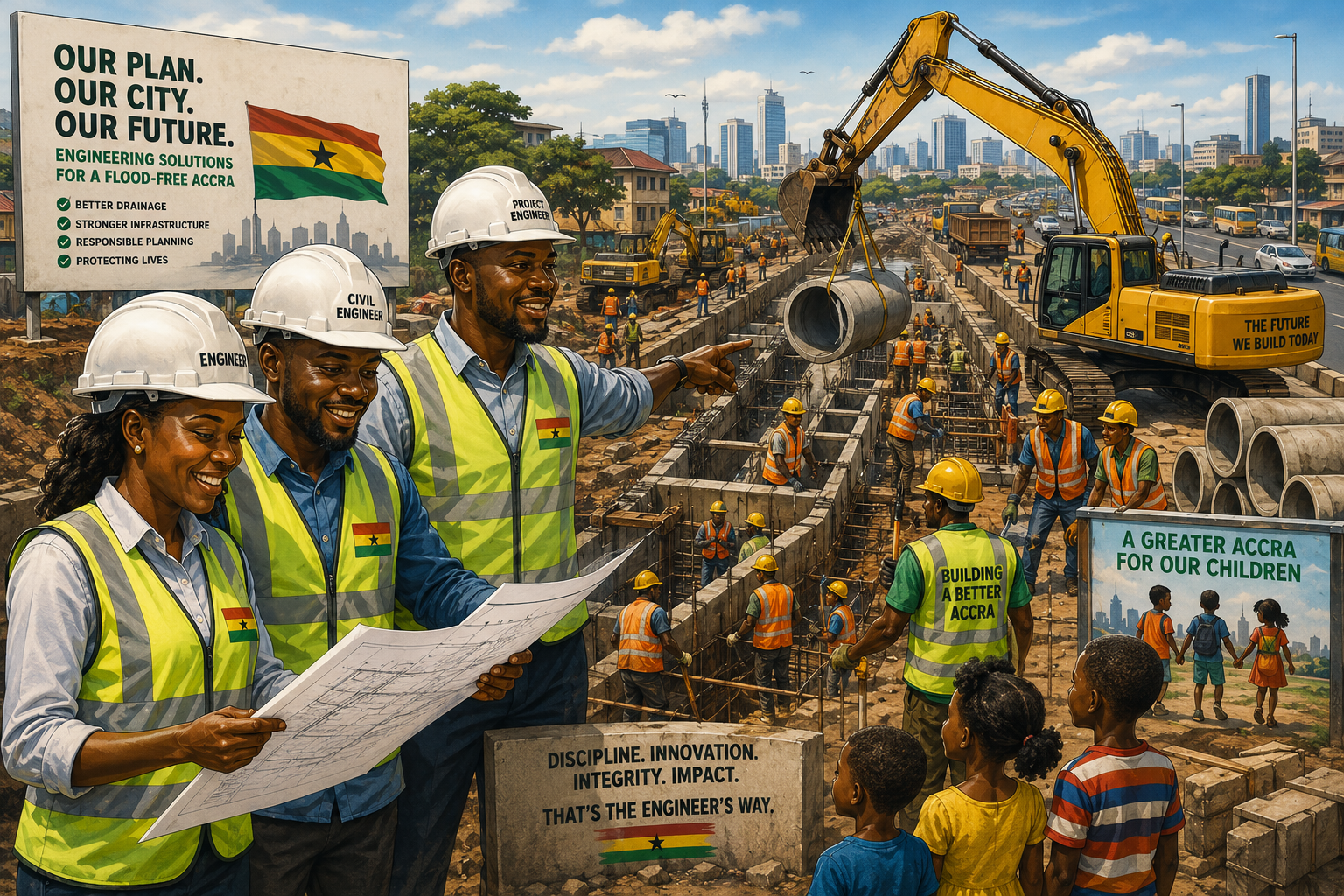
Across the country, Metropolitan, Municipal and District Assemblies employ engineers whose professional training focuses on drainage systems, roads, water flow and urban infrastructure. The Ghana Armed Forces also possesses highly skilled engineers through the Army Engineering Regiment, with expertise in construction, logistics and emergency works.
These professionals understand how water behaves, how cities function and how infrastructure should be designed.
Yet too often, engineers become implementers rather than leaders. Decisions about flood prevention are frequently driven by political priorities instead of comprehensive engineering assessments.
Ghana should reverse this approach.
Engineers should lead the technical planning. Political leaders should provide policy direction, funding and public accountability, but technical solutions should be designed by those trained to solve technical problems.
Trust Ghana's Young Professionals
One encouraging feature of modern Ghana is the emergence of a new generation of highly educated engineers, planners, surveyors, architects and environmental specialists.
Many have studied in Ghana's universities. Others have gained international experience before returning home.
They should not merely be invited to meetings after disasters occur.
They should be empowered to develop twenty- and thirty-year flood management plans for Accra.
Imagine flying teams of young Ghanaian engineers over flood-affected areas to conduct detailed surveys. Imagine giving them access to satellite mapping, modern drainage modelling, geographic information systems and artificial intelligence tools to understand how water moves through the city.
Then imagine giving them the authority—and the resources—to implement their recommendations.
This is not wishful thinking. It is how many successful cities have transformed themselves.
The Army Can Help Build Resilience
The Ghana Armed Forces exist not only to defend the nation's borders but also to support national development during emergencies.
The Army Engineering Regiment has the skills to assist with drainage construction, bridge works, emergency access routes and critical infrastructure.
Rather than relying solely on contractors working under emergency conditions, Ghana should consider a permanent collaboration between civil engineers, local government engineers and military engineers.
Such cooperation could strengthen national capacity while reducing long-term costs.
Changing Behaviour Matters Too
Engineering alone will not eliminate flooding.
Citizens also have responsibilities.
Waste should never be dumped into drains or waterways. Buildings should not be constructed on flood plains or natural drainage channels. Communities should support regular clean-up exercises, while local authorities must consistently enforce planning laws without fear or favour.
Good infrastructure and responsible citizenship must work together.
Parliament Must Move Beyond the Blame Game
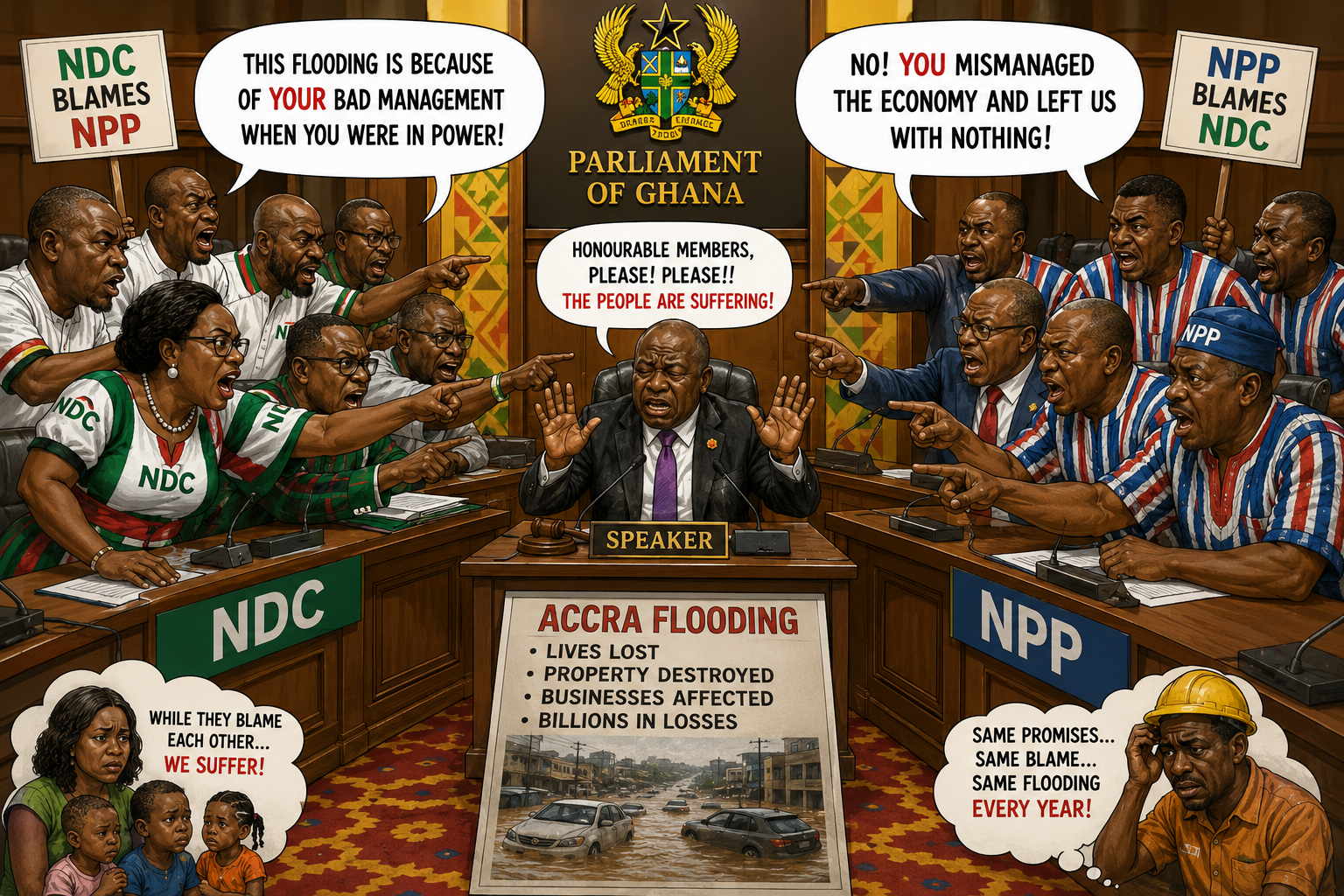
One disappointing feature after major floods is the familiar exchange of political accusations.
The governing party blames previous administrations.
The opposition blames the current government.
Meanwhile, flood victims simply want solutions.
Independent Member of Parliament Kwame Asare Obeng, popularly known as A Plus, recently expressed concern that without sustained action, similar flooding could occur again in future rainy seasons. His warning reflects a frustration shared by many Ghanaians: that promises often receive more attention than long-term implementation.
Parliament has an opportunity to rise above partisan debate by building broad support for a national flood resilience strategy that survives changes of government.
Floodwater does not distinguish between political parties. Neither should the solution.
Decongestion Should Not Distract from the Immediate Task
Some have suggested developing new administrative centres outside Greater Accra to reduce pressure on the capital.
Decentralisation has merits and deserves serious consideration as part of Ghana's long-term development.
However, it should not become a substitute for solving Accra's flooding problem.
Ghana already has regional capitals, district capitals and government offices across all sixteen regions. The country can strengthen decentralisation by gradually relocating the headquarters of selected national institutions to different regional capitals.
For example, one agency could have its national headquarters in Kumasi, another in Sunyani, and another in Koforidua, while regional offices continue serving local populations.
Such reforms could support balanced national development over time.
But regardless of where government offices are located, Accra will remain Ghana's capital. It must therefore become a city capable of managing heavy rainfall safely and efficiently.
The World Has Already Shown That It Can Be Done
History offers reasons for optimism.
Cities including Singapore, Rotterdam, Seoul, Tokyo and others have all faced serious flooding challenges. None solved the problem overnight. They invested consistently in engineering, planning, maintenance, enforcement and public education.
They did not accept annual flooding as normal.
Neither should Ghana.
Every successful city demonstrates that flood resilience is not achieved through one project or one rainy season. It is built through decades of consistent planning and execution.
Ghana can follow the same path.
A National Mission Worth Pursuing
Flood prevention should become one of Ghana's great national projects.
Not because it is politically attractive, but because it protects lives, safeguards businesses, attracts investment and improves the quality of life for millions of people.
It is also an opportunity to inspire confidence in Ghana's young engineers and public servants.
Give them responsibility.
Trust their expertise.
Support them with adequate funding.
Measure them by results.
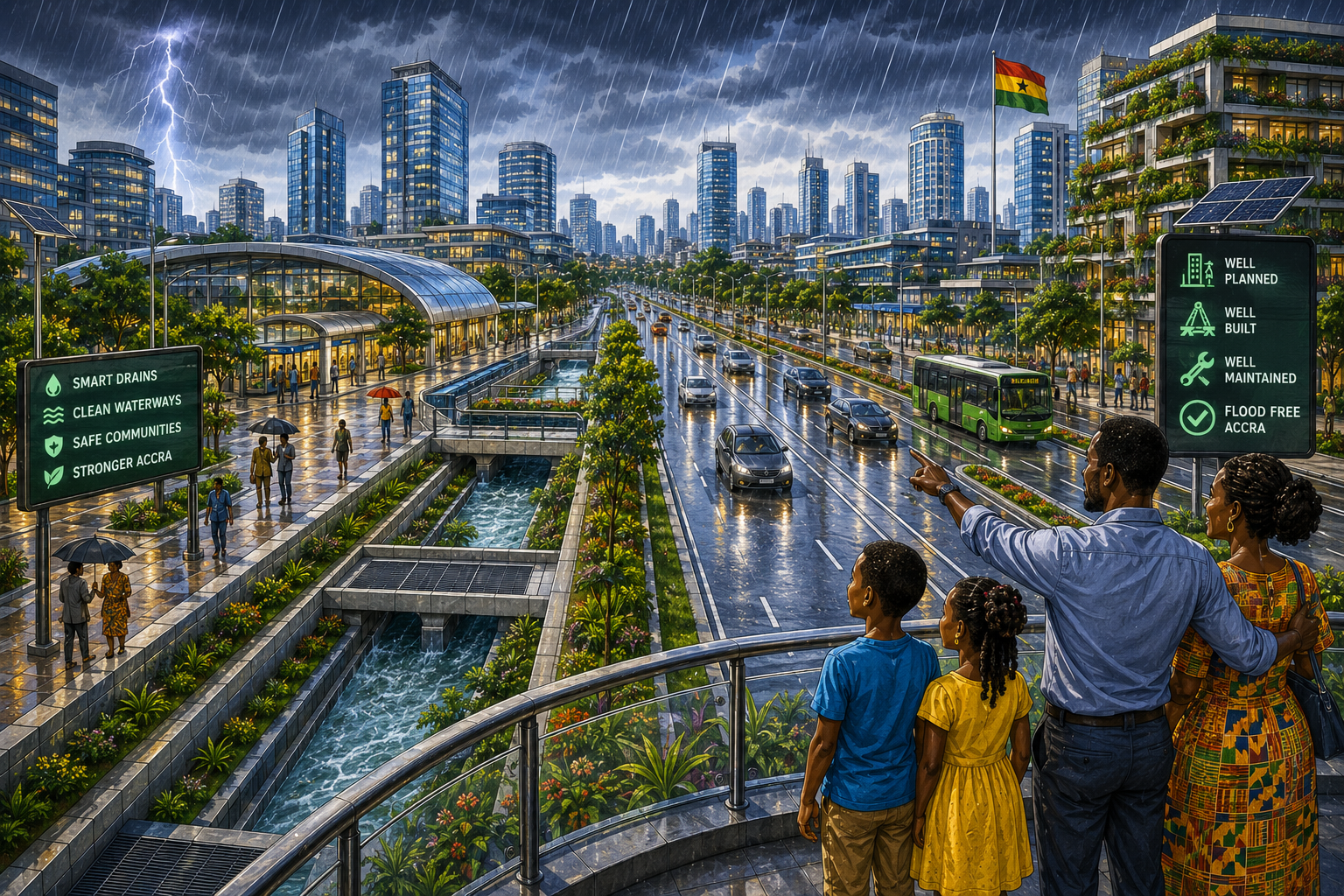
The challenge before us is not simply to clear drains after each flood. It is to redesign how our capital manages water for generations to come.
Accra deserves better.
Ghana deserves better.
And the young professionals capable of delivering that future are already here.
All they need is the opportunity to lead.
Reader's Question
Dear readers, if you could recommend one long-term action to permanently reduce flooding in Accra, what would it be—and who should lead its implementation?